

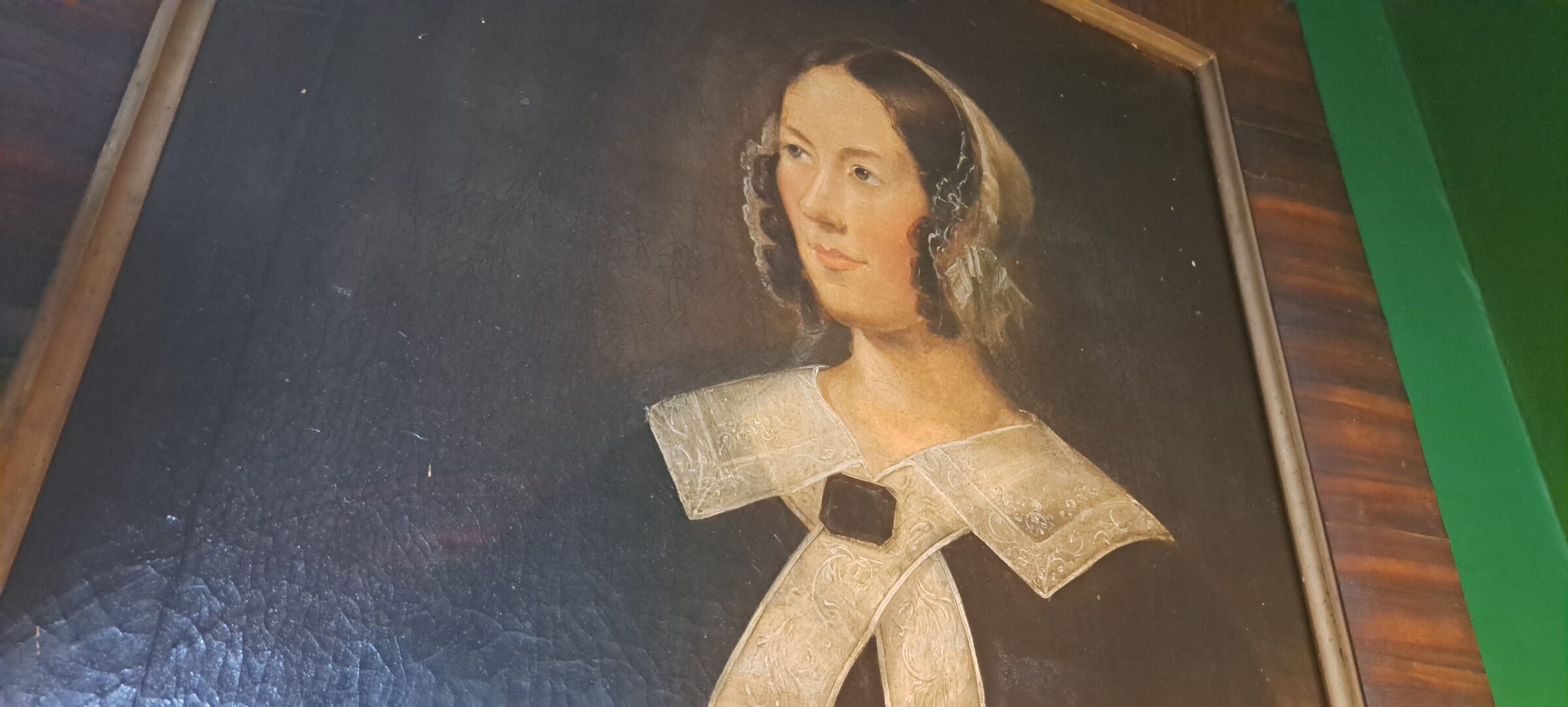
The first gallery holds a surprising light trick, projecting a cross-shaped glow on Good Friday. Additionally, a large canvas depicts a past performance by the National Youth Theatre, seen below.

The Last Harvest at Soulton Hall performed by the National Youth Theatre. (c) Helen Murray and NYT.
There is also a portait of the designer of the Dancing Pavement.
This part of the house has recently received a refresh with the addition of contemporary portraits. The carefully chosen subjects add a new layer to the Hall’s narrative, bridging the gap between its past. The images are deliberately chosen to be both surprising and modern. This boldness ensures they grab attention and effectively communicate their message by standing out from their surroundings.
Plato
There is a pop art portaint of Plato, reflecting the Neoplatonic influences on the builder, Sir Rowland Hill. Plato was a famous ancient Greek philosopher who explored themes of mathematics, knowledge, society, and the role of guardians in a just society.
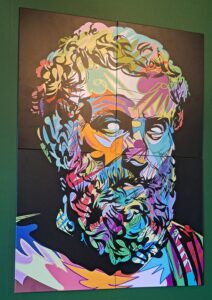
A modern portrait of Plato
This is also a reference to their shared knowledge of mathematics, particularly the rhombic dodecahedron. Concerning the tradition of dance at Soulton Hall, it is intersting to note that Plato had strong views on dance, holding that dance trains the mind and soul to discern actions, feelings, and ideas that cultivate nobility and mental refinement.
He said many things about dance, including:
The Dance, of all the arts, is the one that most influences the soul. Dancing is divine in its nature and is the gift of God.
and:
In order to be a good soldier it is necessary to know how to dance.
Charlemagne
A contemporary portrait of Charlemagne is also included, reflecting the major territory of Sir Rowland Hill’s mercantile activities and the Hill family’s claimed descent from the emperor in two lines.
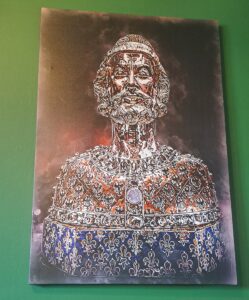
A Modern portrait of Charlemagne
Franklin
A representation of Benjamin Franklin is included because of his friendship with the Shropshire Hills family of Soulton.
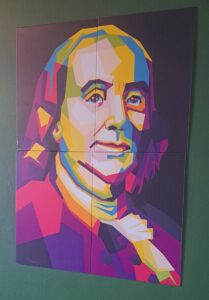
A modern portrait of Franklin
It is likely he visited Soulton Hall. Furthermore, there is powerful evidence he was aware of Sir Rowland Hill’s work, part of hat being taht the first designs for the Great Seal of the United States, in which Franklin was involved, depict a scene strikingly similar to the frontispiece above Sir Rowland’s name: the Israelites’ pursuit by the Pharaoh, the parting of the Red Sea, and divine intervention from the sky.
Cicero
A portrait of Cicero is included because of his association with the Eleusinian Mysteries, which were an obsession of Sir Rowland Hill.
Much that is excellent and divine, does Athens seem to me to have produced and added to our life, but nothing better than those Mysteries by which we are formed and moulded from a rude and savage state of humanity; and, indeed, in the Mysteries we perceive the real principles of life, and learn not only to live happily, but to die with a fairer hope.
The Eleusinian Mysteries, cloaked in secrecy for millennia, remain a compelling puzzle within the rich history of ancient Greek religion.
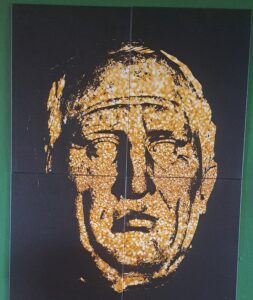
A modern portrait of Cicero
Celebrated annually for over two thousand years in the town of Eleusis near Athens, these multi-day festivals culminated in central rituals whose details were fiercely guarded by initiates.
Understanding these Mysteries relies heavily on fragmented evidence – cryptic literary references, archaeological discoveries, and fleeting depictions in art. The central focus was around Demeter and Persephone, a poignant story of a mother’s grief over her abducted daughter and the subsequent impact on the natural world.
The Eleusinian Mysteries transcended mere religious ceremonies. They fostered a sense of community and pan-Hellenic unity, drawing participants from across the Greek world. Their influence extended beyond Greece itself, shaping philosophical thought and artistic expression in the ancient Mediterranean.
Despite their decline and eventual demise in the late Roman period, the Eleusinian Mysteries continued to intrigue scholars and inspire artistic creations, and Sir Rowland Hill most of all.
*********
The above makes reference to BYRGA GENIHT materils.
