


A Journey Through Time: Exploring the Connections Between Soulton Hall and Plas Mawr
The plasterwork ceiling of “Old” Sir Rowland at Soulton have not come down to us at Soulton, though such ceilings survive at a number of Shropshire country houses of the third quarter of the C16th nearby, such as:
- Wilderhope Manor (now part of YHA)
- The Gate House at Upton Cressett Hall (which has access via the HHA)
- Morville Hall
- Plaish Hall
YHA@yhaofficial
Wilderhope Manor
ð•²ð–—ð–†ð–‰ð–Š 1 ð•·ð–Žð–˜ð–™ð–Šð–‰ ð•ð–šð–Žð–‘ð–‰ð–Žð–“ð–Œ
âš¡ðŸŒ
Here at Newphase LED; we have years of experience working in and on listed buildings.
From @yhaofficial to South Yorkshire Preservation trust. pic.twitter.com/REDocRMwSW— New Phase LED (@NewPhase9) November 25, 2019
An example of one of these ceilings is seen in the Tweet above from Wilderhope Manor.
There has been an enduring mystery as to why there is a cluster of these fine, early Tudor plasterwork ceilings which generally octograms (like the As You Like It Dance notation) in Shropshire and what induced thier craftsmen to come to Shropshire for work. In fact, there is even said to be a ‘Ceiling Club’ of houses that possess them.
The activities of “Old” Sir Rowland point towards a solution: he was, after all (it is well-settled) architectural trend setter.
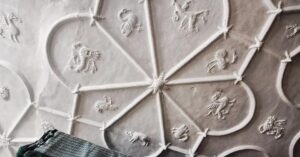
Octogram celing at Plas Mawr, a flavour of the Soulton Ceilings
While we did not hold onto the Soulton ceilings (the house being ransacked for state papers in the C17th certainly did not help with conservation efforts; that being a time when even Sir Rowland Hill’s chair of estate was smashed by Parliamentarian forces), Hannah Deakin had the foresight to record its existence in the Dancing Pavement here during a phase of improvements and modernization.
With that context, it was a great pleasure to visit Plas Mawr in Conwy and see the surviving ceilings there that developed upon the Soulton traditions, becoming rather epic(!)
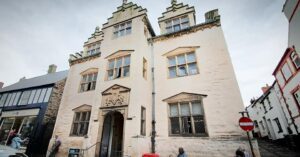
The gatehouse of Plas Mawr, showing its characteristic Renaissance crow-stepped gables, pedimented windows and heraldry
Built between 1576 and 1585, Plas Mawr in Conwy, North Wales, stands as a testament to Elizabethan grandeur. A member of the local gentry, Robert Wynn, constructed the townhouse following his marriage to Dorothy Griffith. Renowned for his hospitality, Wynn ensured Plas Mawr would be a center of social gatherings.
However, his elaborate instructions for dividing his estate upon death sparked a lengthy legal battle. This fortuitous delay in redevelopment preserved the house, allowing us to experience its original splendor today.
There are details of biographical history that links Soulton and Plas Mawr, which it is helpful to set out, and concern mercant networks and Bible Transaltions.
The brother of Robert Wynn (who built Plas Mawr) was Maurice Wynn, whose third wife was Katheryn of Berain.
Katheryn of Berain is sometimes called Mam Cymru (“mother of Wales”, also said to have been the illegitimate great-granddaughter of King Henry VII). She is noted for her four marriages and her extensive network of descendants and relations.
There are a couple lines carrying interst in this setting.
- At the age of 22, Katheryn married John Salusbury, son of Sir John Salusbury of Llewenni (died 1578), of the prestigious Salusbury Family of Lleweni, Denbighshire. This furnishes an aliance with the family of William Salesbury of Llansannan (c.1520-c.1584), a pioneering and relentless agitator for a Welsh translation of the bible, who promoted the Act of Parliament which authorized translation in 1563.
- Katheryn’s second husband, Sir Richard Clough, was a man of immense wealth. Partnering with the famed Sir Thomas Gresham (Mercer and nephew of Old Sir Rowland Hill’s great friend John Gresham), Clough played a pivotal role in establishing the Royal Exchange in London. Having resided in Antwerp, he returned to Denbighshire in 1567, leaving his mark on the landscape with the construction of two grand houses: Bach-y-graig (which is based on Soulton Hall) and Plas Clough.
Interestingly, William Shakespeare’s poem “The Phoenix and the Turtle” was published in a collection called Love’s Martyr (1601), dedicated to Katheryn’s son John Salusbury. He was knighted by Queen Elizabeth in June 1601. There are more literary and scholarly implications to this connection, which will have to wait for another exploration!
Gwydir Castle was also a seat of the Wynn’s. There is more to say about that, but for now we would like to highlight its extraordinary chapel.Â
