

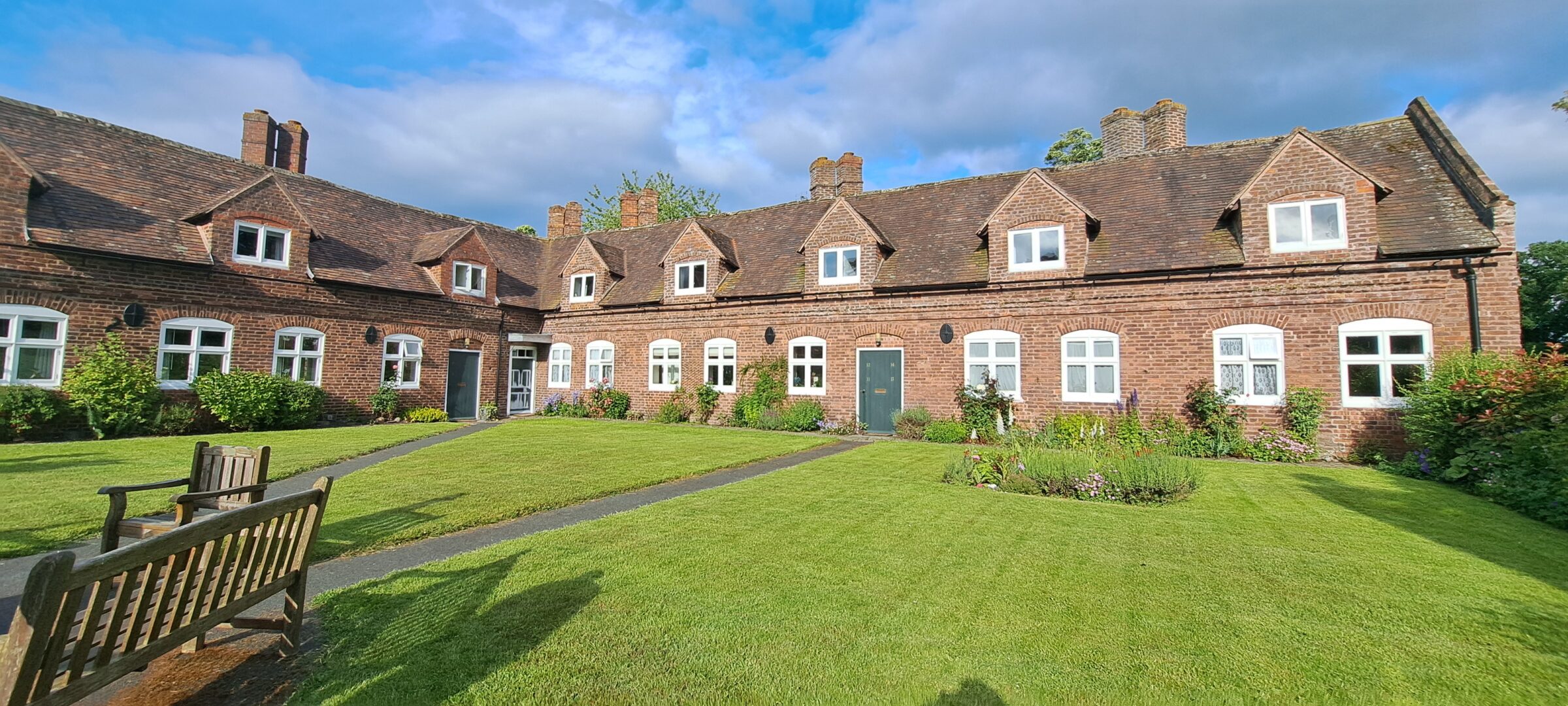
Built in 1672 by Sir Samuel Jones, a wealthy Shrewsbury merchant with estates beyond Shropshire, the Berwick Almshouses are a monument of his generosity.
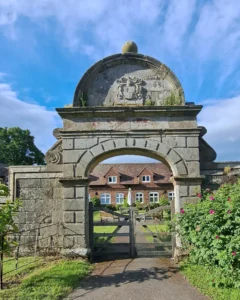
The grateway of teh Berwick Alms Houses (before entering the court)
Designed in a U-shape, the almshouses may reflect the influence of Dr. John Caius, a 16th-century Shrewsbury scholar who advocated for healthy building principles in his writings.
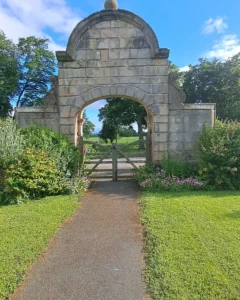
View through the gate looking outof the court of the Berwick Alms House
Inheriting the Berwick Estate from his father, Isaac Jones, Sir Samuel, who had no children himself, bequeathed funds for the construction of a chapel and almshouses.
A fading inscription on the gateway reads:
These Almshouses and Chapel were Given
and Endow’d by Sr Samuel Jones Knight
Anno Domini 1672.
Sharing a connection with Soulton Hall, the Berwick Almshouses’ gateway and courtyard were crafted by the same masons who, just four years earlier in 1668, had created the tabernacle doorcase here.
The 1670s Berwick Alms Houses
It is similar but in a less refined style, but the work at Soulton shows significantly more insigt, suggesting it was directed by another force; more than once Wren has been suggested as directing the Soulton work.
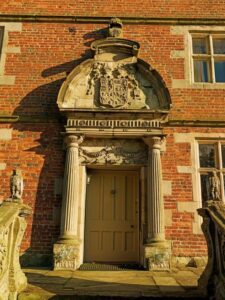
The striking 1668 stone tabernacle doorcase of Soulton Hall
Another building that localy is also of this local tradition is the Shoemakers Arbour which had a fine stone gateway 1679.
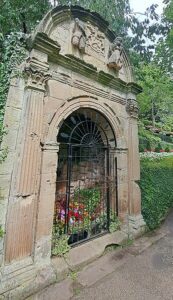
The 1679 Shoemakers Arbour’s fine stone gateway
One of the few remaining elements of Kingsland’s historic buildings, this arbor, now relocated, is testament to the area’s rich cultural and civic heritage spanning centuries.
Shrewsbury’s history of performance and festivity, demonstrably extends back to the pre-Reformation era.:
In ancient times, while the Romish religion prevailed, all the companies united once a year in celebrating the day of Corpus Christi, with great pomp and splendour. At the reformation this ceremony was commuted for another, held on the second Monday after Trinity Sunday, which is still continued, though with less pomp and circumstance than formerly. The Companies form themselves into processions, headed severally by men on horseback in gaudy apparel, called kings, probably as representatives of the monarchs who granted their charters* They move in marshalled array to Kingsland, where they are met by the mayor and corporation and the day is spent in festivity.
Records document the annual convergence of the town guilds for an elaborate celebration on Corpus Christi, a significant Catholic feast day.
Notably, the core element of a guild procession, featuring representatives from each guild potentially echoing past monarchs leading the march on horseback, has endured (Glazebrook, 2017).
It is worth adding that Shrewsbury’s town’s Quarry Park where this arbour now stands itself has long been a significant space for cultural activity with a demonstrably long history.
Pre-dating the Reformation, the friars associated with a nearby convent utilized the amphitheatre-shaped bank within the park to stage religious mystery plays, also known as miracle plays.
This tradition extended well into the 16th century, with performances by Shrewsbury School attracting the attention of royalty).
The school staged elaborate pageants for visiting dignitaries, with documented accounts describing a 1581 performance featuring scholars dressed as nymphs greeting a departing Lord President with verse recitals.
William Shakespeare himself has connections to Shrewsbury. The final acts of his play “Henry IV, Part 1” are explicitly set near the town, and some evidence, albeit circumstantial, suggests that he might have even performed there himself.
Later playwrights, such as George Farquhar, also demonstrably chose Shrewsbury as the setting for their works, with his play “The Recruiting Officer” adding to the town’s theatrical legacy (Harbage, 1952).
The Renaissance period unquestionably witnessed Kingsland’s transformation into a vibrant center for elaborate performances. The various town guilds constructed magnificent arbors, some of which, like the enduring Shoemakers’ Guild arbor, stand as physical testaments to this artistic expression.
This flourishing period also coincided with the rise of John Weaver, a pioneering figure in English ballet and pantomime, who demonstrably honed his craft within Shrewsbury.
********
The above contains reference to scholarship which is the property of BYRGA GENIHT
