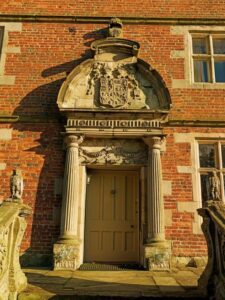
Some Hidden Meanings in Soulton’s 1668 Doorcase
The 1668 door case of Soulton Hall has a set of hidden meanings in it. It is built in a code, this is not the only hiden meaning in the building.
Below is an exploration of this by Country House expert, James D. Wenn of Byrga Geniht, the themes is this passage will be developed in James’s forthcoming book ‘Stones of the Magi’.Â
********
The 1668 Door-Case
It is not improbable that you are reading this short account sitting by a fireside at Soulton Hall, among the cultivated roses of the gardens, or among the wild roses of the estate beyond hedge and wall. If you are not physically in these places, it is nevertheless not improbable that through these words you have now conjured all these places in your memory or imagination; and, following this conjuring, it is not improbable that one of the most distinctive features of the hall that stands out in your mind’s eye is the striking stone tabernacle door-case around the front door.
The striking 1668 stone tabernacle doorcase of Soulton Hall
We are so familiar with classical columns around doors in the so-called tabernacle arrangement that they are symbolically cheapened these days; but the Soulton columns are of a Roman Doric order, and there is meaning there. Doric is the oldest of the classical orders of architecture, but the Roman version is much newer. This sense of the very ancient being renewed and strengthened is the key to the symbolism of this whole piece of architecture.
This key, however, is so easily overlooked, positioned as it is beneath something very special and striking. There are two diverging reasons why the modern eye is baffled by the sculptural forms that are carried above the cornice of the door-case’s entablature, which together act as a rain-throw above the door.
One reason for our confusion in reading the monument is that we are used to seeing all manner of embellishment around doors.
Postmodernism has released architects to play with architectural shapes with great individuality and freedom, in a fantasia of meaning-making. If we grasp just one shape of a sculptural work, there is nowadays a lively competition between different symbol systems in our mind. It takes further information to narrow-down what is going on from a widening field of possibilities. This effect is known as hypersignification. As we grow more familiar with a symbol, we become less sure of which meaning it may have. What was once unconditional is now highly conditional on context and supplied information.
The second reason for our bafflement is simpler: mere forgetfulness of a symbol system that is now ancient.
In the deep past, the business and philosophy of building used to be an affair managed by guilds. The guild system maintained knowledge of a language of architectural symbolism that carpenters and masons used to communicate messages through their work. Speculative Freemasonry began to rise at about the time of the 1660 Restoration in England that is, the restoration of the Crown and King Charles II, the re-establishment of the Church of England, and the resurrection of institutions such as the Order of the Garter which had been abolished or lapsed during Oliver Cromwell’s republic following the English Civil War. Speculative Freemasonry is a social and cultural project that involves using the knowledge of the symbolism of classical and mediaeval architecture to put a language to deep feelings about fellowship, personal growth and civic virtues. It is known as ‘speculative’ to distinguish it from the continuing physical construction work of the operative masons. It seems likely that Freemasonry as a speculative movement emerged as a junior, gentry version of the aristocratic chivalric orders like the Order of the Garter. The moment of the Restoration makes political and social sense as a time when the gentry, who were stepping back from republican power, desired a language of political agency to complement the symbol systems employed by the Garter at Hampton Court Palace, Windsor Castle and in the great aristocratic stately homes of England from which the country was practically managed alongside the smaller gentry estates.
So it was that there were at that time two forces in the country the aristocracy and gentry and two forces in the symbolism of architecture: the court circle, and the Freemasonry of the rest of the politically active people of England. It was a time when people had cause to think about how a society should be run. Those who used plain words, like Thomas Hobbes and John Locke, developed philosophical positions in written works that addressed the idea of a social contract; but the need to engage with society was (and is) a universal concern, and capable of being communicated and enacted through different media. The architectural symbol system of English Freemasonry was a significant part of the fabric of social change and social reproduction through the generations until, more than a century ago, faith in the English social contract (with which Freemasonry was in active conversation) was shaken violently by the grief and disillusionment of the First World War.
Back in 1668, when the Soulton door-case was designed by a mason and sculpted by a mason, the symbol system preserved in the lore of Freemasonry was not only a living language, but a widely understood one too.
The first thing to explain is why the pediment is curved. In James Stevens Curl’s monograph Freemasonry and the Enlightenment: architecture, symbols, and influences, he glossed the pediment as, The triangular gable set over columns or pilasters. The form makes it Masonically significant. Segmental pediments were associated particularly during the Roman Empire with Isiac cults (the crescent-moon, bow of Diana, horned form, etc.), and recur in Masonic Architecture and Art. A segment of a circle is a shallow curved form created by slicing a circle horizontally somewhere above its centre.
This form of pediment contrasts with the triangular form, which (when not seen as merely ordinary) has an association with Mars, the Roman god of war. The male complements the female in one register of interpretation; but at another register, the triangular form represents war and conflict, whilst the segmental form represents peace and love. Within Roman society, which incorporated many religious and cultural traditions from around the Empire, the Isiac cult was very significant. In the Roman magical adventure novel The Golden Ass by Apuleius, the protagonist ends his journey by becoming a high priest, rescued from his hardships by the goddess. James Stevens Curl explains Isis, the Egyptian Goddess who was sister and bride of Osiris. She resurrected Osiris when he was killed and dismembered by Seth, and she conceived Horus by supernatural means. Her tears caused the Nile to flood, she could blind with a stroke of her sistrum, and her fountains could restore sight. Her attributes are the Moon, the Cow’s Horns, the Rose, the Fountain, the Lotus, and much else, and she is clearly a forerunner of the Marian cultus of the Christian Church. Her Mysteries have interesting parallels with Masonic rituals, and she is discussed by a number of writers in Antiquity, including Diodorus Siculus and Plutarch. So not only does the Soulton curved form represent peace and love, but also the awesome power of resurrection, salvation and redemption.
Was the resurrection of the Restoration symbolised in this way elsewhere? Almost ubiquitously. Helen Collins has surveyed the career of a master carpenter whose career bridged the republican gulf between the world of Charles I and Charles II. Edward Jerman, 1605-1668: the metamorphosis of a master craftsman details works for the City of London’s Companies designed and completed in the Restoration atmosphere. Haberdashers’ Hall, Barber-Surgeons’ Hall, Drapers’ Hall, Goldsmiths’ Hall and, most notably, the Royal Exchange, were all major civic projects where Edward Jerman used segmental pediments very prominently, above major ceremonial entrances.
Jerman was an expert in the symbolism of architecture, as he had been responsible for the temporary wooden buildings and floats of the traditional Lord Mayor’s Show. These processional pageants were (and continue to be) longstanding civic rituals entirely concerned with the ceremonial magic of symbolism and allegory. This kind of magic ‒ of conjuring thoughts and emotions in people through ceremonies to promote social cohesion ‒ came from the Platonism of mediaeval and renaissance scholars. Magic in these times meant both the social and natural sciences, as associated with the stargazing Magi who visited the infant Jesus in Matthew’s Gospel in the Bible. Classical Platonism (and Neoplatonism) also added a theoretical structure to Christian social sciences when thinking about ontology ‒ the existence or beingness of things. The idea of a perfect Form (what we might call the concept or eternal ideal truth of something) can be introduced into a physical place by creating symbols and models relating to it. This enables material actions (when perceived and interpreted) to conjure in people’s minds something that does not exist in the material world. To illustrate this, think about how we never see triangleness, only models of triangles made up of atoms with a roughness to them; but if we see a material triangle we can nevertheless understand pure ‘triangleness’ (the Form or concept of the triangle). Forms can be geometric (like triangleness), or values, such as love or justice.
Temporary triumphal arches and displays such as those Edward Jerman created in his lifetime were a significant part of courtly ritual (and ceremonial magic) alongside poetry, theatre, opera, ballet and other performance, in all European Renaissance courts. Indeed, the link between courtly architecture and theatre set design in England boasts such great names as Inigo Jones, architect to James I and VI, and John Vanbrugh, famous for Blenheim Palace and Castle Howard.
Earlier in history, one particular temporary ceremonial building adds more to our interpretation of the door-case at Soulton. In the Royal Collection, the oil painting of The Field of the Cloth of Gold shows in the foreground on the right (with equal prominence to the English king riding in ceremonial procession on the left) the great pavilion of the diplomatic encounter between Henry VIII and Francis I of France. Above the main doorway in the centre of this pavilion are swags of garlands, like at Soulton, and a coat of arms, like at Soulton. There is even a set of two roses, which are represented in the frieze of the Soulton entablature by the two outer ornaments being roses (as much Isiac as Tudor) rather than the straight-petalled flowers of the inner ornaments that are also used in the decoration of the contemporary balustrades in front of Soulton Hall. In the Tudor royal painting there is also a semicircular gable at the top of the pavilion, which is echoed by Soulton. Through these connections the first of the great puzzles of the Soulton door-case begins to be explained. Whilst the curved nature of any pediment carries a large freight of meaning, most Restoration era curved pediments are segmental, not semicircular. The fullness of the curve of Soulton’s carries an extra level of meaning ‒ one anchored in an older, Renaissance, part of the architectural symbol system.
It is important to recognise that The Field of the Cloth of Gold occurred before the Protestant Reformation, so it drew on the full breadth of Catholic symbolism. The first Christian emperor, Constantine, erected a traditional Roman triumphal arch in Rome, and early churches were based on the administrative basilicas of the Roman Empire, which had a giant arch opening into a semicircular apse. This apse is where Roman legal matters would occur, and where later a Christian altar would come to be placed. The giant semicircular arch therefore held a message of Christian triumph in the early church. This then melded with another giant kind of semicircular arch significant in Christian thought ‒ the rainbow which represents God’s covenant with humanity and life on Earth in the ninth chapter of the Book of Genesis in the Bible. This association was reinforced through the glowing colours of Romanesque and Byzantine mosaics. It is clear to see how the semicircular rather than shallow segmental form therefore carries symbolism of covenants, oaths, treaties and unconditionality.
So unconditional love, unconditional peace, and unconditional loyalty all live within the swelling form of the Soulton pediment. This happens in a more forceful way than in other Restoration curved pediments, and in a wider symbolic context more explicitly anchored to a tradition stretching back through generations in England, and also back into the fundamentals of the triangular relationship between the divine, the human and the natural.
The Soulton pediment, however, is a broken pediment.
This could indicate the breakdown of society during the English Civil War.
Broken pediments are often decorative in a way to give space for a taller sculpture or a vase but here this is not so, alerting us to the symbolic significance of the break in the circular arc.
It is, however, restored by a separate segmental pediment floating a little way above the gap, perfectly making-up the loss in the water-shedding aspect of the pediment. The segmental section has volutes (scrolls) at its two ends, evoking the Ionic order. Unlike the Doric order, this is an order particularly associated with wisdom and female divinities (reinforcing the Isiac allusions of the wider design). The section is visually buoyed-up by the space around the coat of arms set within the pediment, drawing attention to it, and also symbolically indicating that there is a relationship between the presence of the remedial, restorative segmental section and the heraldic arms. Above the segment is a spray of flowers signifying new life and hope, elevated on an acanthus leaf stand so that it can be seen from a steep angle from below when on the terrace approaching the front door of the hall.
The last piece of the puzzle is the coat of arms with its two helms. This indicates the union of two families in a marriage; and so a complete thesis is formed in stone.
The Restoration of the kingdom is accomplished through the nature of an unconditional covenant of a divine nature, but this is constructed out of social components such as the unconditional love between two people, representing hope for the future (signalled by the flowers) as well as healing rifts of the past. From the most grand and general to the most personal, private and specific, the Forms of peace, love and sociability are conjured through architectural symbolism in an abstract way, but also with a practical message in terms of how to go about things. The small local steps of building a family are asserted to be central within the society of England in a way that speaks of universal values. The marriage the coat of arms specifically commemorates was that of Thomas Hill of Soulton and Sarah Eyton-Evans, but the monument engages with more than one particular political or family moment, and, like the symbol system of Freemasonry more generally, addresses the theoretical conception of a good social contract, and how we can maintain it and improve it as individuals.
The magic of the Soulton door-case is in synthesising these feelings into a coherent visual and philosophical programme.
No doubt there has been a waning of the power of such a monument to do its Neoplatonic-magical and social work of conjuring persuasive thoughts and emotions in service of a higher purpose; but the meaning nevertheless lies latent within the stones, and can be unlocked with a key such as this short exploration. These days Soulton Hall hosts many weddings, plays, civic events and personal moments, and the door-case benignly and approvingly presides over this activity regardless of people’s sensitivity to it. But inability to read does not imply that writing has no meaning coded within it, and confusion through hypersignification only necessitates a little extra labour of explanation, which is now gladly provided.