


A Tudor World of Connections
In the Tudor era, England was a relatively small country with a population estimated to be around 3 million people. This intimate scale meant that individuals at a certain level of society were likely to know each other, creating a network of interconnected relationships.
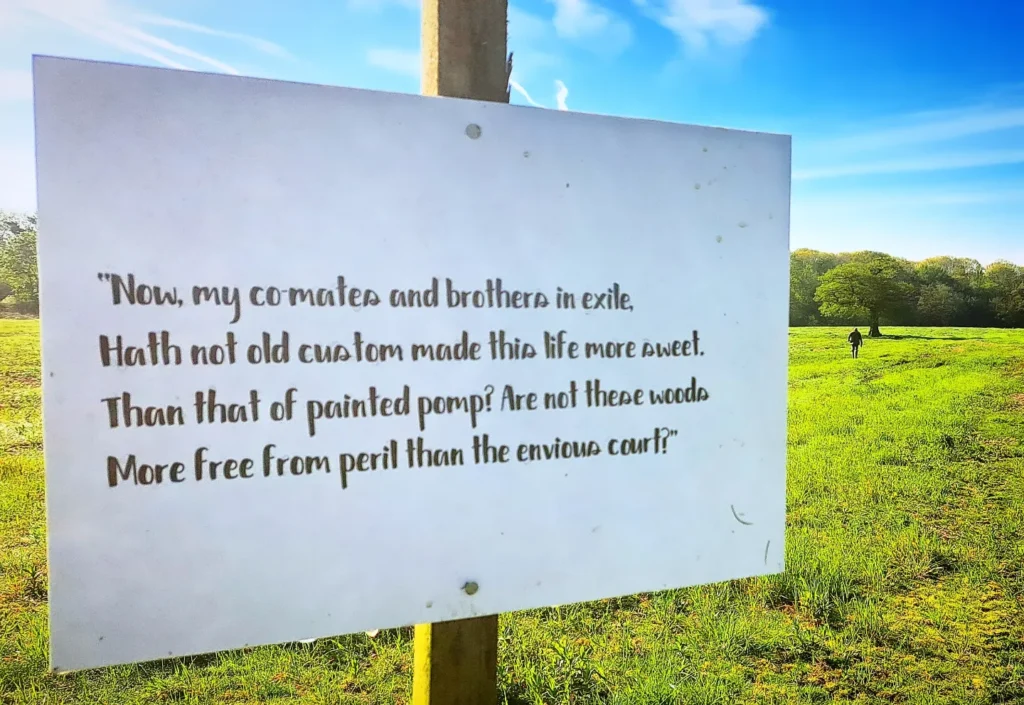
A sign with an AS YOU LIKE IT quotation in the Soulton landscape: Now, my co-mates and brothers in exile,
Hath not old custom made this life more sweet
Than that of painted pomp? Are not these woods
More free from peril than the envious court?
London, the largest city in England at the time, had a population of approximately 100,000. Shrewsbury, a significant town in Shropshire, had a population of around 3,000. Given these figures, it’s evident that individuals in positions of power and influence, like Sir Rowland Hill, would have had a wide circle of acquaintances and connections within these communities.
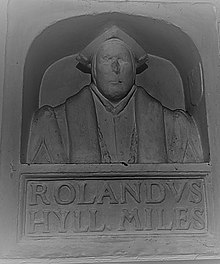
The bust of Sir Rowland Hill at Market Drayton School. Note the spelling: not the only times letters are different….
This interconnectedness played a crucial role in shaping Sir Rowland Hill’s life and career. His numerous associations and connections allowed him to navigate the complex social and political landscape of Tudor England, influencing his public service, charitable endeavors, and business ventures.
********
Sir Rowland Hill, cultivated relationships with powerful individuals and families, which it may be intersting to some to explore.
Connections that have a Shakespeare flavor
The Ardens and the Shakespeares (via the Corbet line)
Sir Rowland Hill was a cousin by marriage to Mary Arden, Shakespeare’s mother.
This operates as follows: one of Hill’s heiresses was his niece Alice Gratewood (died 1603), who married the justice Reginald Corbet (an acolyte of Hill’s); they had a daughter Elizabeth who married Robert Arden, son of Edward Arden. And these Ardens are the senior members of the Arden family of which Mary was a member.
Wriothesleys (Earls of Southampton) and the Vernons
One such connection was with the Wriothesleys and the Vernons, whose intertwined history offers a fascinating glimpse into Hill’s circle.
Henry Wriothesley, the 3rd Earl of Southampton, was a grandson of Thomas Wriothesley, the 1st Earl. Hill was an intimate guest of theirs at the burial of Thomas Wriothesley. Hill’s association with the Wriothesleys suggests a personal connection beyond official business.
Meanwhile, Elizabeth Vernon, Henry’s wife, was the granddaughter of George Vernon. Rowland Hill and George Vernon were members of the Hodnet parish in Shropshire, as boys, and so had their familes been for generations.
This hints at a possible link to the artistic and literary world, considering Henry Wriothesley’s patronage of Shakespeare: Shakespeare dedicated his two narrative poems, Venus and Adonis and The Rape of Lucrece, to Henry Wriothesley, who is often identified as the “Fair Youth” of the poet’s sonnets.
Sidneys and Herberts (Earls of Pembroke)
Hill’s official duties brought him into close contact with other Sidney-Herbert dynasty.
Sir Henry Sidney served with Hill on the Council of the Marches. Sir Phillip Sidney (1554–1586) was a pupil of Shrewsbury School which Hill had a hand in founding.
Hill’s position as a Privy Councillor overlapped with Henry’s tenure, where their paths crossed frequently in the highest circles of Tudor England. The same is true of his connections with the Herberts, Earls of Pembroke: William Herbert, 1st Earl of Pembroke, was a prominent figure in Tudor politics (indeed as an executor of Henry’s will) and an ally of Hill’s. Herbert and Hill cames to share political goals, particularly in their opposition to the Protector Somerset, and Hill’s refusal to send troops to Somerset, as Lord Mayor of London, was a decisive factor in Somerset’s downfall.
Mary’s Sidney married Henry Herbert (1538–1601), second Earl of Pembroke. William, thier son served as Lord Chamberlain from 1615 to 1625 and was a direct patron of Shakespeare, even receiving a dedication in the First Folio, while Mary hosted Michael Drayton, Ben Johnson and others in her literary salon.
Shakespeare’s theater company performed at Wilton House, and it has been suggested that As You Like It may have been the chosen work (see: F. E. Halliday, A Shakespeare Companion 1564–1964). According to John Aubrey’s account in Brief Lives, William Herbert, 1st Earl of Pembroke, faced a brief period of dispossession during the reign of Queen Mary I:
In Queen Mary’s time, upon the return of the Catholique religion, the nunnes came again to Wilton Abbey; and this William, Earl of Pembroke, came to the gate which lookes towards the court by the street, but now is walled up, with his cappe in his hand, and fell upon his knees to the Lady Abbess and nunnes, crying peccavi. Upon Queen Mary’s death, the Earl came to Wilton (like a tygre) and turned them out crying, ‘Out, ye whores! to worke, to worke—ye whores, goe spinne!
– Brief Lives’, by John Aubrey, between the Years 1669 & 1696; edited by Andrew Clark, p. 316. Available here on-line: https://archive.org/details/briefliveschiefl01aubruoft via the Internet Archive.
If the historical account of William Herbert’s dispossession and subsequent return to Wilton Abbey is accurate, it’s possible that certain lines in As You Like It resonated particularly strongly in performance there:
JAQUES DE BOYS
Let me have audience for a word or two:
I am the second son of old Sir Rowland,
That bring these tidings to this fair assembly.
Duke Frederick, hearing how that every day
Men of great worth resorted to this forest,
Address’d a mighty power; which were on foot,
In his own conduct, purposely to take
His brother here and put him to the sword:
And to the skirts of this wild wood he came;
Where meeting with an old religious man,
After some question with him, was converted
Both from his enterprise and from the world,
His crown bequeathing to his banish’d brother,
And all their lands restored to them again
That were with him exiled. This to be true,
I do engage my life.DUKE SENIOR
Welcome, young man;
Thou offer’st fairly to thy brothers’ wedding:
To one his lands withheld, and to the other
A land itself at large, a potent dukedom.
First, in this forest, let us do those ends
That here were well begun and well begot:
And after, every of this happy number
That have endured shrewd days and nights with us
Shall share the good of our returned fortune,
According to the measure of their states.
Meantime, forget this new-fall’n dignity
And fall into our rustic revelry.
Play, music! And you, brides and bridegrooms all,
With measure heap’d in joy, to the measures fall.– William Shakespeare, As You Like It
Stanley Dynasty (Earls of Derby) (& Vernon, again)
The Stanley family’s connections to Sir Rowland Hill were deeply rooted in their shared regional ties and their positions within the Tudor elite. Both families had strong associations with Shropshire, and their parishes were closely linked. Hodnet, the parish where Hill resided, and Tong, a neighboring parish associated with the Stanleys, shared a close relationship. This connection is underlined by the relocation of the font from Tong Church to Hodnet Church. The Hill and Stanley families, were together in London and the Midland for generations before the 1500s. Moreover, Sir Thomas Stanley’s wife was Margaret (née Vernon) of the Parish of Hodnet.
The Devereux Dynasty (Earls of Essex)
Walter Devereux, the first Earl of Essex, enticed Thomas Ashton (who may have been hiden at Soulton along with Matthew Parker by Rowland Hill), the founding headmaster of Shrewsbury School (which Hill had a hand in founding), into his service. Ashton provided tuition to Walter’s son, Robert, until Walter’s death in 1576. The Devereux family originated in the Staffordshire-Shropshire region and were related by marriage to the Corbet family, who married one of Hill’s heiresses, Alice Gratewood. Hill and Walter Devereux were both active at court, likely interacting and collaborating on various matters.
Walter’s son Robert, the 2nd Earl, met a dramatic end. Robert’s failed coup in 1601 the alrming use of theatre as an act of civil war. His supporters commissioned a performance of Shakespeare’s Richard II at the Globe Theatre on February 7, 1601, hoping to spark rebellion. The Devereux family’s ties to the literary world include Penelope Devereux, Robert’s sister, is believed to be the inspiration for “Stella” in Sir Philip Sidney’s Astrophel and Stella, showing the family’s deep connection to the artistic circles of the time.
Other connections
The following connections, which can be attested from the records, show how embedded he was across Tudor society:
- Hill was a close friend of Sir John Gresham (another mercer and Lord Mayor), who provided him with a black gown to attend his funeral and whose executor he was. John’s nephew, Thomas, would go on to found the Royal Exchange.
- Hill was a “trusty friend” of Sir Thomas Seymour, and was given land at Hoxton for life under his will. He was said to “knew much of the intent and purpose” of Sir Thomas Seymour.
- Bishop Ridley refers to Hill in his farewell to his friends in general before his execution.
- Hill was left a piece of gold in the 1552 will of Chief Justice Sir Thomas Bromley (died 1555), who was on the Regency Council for Edward VI, and had lands from Hill in Shropshire “for a token of a remembrance for the old love and amity between him and me now by this my decease ended.”
- Hill was chief overseer to the will of William Lok (ancestor of the philosopher John Locke).
- Rowland Hill’s protégé, Thomas Leigh, led the coronation procession and escorted the newly crowned Queen Elizabeth I through the streets of London on the day of her coronation.
