


A Scholar and Protestant Champion
Reverend Thomas Ashton, a prominent Elizabethan schoolmaster, played a significant role in shaping English drama.
He graduated from St John’s College, Cambridge, in 1520 (BA) and became a fellow that same year. His association with St John’s brought him into contact with Roger Ascham, also renowned scholar advocating for classical language study and Protestant education.

St John’s College Cambridge – a cruicible of the Reformation in England
Connections and Career
Little is known about Ashton’s activities under Queen Mary I (1553-1558) — his “movements during Mary’s reign are unknown”.[1]
This echoes the period of hiding during thistime of Mathew Parker, which has be shrouded in secrecy but is now increasingly accepted to have been at Soulton.

An early 17th-century portrait depicting Matthew Parker
His career flourished with Elizabeth I’s ascension. His association with Archbishop Matthew Parker, likely forged through their shared connections to St John’s and the Lincoln Diocese, may have played a role.
Ashton’s time at St John’s College connected him to another influential figure in royal education: Roger Ascham. Ascham, a renowned scholar and contemporary of Ashton’s, held the prestigious position of tutor to Queen Elizabeth I herself. His emphasis on classical languages and a well-rounded education, encompassing moral character and physical fitness alongside academics, undoubtedly influenced the young queen’s intellectual development and shaped her approach to governance.
Ascham’s diplomatic skills were evident in his role as Latin Secretary to Queen Mary I. Despite the heavy workload, particularly during his initial months, he managed his duties effectively. Bishop Gardiner’s intervention secured his position upon Mary’s return to England, and Ascham continued to serve with a £20 annual pension.

“Old” Sir Rowland recovered from a period of disfavor enough to sit as a judge in treason proceedings… but all the while, he was working on publishing that would have horrified Mary I.
This successful transition to away from and back Queen Elizabeth I’s court demonstrates a tact and ability to navigate the turbulent political climate which conspiciously echoes that of our own Old Sir Rowland…
In 1562, with Parker’s special license, Ashton became the first headmaster of Shrewsbury School.
Shrewsbury School and Beyond
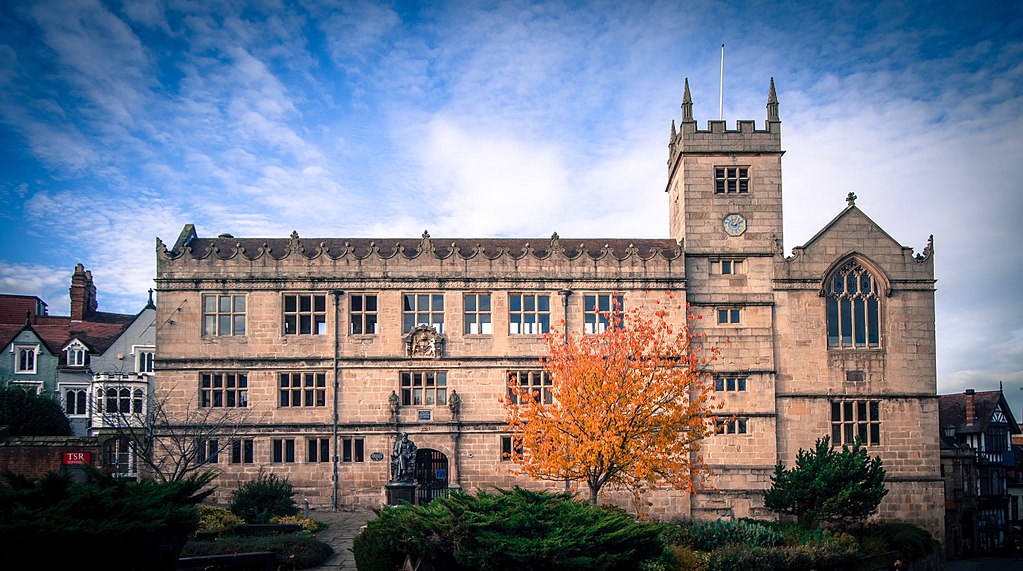
Shrewsbury School old buildings, now the Shrewsbury Library
Under Ashton’s leadership, Shrewsbury School thrived, attracting prominent students like Philip Sidney and Fulke Greville. He also wrote and possibly performed a prestigious play at the school. Following his resignation, Ashton served the Earl of Essex, managing his affairs and tutoring his son, Robert.

The aedicule window at the base of the old buildings of Shrewsbury School mirrors the chapel at Soulton Hall. The library is at the top, then the chapel for the boys, and then this curious small aedicule window.
There is, incidentally, an intersting archtectural link between Soulton Hall and the renaisance buildings of Shrewsbury School (these stone buildings were built 1594 to 1630). This is shown inthe form of the aedicule windows on both buildings.

Looking out of the aedicule window of Shrewsbury School’s old buildings – an arrangement facing east that echoes the chapel at Soulton.
Traditionally it is understood that these windows show the tablets of law given to Moses.

The chapel in Soulton Hall has an aligment to the dawn sun on Easter morning
Historical records suggest Ashton also participated in secret work for Elizabeth I’s Privy Council.
Robert Devereux and the Power of Drama
Robert Devereux, the Earl of Essex’s son, was given a curious greating by Shrewsbury School in 1585 (the instiution his tutor has run as headmaster), when the students of the school formed a martial display at the castle gates, equipped with bows and arrows.
He would later tragically demonstrate the power of drama in real life. Having been educated by Ashton and likely exposed to the influence of theatrical productions, Robert developed a deep understanding of drama’s ability to sway public opinion and influence political events. This understanding, however, proved disastrous when he attempted to use a staged rebellion to overthrow Queen Elizabeth – a failed coup that ultimately led to his execution.
Later Years and Legacy
Ashton’s final years saw him return to Shrewsbury to draft school governance ordinances and deliver a farewell sermon. He passed away near Cambridge in 1578. Both Ashton and the Ashtons of Soulton trace their lineage back to Hugh Ashton, a patron of St John’s College.
———
[1] See https://shrewsburylocalhistory.org.uk/shropshire-christianity/promoting-the-reformation and CW Radclyffe, Memorials of Shrewsbury School, 1843, SA 5447/2.