

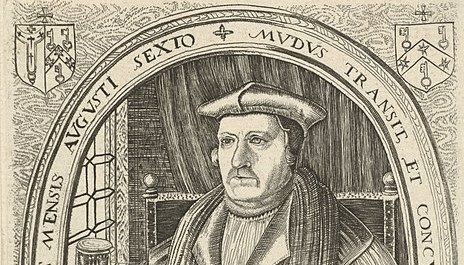
Our website occasionally profiles important figures connected to Soulton’s story, both past and present. Today, we’re taking a look at an important Tudor friend of “Old” Sir Rowland Hill.
********
Architect of the Elizabethan Church of England
Matthew Parker (1504-1575) was a pivotal figure in English religious history, serving as the Archbishop of Canterbury during the reign of Queen Elizabeth I (1558-1603). He was close to Elizabeth I having been chaplin to her mother Anne Boleyn.
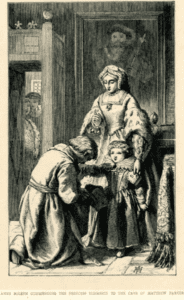
Matthew Parker, with Queen Anne Boleyn and her child Elizabeth I
Parker played a leading role in shaping the Church of England as a distinct entity, separate from both Roman Catholicism and radical Protestantism.
Early Life and Education
Born in Norwich, Parker received a traditional education at Corpus Christi College, Cambridge. He embraced Protestant ideas during the reign of Henry VIII (1509-1547) and became a close associate of influential figures like… Sir Rowland Hill.
Under Mary I
When the Catholic Queen Mary I ascended the throne in 1553, Parker, a married priest, faced persecution.
He went into hiding, fearing themost severe sanction for his Protestant beliefs. We know from his letters that he was, perhaps surprisingly, extremely happy comfortable and productive during this period, and it is understood that he may have had the protection of Sir Rowland Hill here at Soulton.
Here are some quotations on that longstanding mystery:
“Stripped of his offices Parker, for the rest of Mary’s reign lived hidden in the house of a friend, with his wife and two children. So says Jocylin, who describes his conditions as poor and needy, since he had no pension from any of his previous offices. But Parker himself does not seem to have felt unduly oppressed…his years of obscurity were years of real happiness… there is a succesion of notes in is Memoranda under various dates, each in turn testifying to his continuous contentment and marked by quite simple sincerity”
Writing to Lord (Nicholas) Bacon he said:
“Your lordship knoweth…[t]he delightful literary leisure to which the good providence of God recalled me yielded me much greater and more solid enjoyments, than my former dangerous and busy life had ever afforded me.”
– ‘Life of Parker’ by V. Brooke pp. 51
This period likely influenced Parker’s cautious approach to religious matters later in life.
Archbishop of Canterbury
With Elizabeth I’s Protestant reign beginning in 1558, Parker emerged as a leading candidate for the vacant position of Archbishop of Canterbury. Although reluctant to take the office, Parker possessed the qualities Elizabeth sought: a moderate temperament, scholarly reputation, and unwavering loyalty to the crown.
The Elizabethan Settlement
As Archbishop, Parker spearheaded the Elizabethan Settlement, a series of reforms defining the Church of England’s doctrines and practices. He was instrumental in:
- Compiling the Thirty-Nine Articles,
- Overseeing the Book of Common Prayer
- Reorganizing the Church hierarchy and promoting education among clergy.
Legacy
Matthew Parker’s is admired for his scholarship and his role in establishing a stable, moderate Church of England.
Antiquary
Parker was a passionate scholar and antiquarian. He is associated with collecting historical manuscripts and promoting the preservation of learning.
These materials would have expected to have been destroyed in the tumolt of the Reformation, and they include treasures such as: the sixth-century Gospels of Augustine, the earliest copy of the Anglo-Saxon Chronicle, the Bury Bible.
Sir Rowland Hill was cartainly intersted in publishing and scholarship and it is wonderful to think of him and Parker at Soulton working through a plan in the the emergencies of the 1550s.
