

The Battle of Numbers: Unveiling a lost game at Soulton Hall
Hidden withinSoulton Hall lies a testament to a fascinating historical game: Rithmomachia. Also known as “The Battle of Numbers,” this early European mathematical board game enjoyed a surge in popularity between the 10th and 16th centuries.

1554 illustration of a Rithmomachia board and pieces by Claude de Boissiare
Rithmomachia combined strategy with mathematical prowess. Played on a board resembling a chessboard, players captured their opponent’s pieces using calculations and geometric movement. Unlike chess, however, the color of the pieces held no advantage. Instead, victory hinged on the numerical values inscribed on each piece and the strategic application of capture rules.

Rithmomachia
Sir Rowland Hill and the Soulton Hall Connection
Intriguingly, Soulton Hall boasts a direct link to Rithmomachia through Old Sir Rowland Hill, who built the building. Sir Rowland, a celebrated figure known for publishing and statecraft, was also a scholar with a keen interest in this intellectual pursuit.
A Game of the Mind, Preserved in Stone
The most captivating evidence of Sir Rowland’s fascination lies within the very walls of Soulton Hall “ a Rithmomachia board laid into the stone floor of his prayer room, next to the concealed chapel. This unique feature offers a tangible glimpse into the past, showing how this mathematical game once captivated the minds of intellectuals like Sir Rowland.
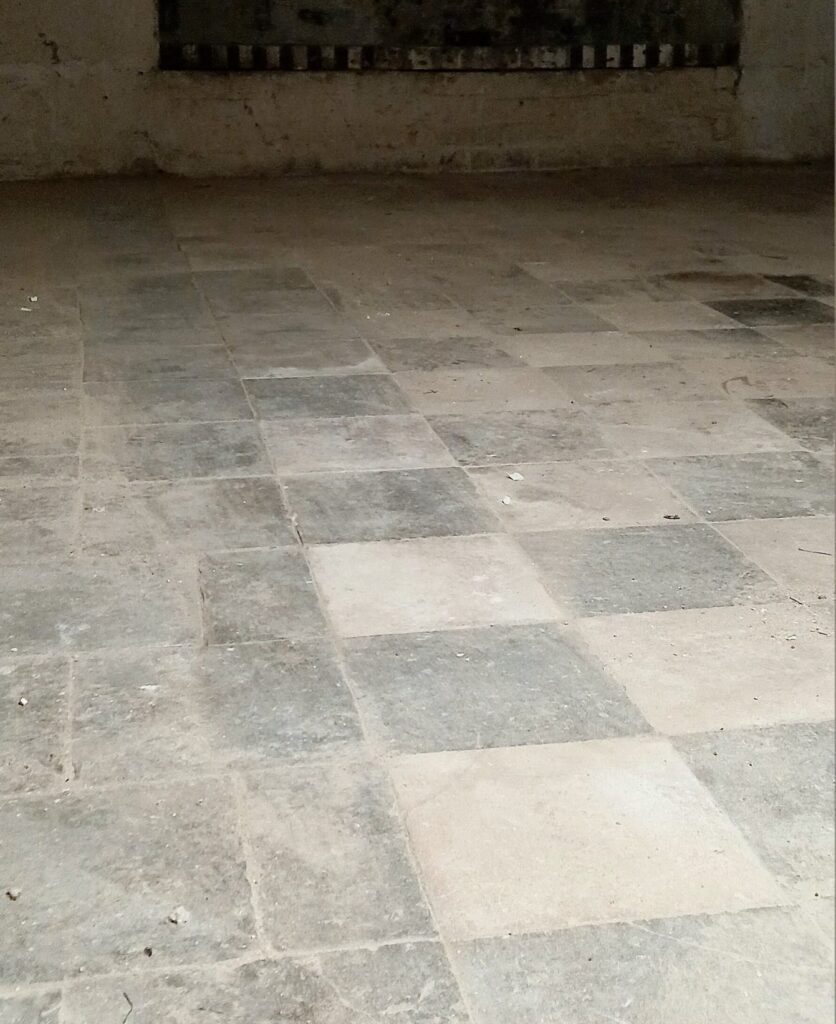
The Rithmomachia Pavement in the Prayer Room of Soulton Hall – 2022, awaiting conservation.
A Legacy of Strategy and Learning
While Rithmomachia may not be as widely played today, its historical significance remains undeniable. The game’s presence at Soulton Hall serves as a reminder of the intersection between strategy, mathematics, and intellectual leisure in the past.
Perhaps, for some visitors, it might even spark a curiosity to delve into the world of Rithmomachia and experience “The Battle of Numbers” themselves.
This room is visited on some house tours and may be visited on request by intersted groups. It cannot be visited unsupervised.
********
You can have a go at playing the game here.
And below is a video explaining it:
