

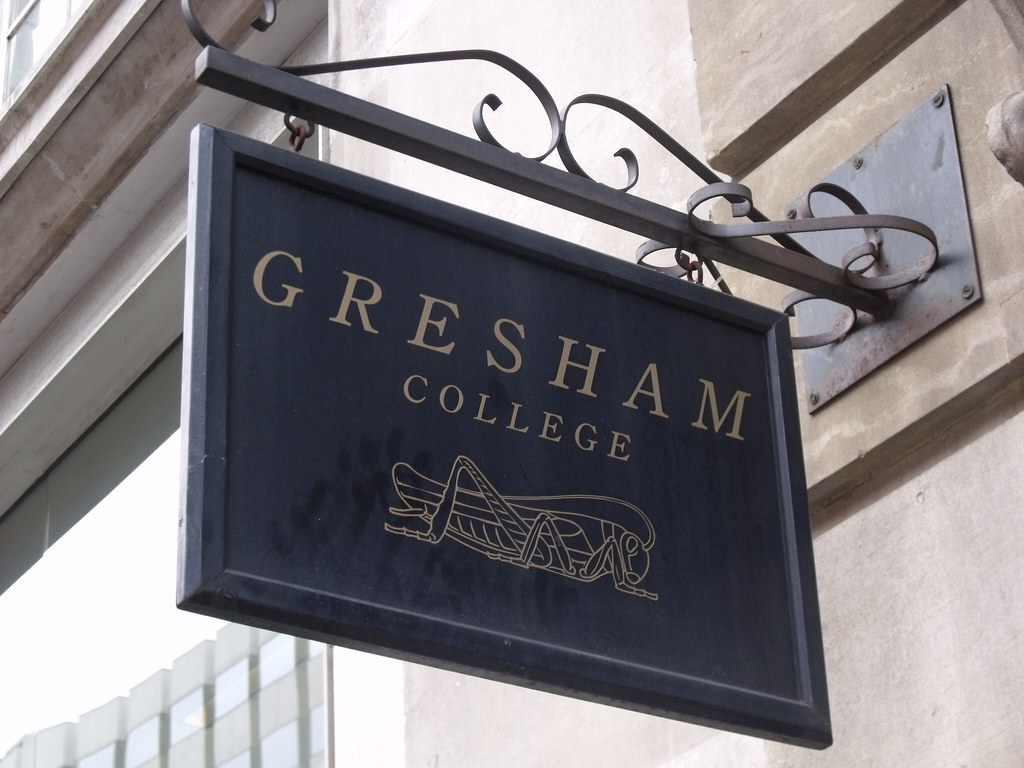
Gresham College: A Cradle of Enlightenment
Gresham College is a distinctive institution located in London.
Unlike traditional universities, it does not award degrees or enroll students. Founded in 1597, the college is supported by the City of London Corporation and the Mercers’ Company. One of Gresham College’s primary functions is to offer free public lectures on a wide variety of subjects. These lectures are accessible to anyone interested in learning and are a valuable resource for the community. Since 2001, all lectures have been made available online, expanding their reach to a global audience.
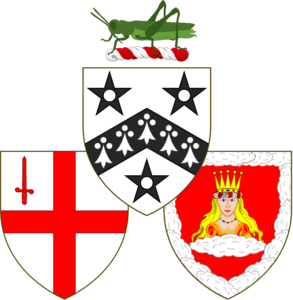
The Arms of Gresham CollegeThe Arms of Gresham College
Sir Thomas Gresham, the visionary founder of the Royal Exchange, left a substantial legacy to support his wife and heirs, bequeathing them estates valued at over £2,300 annually. However, Gresham also had a grander plan. He stipulated that upon his wife’s passing, his personal residence in Bishopsgate Street and the rental income from the Royal Exchange should be entrusted to the City of London Corporation and the Mercers’ Company.
With this endowment, Gresham envisioned the establishment of a college where seven distinguished professors would deliver daily lectures on astronomy, geometry, physics, law, divinity, rhetoric, and music. This pioneering initiative led to the founding of Gresham College in 1597, marking London’s first institution of higher learning.
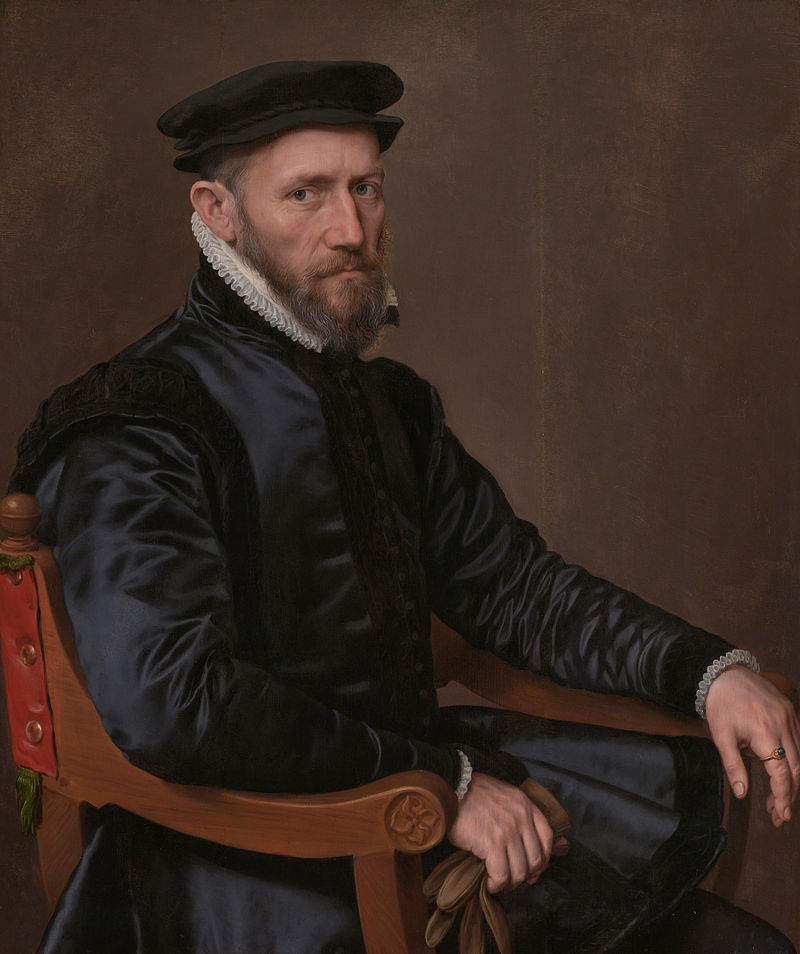
Sir Thomas Gresham
Sir Thomas Gresham, while still a student at Gonavile and Caius College, Cambridge, began his apprenticeship in the Mercers’ Company under the guidance of his uncle, Sir John Gresham, a friend of Old Sir Rowland Hill, both of whom served as Lord Mayor of London. Following his apprenticeship, Gresham embarked on a successful business venture in the Low Countries, representing King Henry VIII in various matters.
Gresham’s business ventures were aided by his associate, Richard Clough. Clough constructed of Bach-y-Graig, a building inspired by Soulton.
Despite a brief period of disfavor during Queen Mary’s reign, similar to the experience of Old Sir Rowland Hill, Gresham’s exceptional skills in negotiation and finance led to his reinstatement and a prominent role in the royal court. His contributions to the crown earned him substantial rewards, including a generous salary and grants of church lands.
The network of influential individuals within the Mercers’ Company and the broader London community played a crucial role in Gresham’s success. This network provided him with valuable connections, support, and opportunities, ultimately contributing to his significant impact on England.

I am more proud to be Sir Rowland’s son,
His youngest son- and would not change that calling
To be adopted heir to Frederick.
Old Sir Rowland Hill’s use of Soulton as a private retreat for intellectual pursuits in the 1550s likely inspired Gresham’s vision of a dedicated space for scholarly endeavors. This familial connection and shared interest in intellectual pursuits may have played a significant role in Gresham’s decision to create a lasting legacy through the establishment of Gresham College.
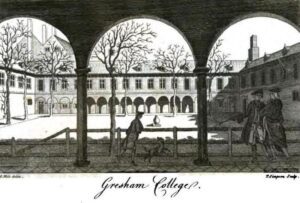
Gresham College, the court with figures in eighteenth-century dress.
Gresham College was initially established in Sir Thomas Gresham’s former mansion in Bishopsgate, the site now occupied by Tower 42, the former NatWest Tower. To ensure its financial sustainability, Gresham endowed the college with the rental income from shops located around the Royal Exchange.
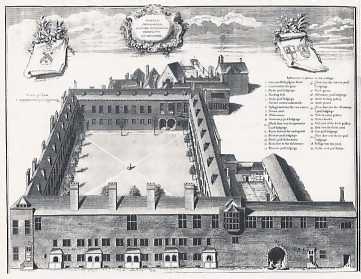
Gresham College, formerly Gresham’s Mansion, as depicted in an engraving by George Vertue, 1740.
The seven original Gresham College professorships, dating back to the college’s inception, encompassed the core subjects of the medieval university:
- astronomy,
- divinity,
- geometry,
- law,
- music,
- physic, and
- rhetoric.
The purpose of establishing a college with seven professors, each delivering a lecture on a different day of the week, was to provide a continuous and comprehensive program of academic instruction. This daily schedule ensured regular exposure to diverse subjects and facilitated in-depth study.

The Astronomy and Rhetoric door at the Bodlain, Oxford
This is similar to the later Bodleian Library quadrangle in Oxford, which dates from the early 17th century, which honours different subjects with doors. While the Bodleian Library quadrangle expanded upon this concept by incorporating even more subjects into its curriculum, Gresham College’s foundational approach laid the groundwork for such educational endeavors.

The door for law at the Bodlain, Oxford
It also finds an echo in The College of the Six Days Works, a fictional institution in Francis Bacon’s New Atlantis, is dedicated to scientific research. It’s divided into six houses focused on different senses and conducts experiments to uncover the laws of nature and improve human life. Scientists collaborate and educate young scholars to advance knowledge.
Title page of New Atlantis in the second edition of Francis Bacon’s Sylva sylvarvm: or A naturall historie. In ten centvries. London
Among the notable early Gresham College professors were Christopher Wren, a renowned astronomer of the 17th century, and Robert Hooke, who held the prestigious position of Professor of Geometry from 1665 to 1704.
The Gresham College Group, a precursor to the Royal Society, was a loose association of English scientists active during the 1640s and 1650s. This group’s pivotal role in the establishment of the Royal Society, chartered in 1662, is widely acknowledged, though the exact influence of other contributing groups remains a subject of debate.
Gresham College’s strategic location and its membership of distinguished scientists and scholars significantly contributed to the Royal Society’s development. A pivotal event occurred on November 28, 1660, when a committee meeting convened in the rooms of Lawrence Rooke at Gresham College, following a lecture by Christopher Wren. The minutes from this meeting documented a proposal for a new “college,” which is widely regarded as the catalyst for the Royal Society’s formation. This collective of “virtuosi” successfully transformed themselves into a learned society. One of the key figures in this process was Abraham Hill, a wealthy London merchant who had chambers in Gresham College…
The “Invisible College” was a loose network of scholars who exchanged ideas and collaborated on various projects. One such group, centered around Robert Boyle, is often considered a precursor to the Royal Society. While the exact membership of this group is debated, it included prominent figures who later played a significant role in the formation of the Royal Society.
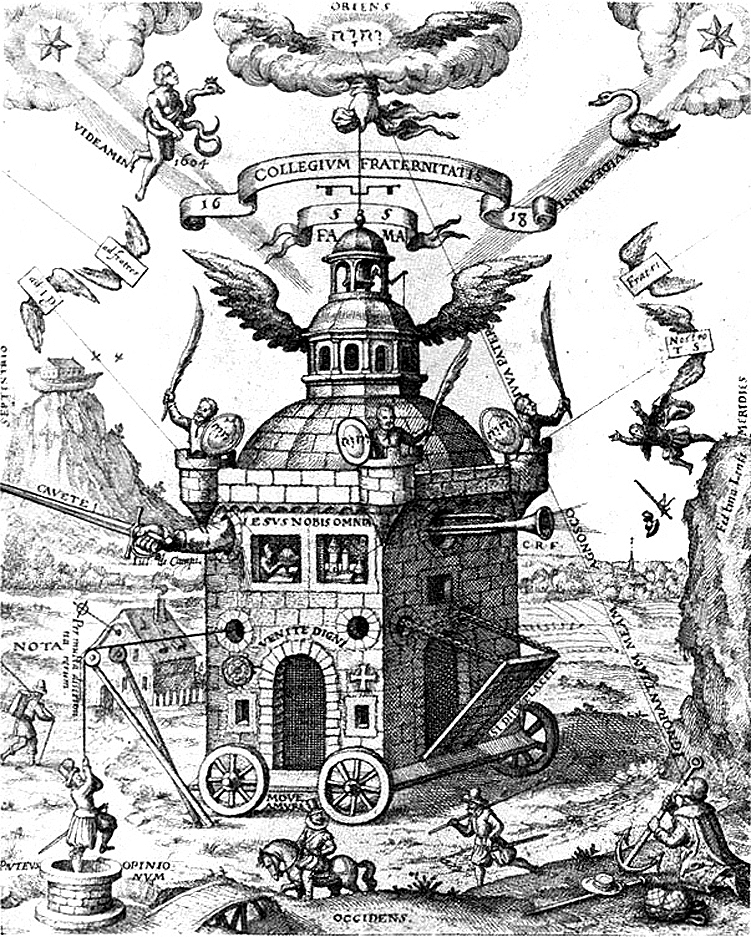
Emblematic image of a Rosicrucian College; illustration from Speculum sophicum Rhodo-stauroticum, a 1618 work by Theophilus Schweighardt. Frances Yates identifies this as the “Invisible College of the Rosy Cross”.
The concept of an “invisible college” originated in German Rosicrucian pamphlets and was later popularized by Ben Jonson in his masque “The Fortunate Isles and Their Union.” The term gained currency within the Republic of Letters, a network of scholars who communicated through correspondence.
While the connection between the “Invisible College” and the Royal Society is well-established, the exact nature and extent of this relationship remain a subject of ongoing research. Historians continue to debate the specific contributions of the “Invisible College” to the formation of the Royal Society.
With thanks to James Wenn for scholarly support.
Please note that this blog contains references to intellectual property owned by Byrga Genight Limited.
