

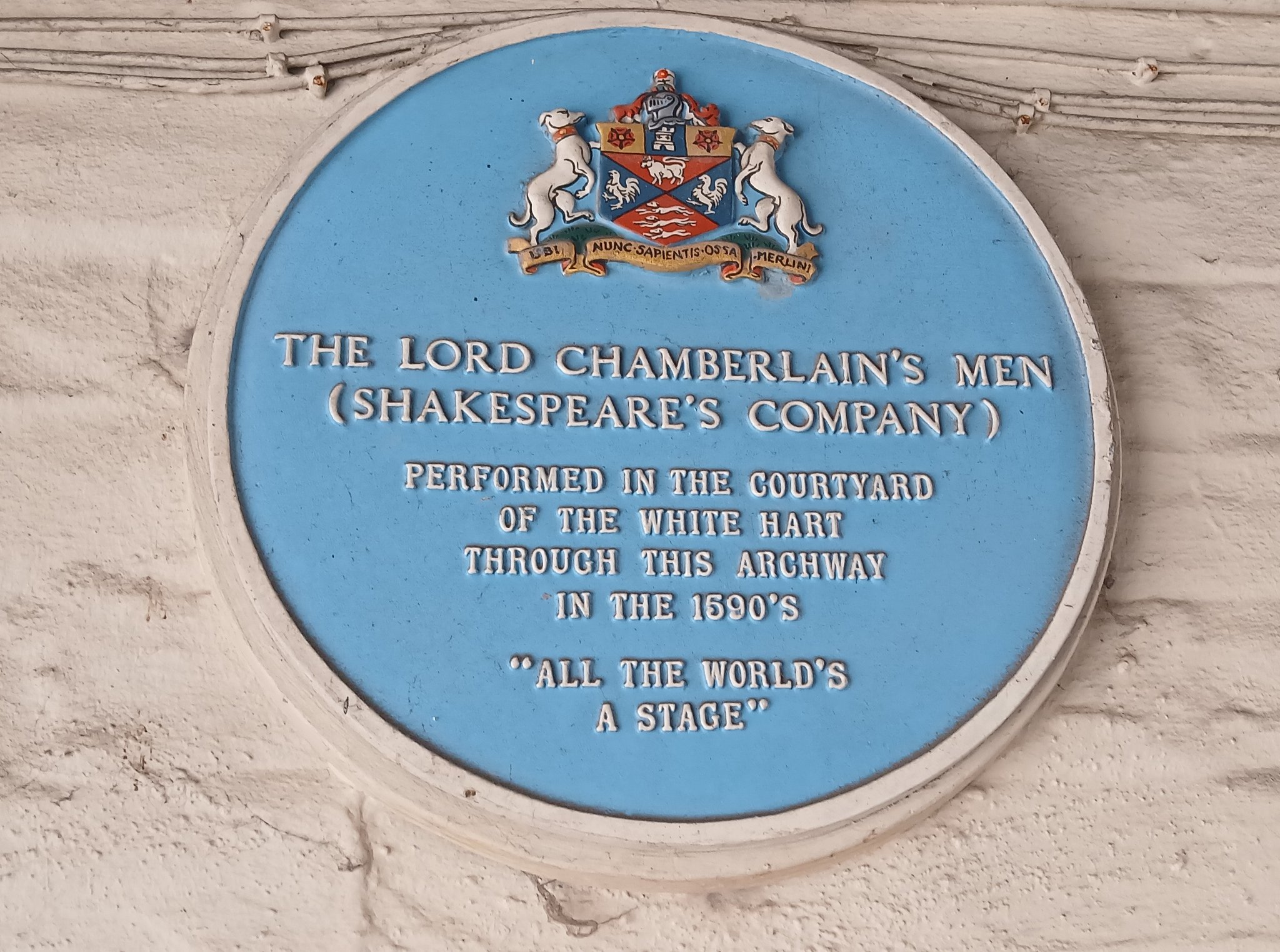
A blue plaque caught our eye on a recent trip to Marlborough, and it immediately set out the association of the town with the extensive tours that Shakespeare and his colleagues went on.

Shakespeare Plaque in Marlborough
Of course, this widespread practice of touring is reflected in Shropshire as well as Wiltshire, because these famous acting companies were national phenomenon, bringing their artistry far beyond London’s Globe.
This specific plaque marks the location of The White Hart Inn, an inn whose courtyard would have been the vibrant stage for Shakespeare’s company during their visits in the 1590s. The original inn sadly perished in the Great Fire of Marlborough in 1653.
What this single plaque underlines is the extraordinary reach and wide travel of these Elizabethan players.
They were not just confined to the bustling theatres of London; they were often on the road, bringing their artistry to communities across England. It makes you vividly imagine the excitement as these famous actors arrived in a provincial town!
This discovery reminded of other locations where Shakespeare’s companies performed.
Fast forward a few years, and with the ascension of James I to the throne in 1603, The Lord Chamberlain’s Men became The King’s Men – the official royal acting troupe. And where was one of their very first destinations under this new patronage? Shrewsbury!
Shrewsbury, with its central location and prosperity, was a natural choice for touring performances.
Historical records confirm that The King’s Men performed there, particularly between 1603 and 1605. While it’s not definitively documented that Shakespeare was personally present for every single performance, his role as a leading member of the company makes it highly likely he would have been part of these important early tours.
The link between Shakespeare and Shrewsbury runs even deeper than just his company’s performances.
The town’s rich history, most notably the Battle of Shrewsbury (1403), served as direct inspiration for his work. This pivotal English conflict is famously featured in Shakespeare’s Henry IV, Part 1, bringing the very landscape and historical figures of Shropshire to life on stage.
Further connections are apparent on his works from Shropshire: in other plays like As You Like It and Richard III.
These instances in Marlborough and Shrewsbury highlight a crucial aspect of theatrical life in Shakespeare’s time: the itinerant nature of acting companies.
They travelled across the land, bringing culture and entertainment to diverse communities.
As Shakespeare’s company journeyed through England, performing in inn courtyards and country houses, they were weaving his timeless stories into the fabric of the nation, reaching audiences who were undoubtedly enthralled by the magic of theatre.
Our Marlborough discovery brought home how much more there is to explore about the breadth of Shakespeare’s world!
