

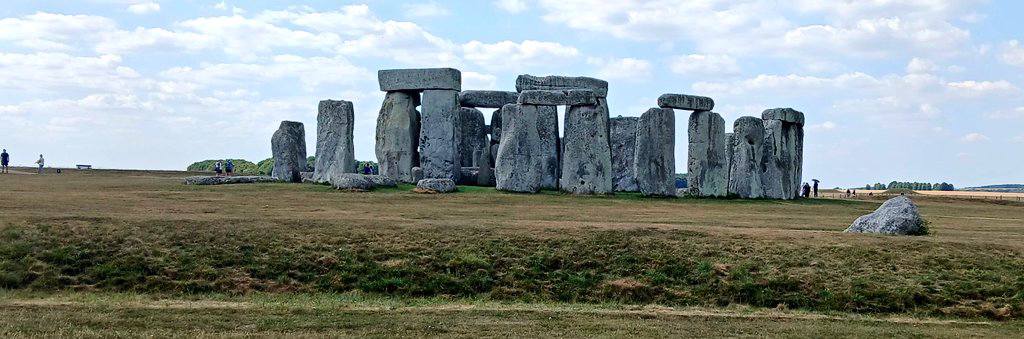
The scale of the achievement that is Stonehenge is breath-taking.
It’s so beautiful and represents so much achievement in so many ways, at a time where things were so much more arduous.
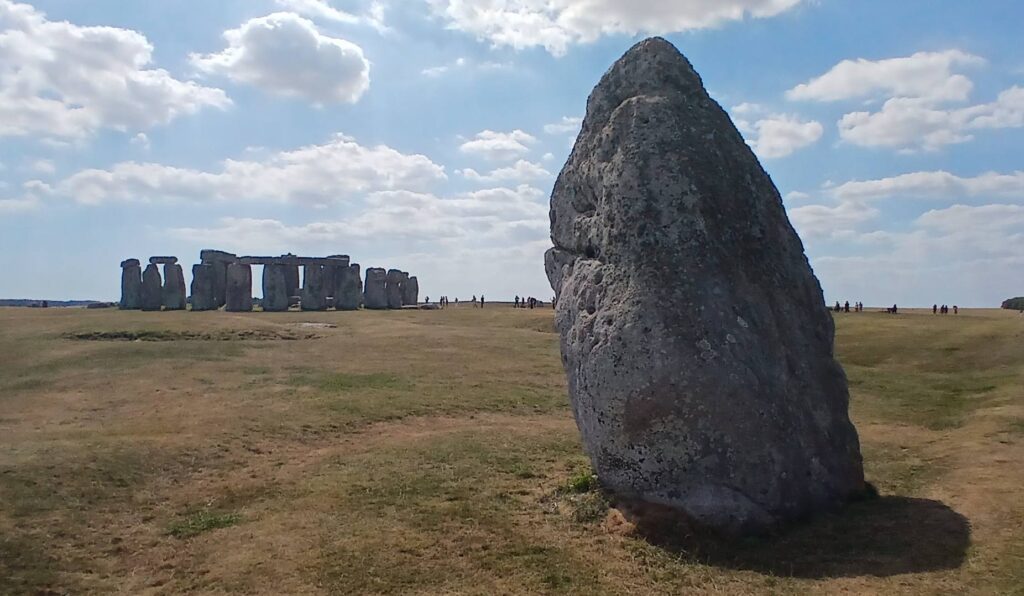
Looking from the heal stone to Stonehenge
This iconic structure, dating back to the Neolithic period, is a clear sign of its builders’ sophisticated capabilities.
Its precise alignments with solstices and equinoxes show its creators had a deep interest in astronomy. The monument’s fascination has lasted through centuries, notably during the Renaissance and Enlightenment.
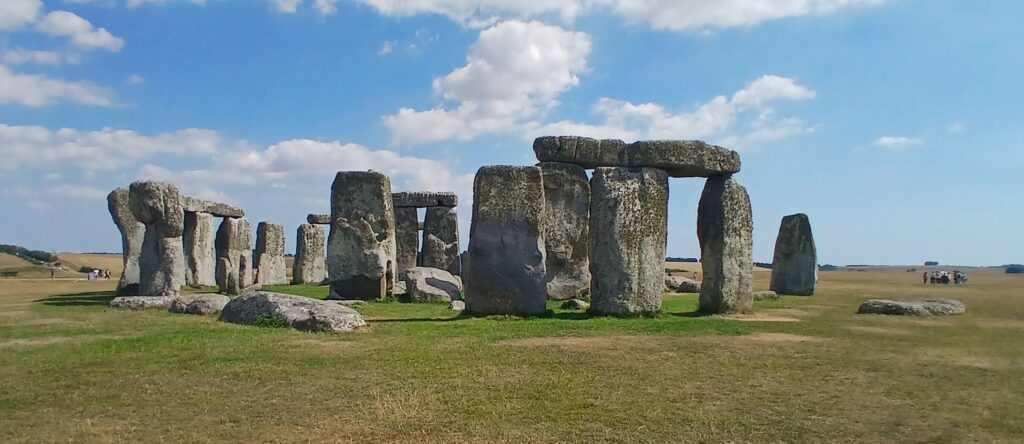
Stonehenge, in the drought of 2025
Figures like Inigo Jones, the celebrated architect, carried out some of the earliest detailed studies of Stonehenge in the 17th century. Jones, approaching Stonehenge with a classical perspective, suggested its layout followed Roman geometric principles, highlighting an early appreciation for its underlying mathematical order.
Later, in the 18th century, William Stukeley, a pioneering antiquarian, conducted extensive surveys of Stonehenge. Stukeley’s meticulous work not only documented its astronomical alignments but also explored the sacred geometry he believed was part of its design. Both Jones and Stukeley, despite their different ideas, saw that Stonehenge was a result of sophisticated planning. It showed an advanced understanding of both celestial mechanics and geometric principles, far beyond what was often thought of prehistoric societies at the time.
Their work began to uncover the intricate relationship between the monument’s shape, its celestial functions, and its precise spatial arrangements.
For us at Soulton Hall, Stonehenge has particular significance, especially given the work on the Soulton Long Barrow, which began ten years ago.

Soulton Long Barrow in its landscape
Our project draws direct inspiration from Neolithic architecture, serving as a contemporary communal space that honours the legacy of these ancient builders. Like the creators of Stonehenge, the farmers of the Neolithic era were intimately connected to the land and its cycles.
Our work with the Long Barrow respectfully acknowledges their ingenuity and profound relationship with their environment.
The construction of the Soulton Long Barrow, much like its ancient predecessors, involved significant effort and a deep respect for historical methods. It provides a physical link to the engineering and intellectual traditions that culminated in magnificent structures like Stonehenge.
The continuing study of Stonehenge, from the pioneering efforts of Jones and Stukeley to modern archaeology, reinforces the idea that these prehistoric peoples were master mathematicians, engineers and astute observers of both the earth and the sky.

The Summer solstice sun reaches into Soulton Long Barrow at sunrise
