

The sanctuary knocker on the north door of Durham Cathedral remains one of its most evocative symbols—a reminder of a time when reaching that heavy threshold meant immediate safety and refuge.
Yesterday Tom Holland @holland_tom became the first Bede Librarian at Durham Cathedral🙌
At Evensong yesterday Tom knelt by Bede's tomb in the Galilee Chapel and was inaugurated as Bede Librarian. pic.twitter.com/BLBjk54hkF
— Durham Cathedral (@durhamcathedral) May 26, 2026
It is a fitting image to hold in mind when reflecting on the festival evensong for Saint Bede, a profoundly moving service where Tom Holland was made the Bede Librarian of Durham.

Looking Up In the Durham Cathedral Crossing
It was deeply emotional to see a significant public and scholarly historian being honored in a landscape that fits his work so perfectly. Seeing Tom, Sadie, and the community gathered together brought a powerful sense of continuity, making the seventh century feel entirely present. The service itself made magnificent use of the cathedral’s architecture, beginning in the crossing and nave before progressing into the Galilee Chapel, where the formal oaths of the new office were exchanged with the Dean.

Cuthbert remembered in Durham
There was a wonderful, light moment at the great font when Tom made a remark comparing historical struggles to modern ones. He noted that while the Saxon saints certainly endured immense privations to be translated to their final resting places, he had just survived his own version of a trial: enduring a dreaded rail replacement bus service from London in record-breaking heat.
The moment naturally made one think of how Chad and Erkenwald operated as colleges of the North, echoing the deep bonds that Cuthbert and Bede held in this landscape.
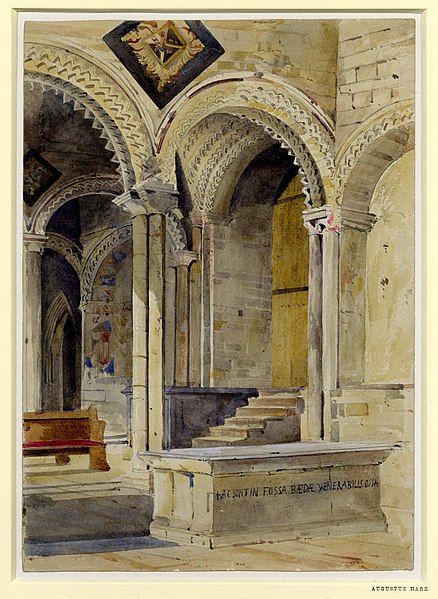
Watercolor by Augustus Hare of Bede’s tomb in the Galilee Chapel of Durham Cathedral. The inscription in Latin is as follows:
HAC SUNT IN FOSSA
BEDAE VENERABILIS OSSA.
(“Here are in a grave the bones of the Venerable Bede”)
Beside this final resting place lies a monument to C.A. Alington, a former Dean of Durham. For those visiting from Shropshire, this provided a pleasing regional connection; prior to his time at Durham, Alington served as the headmaster of Shrewsbury School.
His influence was felt directly during the service as the congregation sang his, on the day deeply fitting, words:
God, whose city’s sure foundation
Stands upon his holy hill,
By his mighty inspiration
Chose of old and chooseth still
Men of every race and nation
His good pleasure to fulfil.Here in England through the ages,
While the Christian years went by,
Saints, confessors, martyrs, sages,
Strong to live and strong to die,
Wrote their names upon the pages
Of God’s blessed company.Some there were like lamps of learning
Shining in a faithless night,
Some on fire with love, and burning
With a flaming zeal for right,
Some by simple goodness turning
Souls from darkness unto light.As we now with high thanksgiving
Their triumphant names record,
Grant that we, like them, believing
In the promise of thy word,
May, like them, in all good living
Praise and magnify the Lord.
After the service, there was time to immerse ourselves in Durham’s history at the museum, now housed in the old Great Kitchen beneath that spectacular eight-pointed star vaulted ceiling. Seeing the seventh-century artifacts displayed together in that space—the comb, the pectoral cross, the portable altar, and the engraved wooden coffin of Cuthbert—carries an immense historical weight. A walk through the library museum gallery and a climb up the tower completed the visit.
Reflecting back on that iconic north door, such a recourse was vital in an age when the law itself could be twisted into an instrument of abuse, weaponized to manipulate people into committing wrongs under the guise of legal obligation.
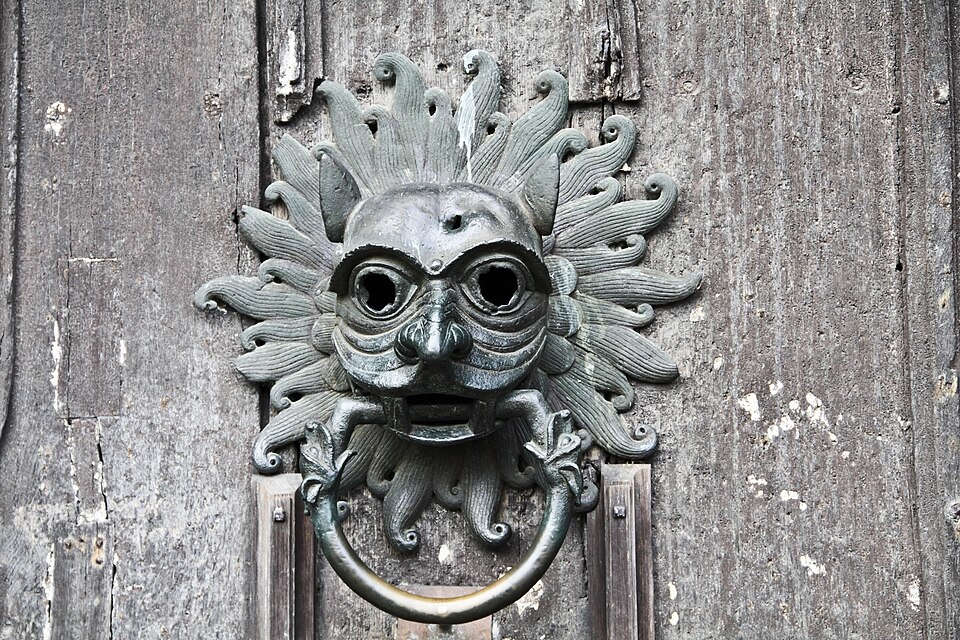
Sactuary
As Shakespeare frequently reminds us, legal frameworks and political systems are easily corrupted by those in power to bind individuals to wrongful acts that contradict their true ethical duties. This is not a gone idea; law is abused now just as it was then, remaining a tool that can instrumentalize people outside of their genuine moral responsibilities. The knocker is a painful reminder that people still need sanctuary, and that justice can still be perverted by the decree of an executive, the overreach of a modern state, or the violent claims of an ancient, contested soil.
Durham is full of these collisions between shifting political power and individual conscience.
Just across Palace Green sits Durham Castle, now a college of the university, where the chapel holds the portrait of Bishop Cuthbert Tunstall. Living through the reigns of four Tudor monarchs, Tunstall knew firsthand the swinging pendulum of a period when the law was used to inflict retrospective punishment. His portrait perfectly captures this struggle to survive changing regimes: his hands are clenched together, where he originally held a Catholic rosary. Under the shifting tides of the era, the beads were painted out to appease Protestant zeal, painted back in when a Catholic monarch took the throne, and eventually painted out once again under Elizabeth I—leaving his empty hands to survive the ideological storms.
The day ended on an excellent note, filled with useful interregional conversations and a brief, private catch-up with Tom.
