

From Rhombic Dodecahedrons to Reformation Screens: A Journey Through Tudor Symbolism
Yesterday, we made a return visit to Little Moreton Hall, a Tudor masterpiece a short drive away in the Cheshire countryside.
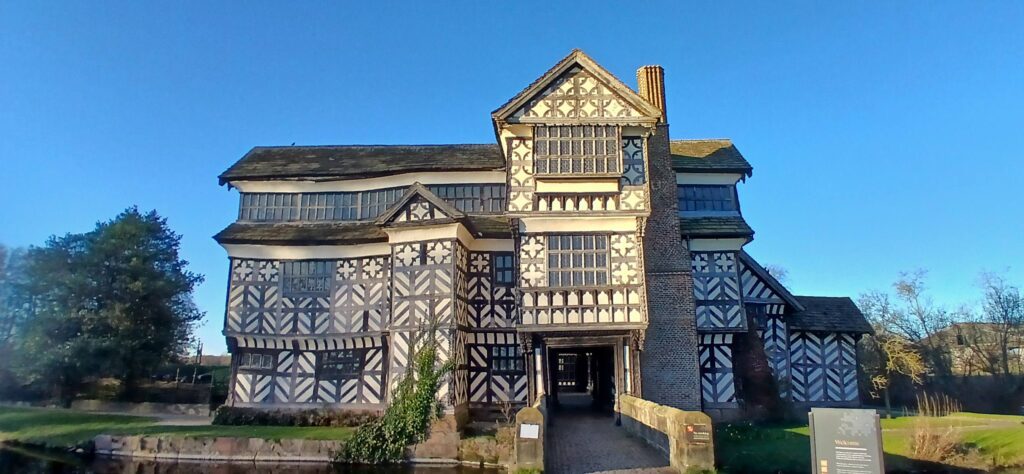
Little Moreton Hall, neighboring the manor of Rowland Hill’s mother’s family.
This house, slightly post dating Soulton, is an emphatic expression of the English Renaissance era’s fascination with embedding mathematical allegories for harmony which draw on classical ideas in design. Recently this has been explored in the context of Soulton via the scholarship of James Wenn which focuses on Old Sir Rowland Hill’s interest in the rhombic dodecahedron.
For us, the connection to Little Moreton Hall runs deeper: Sir Rowland Hill’s mother’s family hailed from the neighbouring manor, which adds a personal layer to our experience.
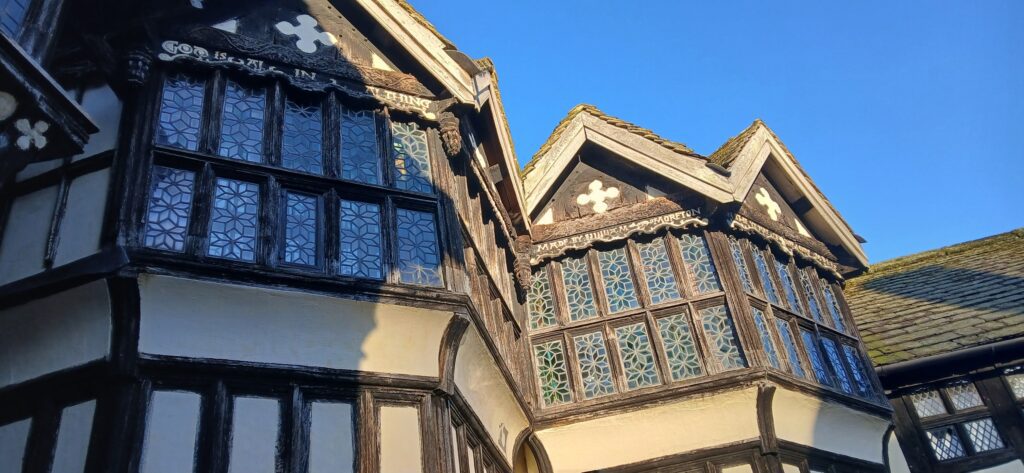
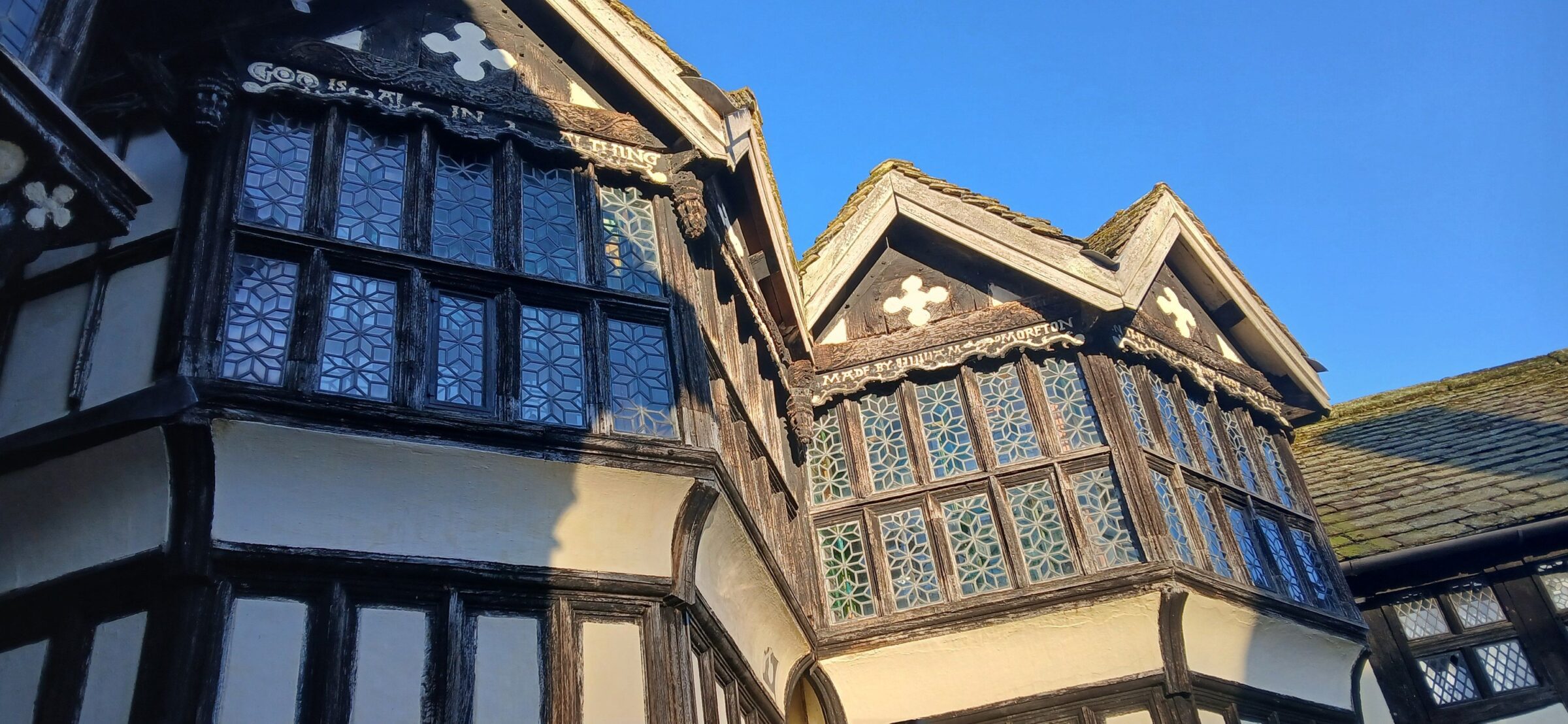
Little Moreton Hall glazing: Octograms of 8 lozenges, referencing the ‘As You Like It’ dance.

The Soulton Dancing Pavement, showing The Dance, which features in AS YOU LIKE IT
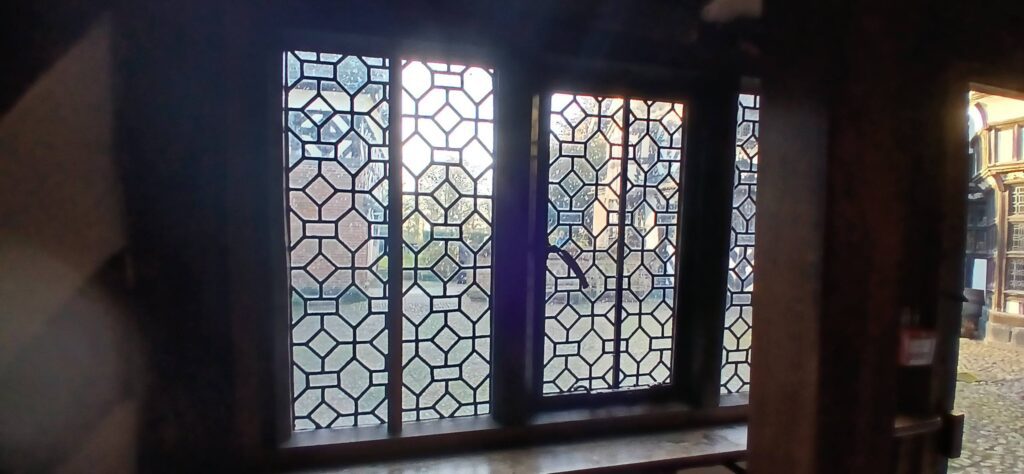
Geometric glazing in the Little Moreton Hall
The mathematical harmony at Little Moreton Hall is most evident in:
- the intricate glazing,
- the precise timber work, and
- the meticulously crafted paneling.
These elements speak to a deep understanding of geometric principles.
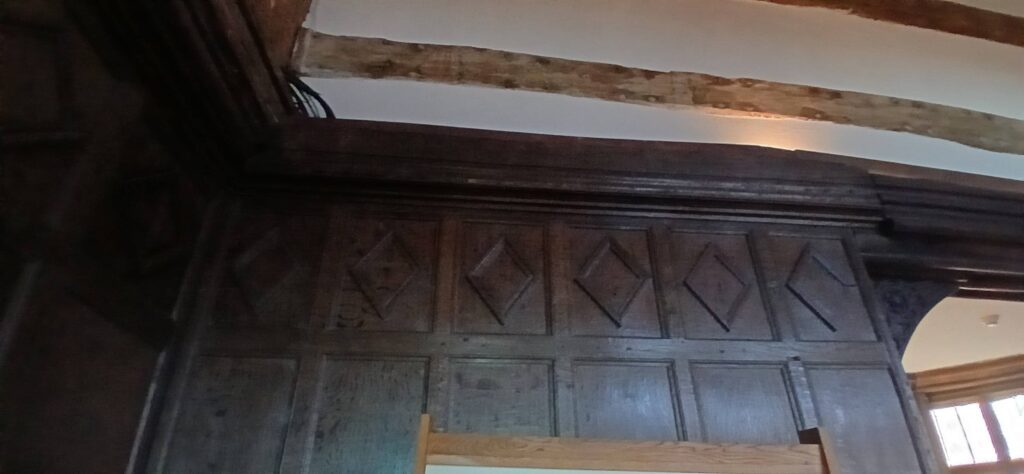
Detail of the Great Hall panelling, featuring tilted square designs
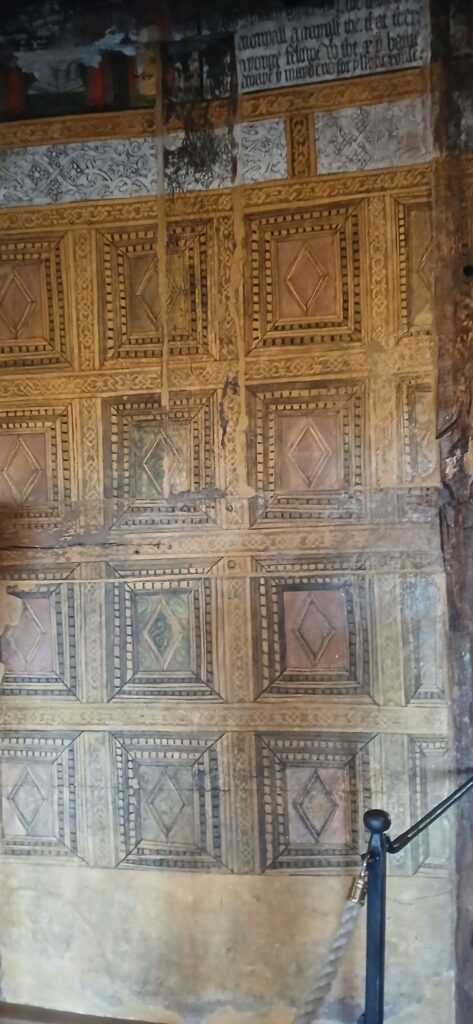
Tilted squares on wall paintings
Walking through the Long Gallery, one is immersed in an atmosphere of intellectual curiosity.
The intricate plasterwork celebrates Robert Recorde, a pivotal figure in English mathematics.
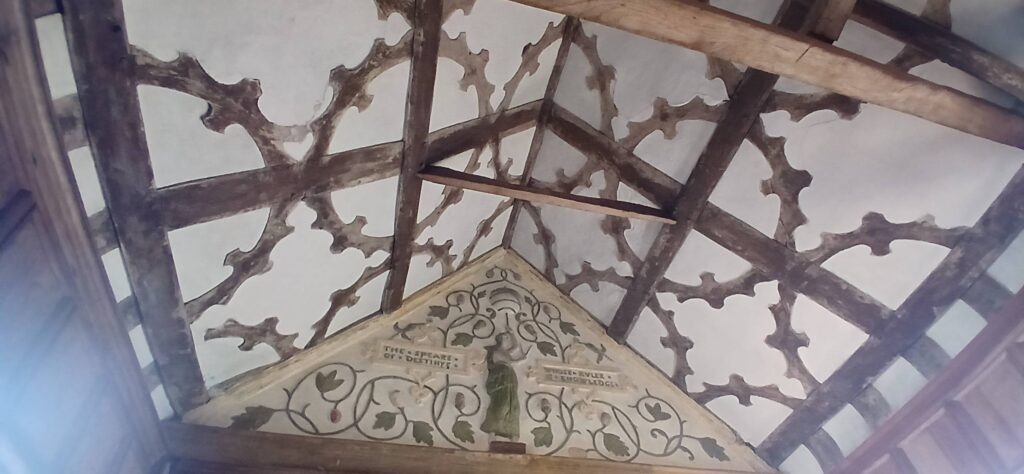
Plaster rendering of Destiney – are these circles in the ceiling, with 8-fold divisions, interested in The Dance of Harmony in As You Like It?
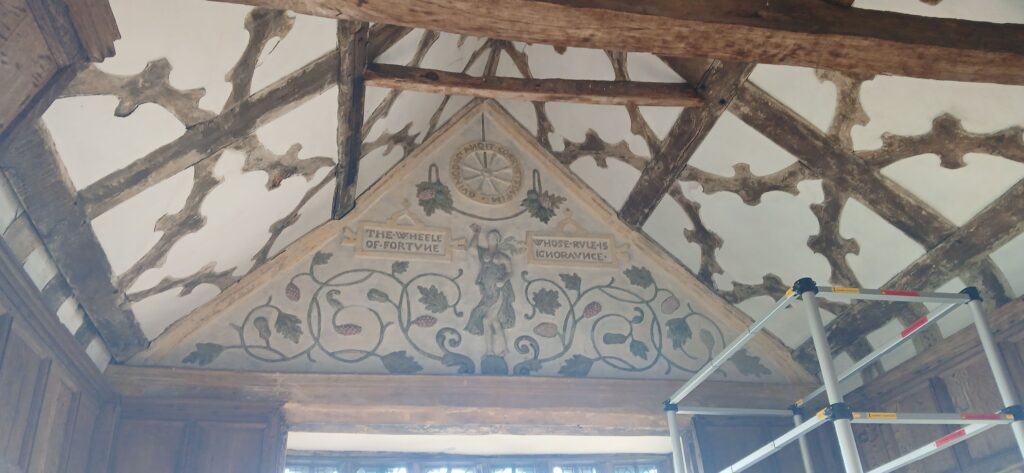
Plaster rendering of Fortune
His diverse works, from the foundational Grounde of Artes to the ground-breaking Whetstone of Witte—introducing the equals sign—attest to the household’s deep engagement with learning. The gallery’s artistic depictions of Destiny and Fortune extend this intellectual exploration, visually presenting the Renaissance debate between free will and predestination. This tension, the conflict between personal agency and fate, is a recurring theme in Renaissance thought, famously articulated this critique of blaming misfortune on the stars in Shakespeare’s King Lear:
This is the excellent foppery of the world, that when we are sick in fortune (often the surfeits of our own behaviour) we make guilty of our disasters the sun, the moon, and stars, as if we were villains on necessity; fools by heavenly compulsion; knaves, thieves, and treachers by spherical predominance; drunkards, liars, and adulterers by an enforced obedience of planetary influence; and all that we are evil in, by a divine thrusting on. An admirable evasion of whoremaster man, to lay his goatish disposition on the charge of a star!
This Long Gallery echoes the dual Long Galleries of Soulton Hall, extending beyond mere leisure.
While often interpreted as spaces for recreation, they primarily functioned as display areas for artefacts intended to cultivate virtue—a form of applied psychology. These displays, including family virtue narratives, portraits of philosophers, and collections of books, served to prompt virtuous contemplation. Crucially, such spaces also signalled the house’s status and the owner’s education, demonstrating suitability for advancement within the Tudor state. By showing intellectual and virtuous pursuits, these galleries reinforced the shared values and harmonious aspirations of the Tudor project to fellow travellers, as they saw it.
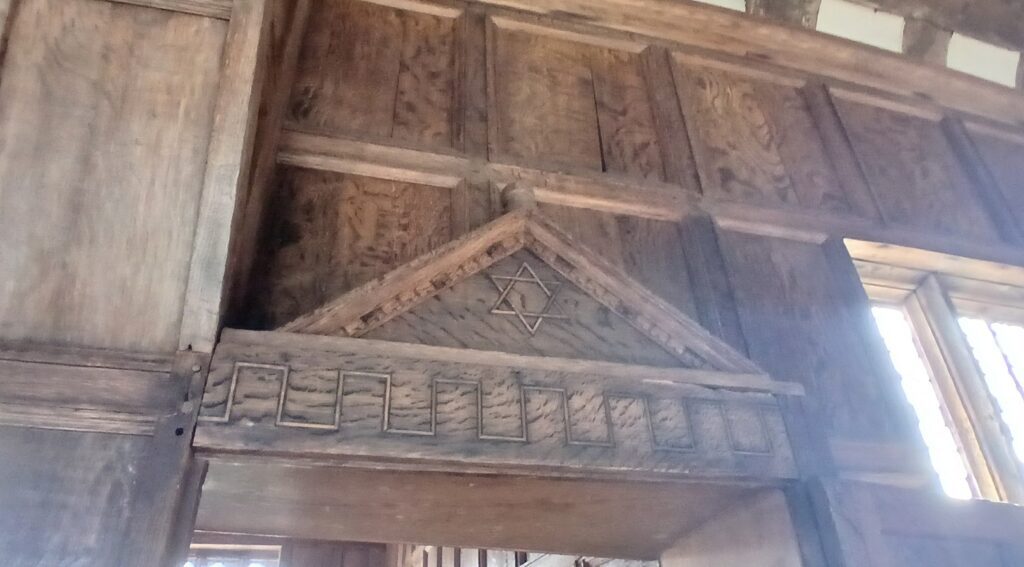
Architectural feature: A possible confluence of mathematics, biblical scripture, and Platonic interest in the rhombic dodecahedron.

Notice similar ideas expressed in the original roof scape of Soulton Hall. Scholarly reconstruction of Soulton Hall in accession created by James D. Wenn and James R. Syrett of Byrga Geniht Ltd for Soulton Hall in 2024.
Within the Long Gallery, an intriguing detail above a doorway reveals a triangular pediment adorned with a hexagon and star motifs. This combination suggests a familiarity with the Holy Almandal, a concept linked to the Book of Ezekiel. We consider that it may be an application of ideas in the research by James Wenn, where this architectural element also points to an expression of an understanding of Ezekiel which appears to have been part of the intellectual currents of the period and is happening at Soulton.
It was the chapel that truly resonated with us.

Interior view of the Reformation-period chapel in Little Moreton Hall, note the window glazing
The intact tabernacle screen at Little Moreton Hall served as a stark reminder of what we lost at Soulton. It brought into sharp focus the devastating impact of the incident at Soulton, where our own prayer room’s screen was ripped out by NFU Mutual following a water escape around 2004: without our consent, and without the oversight of a heritage expert, they effectively deleted a significant historical feature of our listed building.
Here, a rare survival of a Reformation-period chapel, likely Protestant in its origins, allows people to unlock the the religious shifts of the 16th century. It mirrored, in a way, what we once had at Soulton Hall, and must now set to in restating. Fortunately, we salvaged pieces of the original screen from the disposal skip. While simple in design, featuring unadorned timber and a limewashed finish, it formed an integral part of the room’s somber and contemplative atmosphere. These salvaged pieces will be invaluable in a dedicated restoration effort.
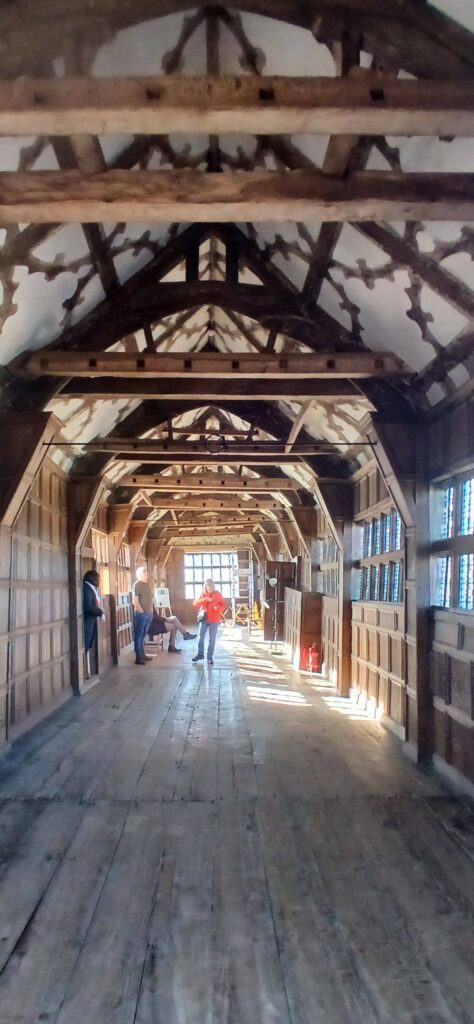
The Moreton Hall Long Gallery
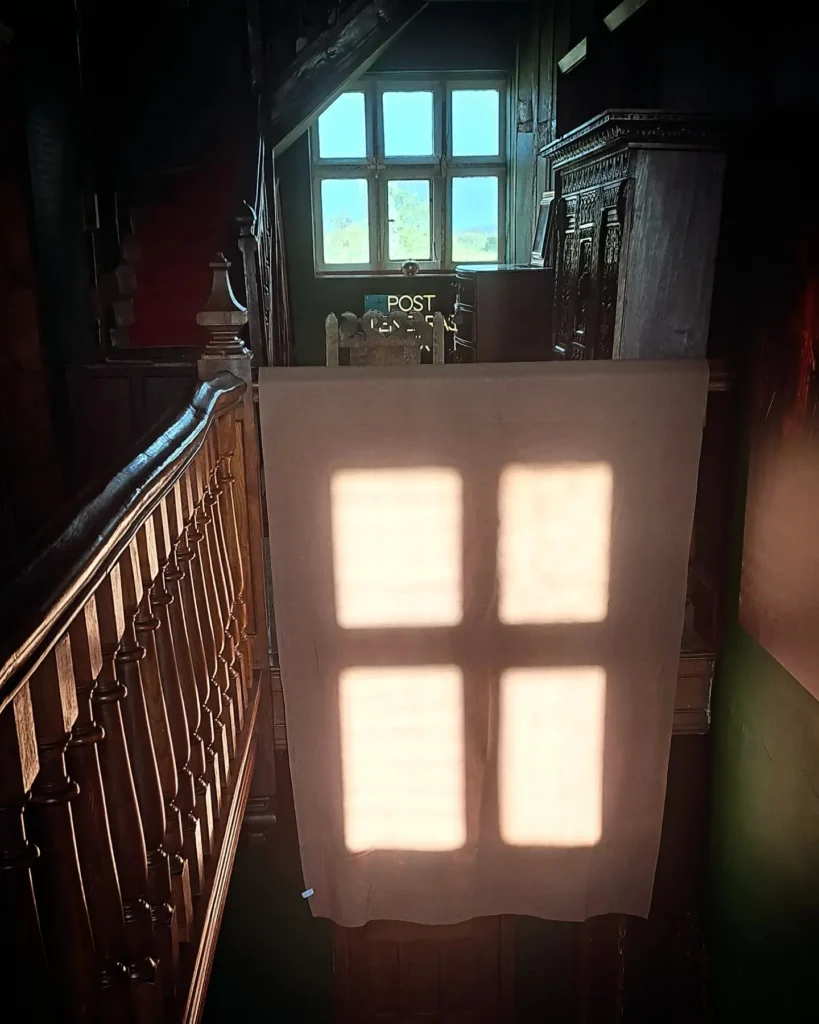
One of the galleries in Soulton Hall – showing and Easter light effect
We also noted the intriguing mounds surrounding the manor, a feature that calls back to the ancient mound at Soulton.
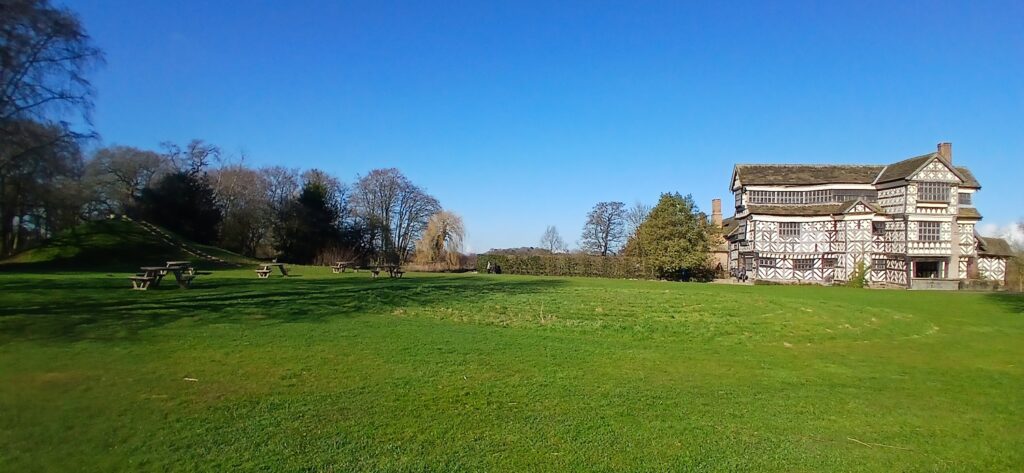
A C16th mound (one of two) at Little Morton Hall (left) – a high five with the C12th Soulton one?
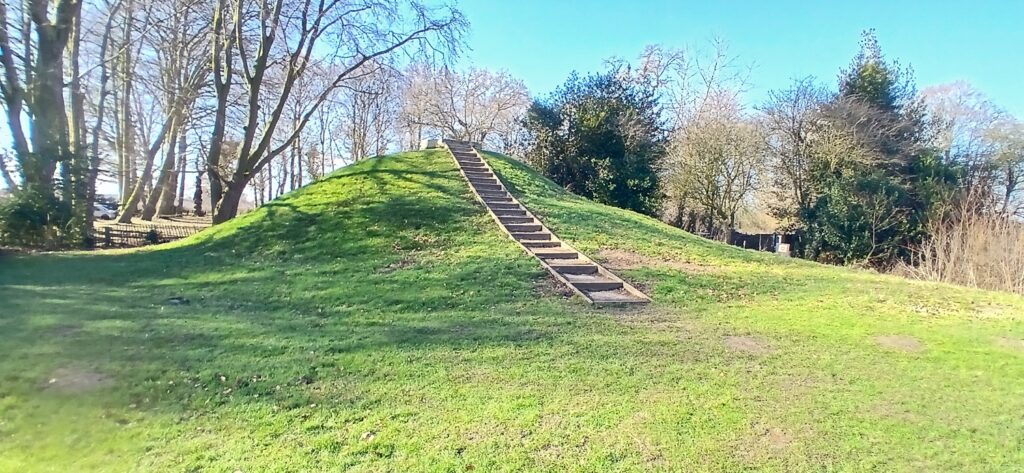
A close look at the mound outside the moat – these are a common C16th feature, Francis Bacon builds one in Gray’s Inn – why?
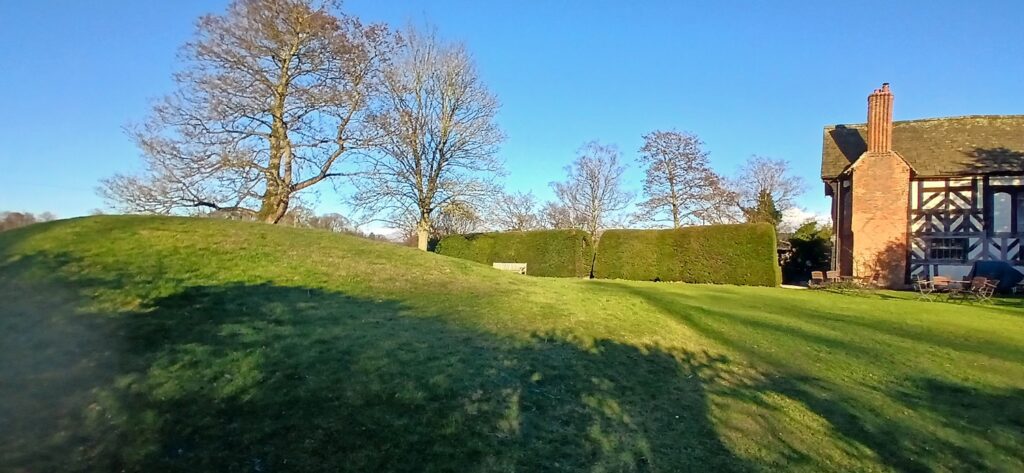
Little Moreton Hall’s Other Mound
It’s fascinating how these subtle landscape features connect us across time and space. Adding to the sense of history and association, from the manor, one can see the ruins of a castle, a reminder of the turbulent past that shaped this region.
This experience underscores the fragility of our heritage. The survival of Little Moreton Hall’s chapel is a precious gift, a window into the past. At Soulton, we strive to reclaim what was unjustly taken, to restore the harmony and historical readability of our own prayer room.
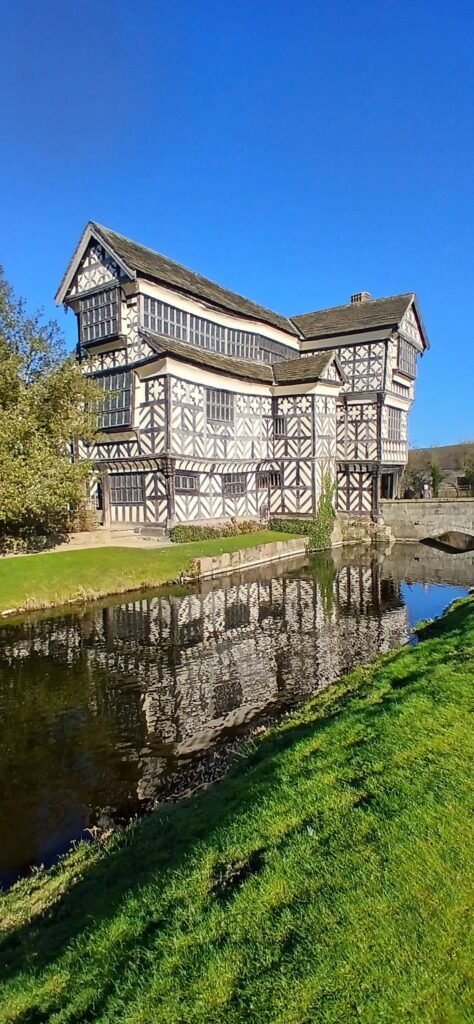
Little Moreton Hall and its moat
The wall paintings of Susanna and the Elders in Little Moreton Hall’s Little Parlour, dating from 1563-98, offer a fascinating glimpse into the household’s potential religious leanings.
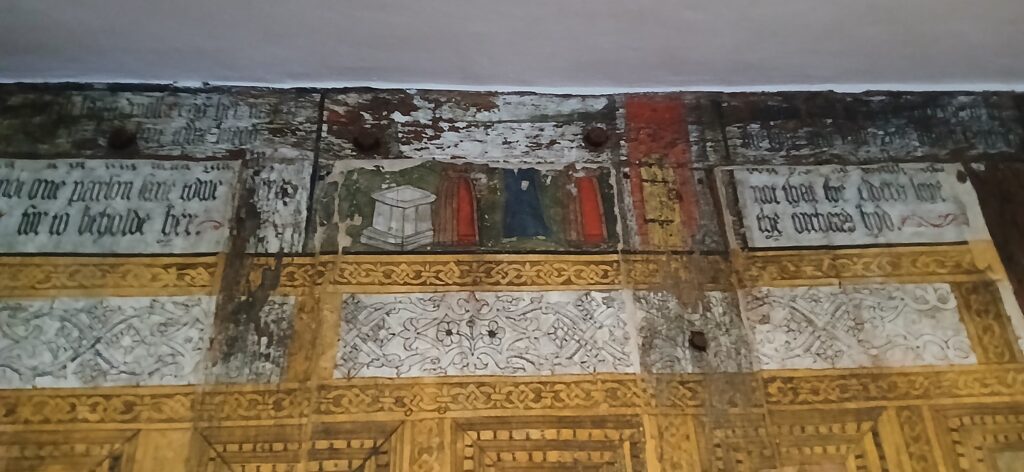
Wall paintings illustrating the Apocryphal story of Susanna and the Elders, Little Moreton Hall, painted 1563-98
Understanding the narrative’s complex canonical status is crucial. For Catholics, Oriental Orthodox Churches, and Eastern Orthodox Churches, Susanna and the Elders is part of the Book of Daniel. However, Protestants, including those within the Church of England during the Tudor period, placed it within the Apocrypha, viewing it as non-canonical, though still edifying. The narrative’s absence from the Jewish Tanakh and early Jewish literature further underscores this divergence.
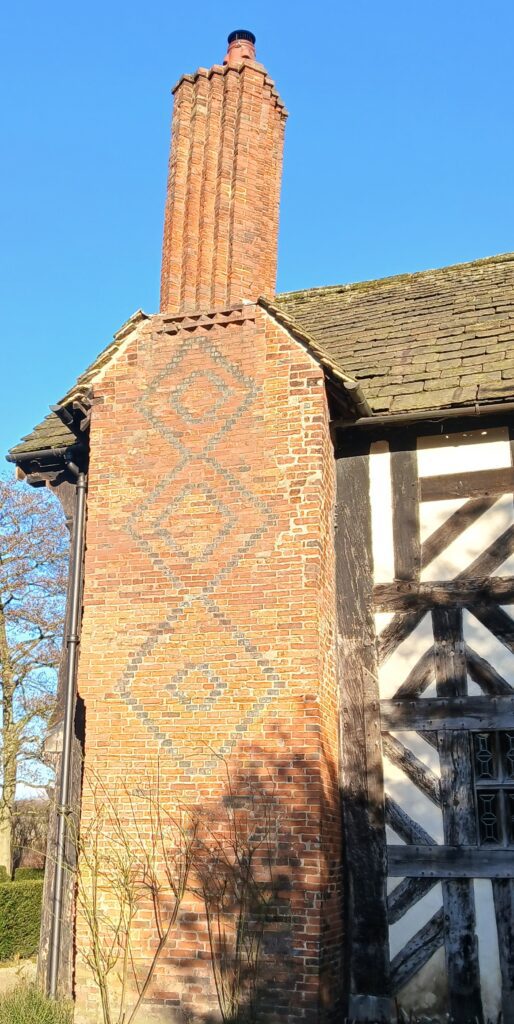
Diaper brickwork at Little Moreton Hall. Similar patterns at Soulton Hall have been linked to the Jewish Sephirot and the rhombic dodecahedron, suggesting potential symbolic significance here as well
Therefore, the prominent display of this story at Little Moreton Hall suggests a household that likely aligned itself with, or was significantly influenced by, Protestant perspectives on scripture. While Catholics considered the story divinely inspired, the deliberate inclusion of an Apocryphal narrative in a domestic setting points to a potential embrace of Protestant interpretations, which emphasized the moral and didactic value of such texts. This choice becomes a significant marker for scholars seeking to understand the religious identity of the household and the broader religious landscape of Tudor England, showing a possible divergence from traditional Catholic norms, and a lean towards the reformed thinking of the time.
********
A visit to Little Moreton Hall is more than a step back in time; it’s an invitation to engage with the very essence of Tudor intellectual life.
This remarkable building, echoing the ideas and explorations we’ve uncovered at Soulton, sis an amazing expression of that era’s profound curiosity.
Beyond its architectural splendour and immense charm, Little Moreton Hall offers a tangible connection to the complex mathematical and philosophical concepts that shaped Tudor thought. The intricate details, from the geometric brickwork to the symbolic wall paintings, are living classroom, simplifying complex ideas and revealing the powerful ways in which Tudor minds sought to understand the world.
We warmly encourage you to experience Little Moreton Hall first-hand, to witness the tangible legacy of this extraordinary period and to discover how it can illuminate the intellectual connections we are exploring at Soulton.
It’s a journey into the life of the Tudor mind, a journey you won’t ever forget.
********
It’s crucial to remember that the Renaissance codes and symbols we explore—these intricate patterns and allegories—function as learning technologies. They are tools designed to train the mind and unlock socially valuable perspectives. Their true worth lies in their ability to expand our understanding and foster critical thinking. Access to these codes does not inherently elevate one’s personal worth or make one superior. Instead, they offer a pathway to intellectual growth and a deeper appreciation of the complex ideas that shaped the Renaissance, ultimately empowering us to contribute more meaningfully to our own communities.
