

“We shed as we pick up, like travellers who must carry everything in their arms, and what we let fall will be picked up by those behind. The procession is very long and life is very short. We die on the march. But there is nothing outside the march so nothing can be lost to it. The missing plays of Sophocles will turn up piece by piece, or be written again in another language. Ancient cures for diseases will reveal themselves once more. Mathematical discoveries glimpsed and lost to view will have their time again. You do not suppose, my lady, that if all of Archimedes had been hiding in the great library of Alexandria, we would be at a loss for a corkscrew?”
― Tom Stoppard, Arcadia
In Tom Stoppard’s masterpiece, Arcadia, we are introduced to the remarkable young genius, Thomasina Coverly.
Living in the early 19th century, Thomasina is a true prodigy, grappling with mathematical and scientific concepts that are centuries ahead of her time.
She is fascinated by iterated algorithms and the intricate patterns of nature, essentially stumbling upon the foundations of fractal geometry long before the field was formally recognized.
Most poignantly, she begins to intuit the Second Law of Thermodynamics, the principle that governs the universe’s slide into disorder, famously explaining it by observing that:
When you stir your rice pudding, Septimus, the spoonful of jam spreads itself round making red trails like the picture of a meteor in my astronomical atlas. But if you stir backwards, the jam will not come together again. Indeed, the pudding does not notice and continues to turn pink just as before. Do you think this is odd?
― Tom Stoppard, Arcadia
Despite her breath-taking intellect, Thomasina’s work is tragically lost to time.
Her brilliant insights are confined to notebooks and scraps of paper.
They are only to be rediscovered centuries later by academics poring over her family’s country house papers.
The play’s central tragedy is that her genius was marginalized by the very moment in which she lived—an era that simply did not have the framework to understand her ideas, and certainly didn’t expect them from a young woman.
This has paroles with a real-life visionary who faced a very similar fate: Ada Lovelace.
Born in 1815, Ada was the daughter of the poet Lord Byron, but it was mathematics and science that truly captured her mind. She collaborated with Charles Babbage on his Analytical Engine, a theoretical mechanical computer, but it was Lovelace’s own notes that were truly revolutionary. In them, she outlined an algorithm to compute Bernoulli numbers, a work now recognized as the first computer program.
Like Thomasina, Ada Lovelace was a trailblazer whose ideas were largely overlooked in her own time.
She was a woman in a male-dominated field, and the full significance of her contributions was not truly understood until long after her death. Both women were pioneers whose intellectual contributions were dismissed or marginalized by the norms and expectations of their age.
Fortunately, times have changed. It wasn’t until much later that women were formally given the opportunity to study at institutions like Oxford. Lady Margaret Hall (LMH), one of the first women’s colleges at the university, was founded in 1878, a pivotal moment in the fight for female access to higher education. This historical link is particularly relevant to Soulton Hall, which has its own relationship with LMH, providing a bridge between the past struggles for women’s education and the present.

Some early victorian graffiti in the 1830s Soulton Hall accounts books, some from children at the time the pavements was put in
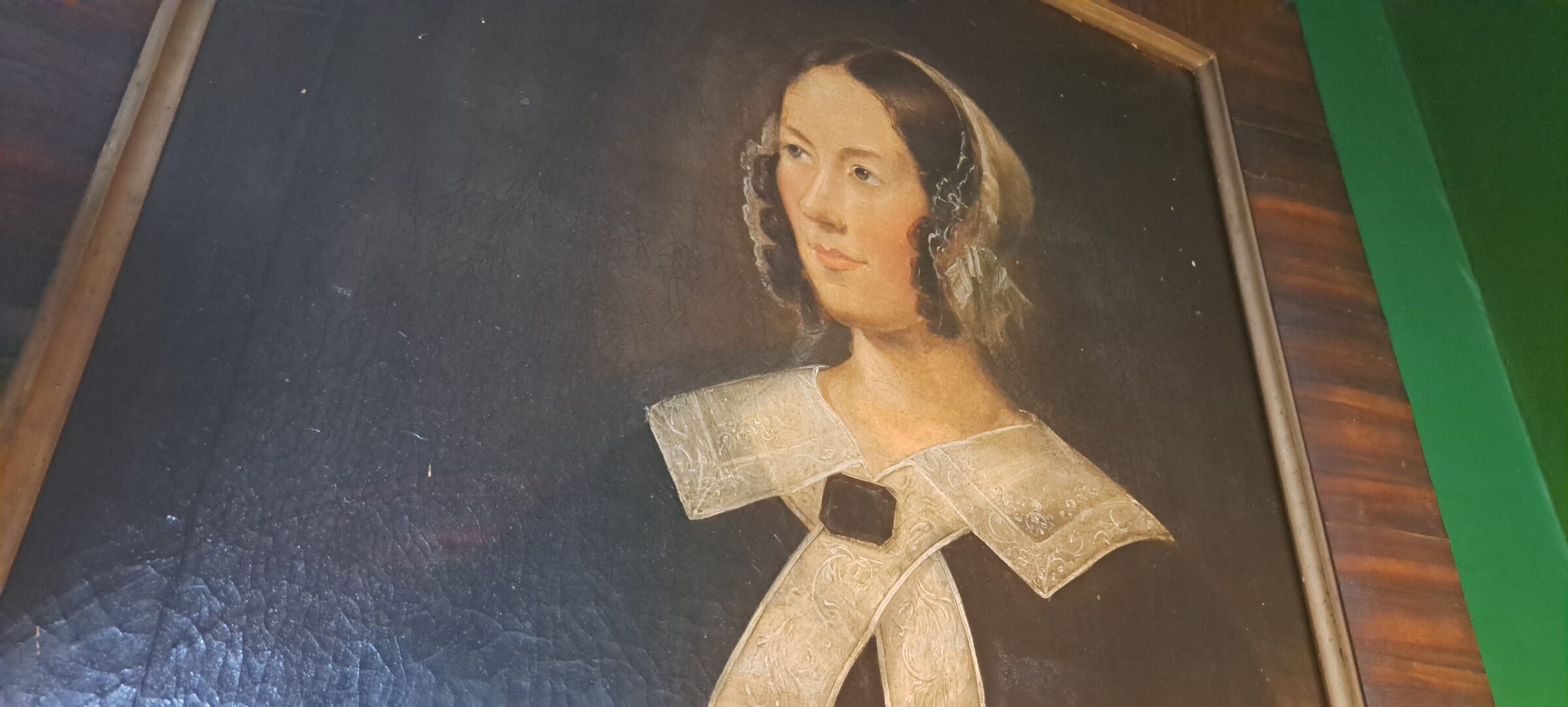
This connection brings us to Hannah Deakin of Soulton.
Like the fictional Thomasina, Hannah Deakin is also a historical prodigy.
A real-life Thomasina, she was exploring complex mathematical concepts back in 1847—the very same ones we have been discussing.
Hannah’s genius extended even further, into elite geometry and higher-dimensional spaces, ideas not formally explored in scholarship for many years after her work. We can only unlock it all because of her fiendishly clever dancing pavement, seen below.

The famous Soulton Dancing Pavement
As brilliant, defiant female pioneers of maths and ideas, both Hannah and Thomasina were not fully noticed in their own time.
The full extent of what Hannah unlocked is only now being seen by looking at the papers and artifacts she left behind.
********
This journey through the lives of these brilliant women leads us to a remarkable, high-profile exhibition that will set out these very ideas. Starting soon in Essex, the exhibition “Number in Time and Space: Exploring Plato’s Fifth Element” will be on display at The Minories in Colchester.
From Wednesday, August 20th to Sunday, August 31st, 2025, you can explore the forgotten culture of England through a unique mix of genuine antiquities, contemporary sculpture, and digital projection. It’s a rare opportunity to see these timeless mathematical and philosophical concepts brought to life, offering a tangible connection to the lost and recovered genius we’ve discussed.
Click Through for more on the Exhibition: Number in Time and Space: Exploring Plato’s Fifth Element

“Number in Time and Space” a BYRGA GENIHT Ltd. show
