

The Lost Theatre Cockpit at Court: A Glimpse into Henry VIII’s Ambitions Roof that pre-dates Old Sir Rowland’s Lost Lantern upon Soulton
In recent times, there has been renewed interest in the original, lost, roofscape of Soulton Hall.
There was a pyramidal roof at Soulton Hall when it was originally constructed by Sir Rowland Hill. We instructed our consultants, BYRGA GENIHT to help us shed new light on this intriguing architectural feature.
To some people, unfamiliar with the internal clues that inform the reconstruction, as well as the codes in use in the building, the idea of a pyramidal roof may seem unconventional. It is important for such people to consider the innovative spirit of the Tudor era and the bold architectural statements that were often made: Hampton Court Palace itself has also lost some of its lively roofline, and what is understood to have been first constructed at Soulton is not in any way as extravagant as the fantastical Nonsuch Palace.
Comparing Soulton Hall’s proposed design to its more extravagant contemporaries highlights its relatively conservative nature.
Let us therefore do so.
The Cockpit at Court
The Cockpit at Court was a remarkable structure from the reign of Henry VIII, which was part of the Place of Whitehall. Initially built by Henry VIII for cockfighting, it was later transformed into a private theatre by Inigo Jones.
One of its most distinctive features was its lantern roof, a complex architectural element that predates the lost roof of Soulton Hall and is clearly more complex than the perhaps timid reconstruction .
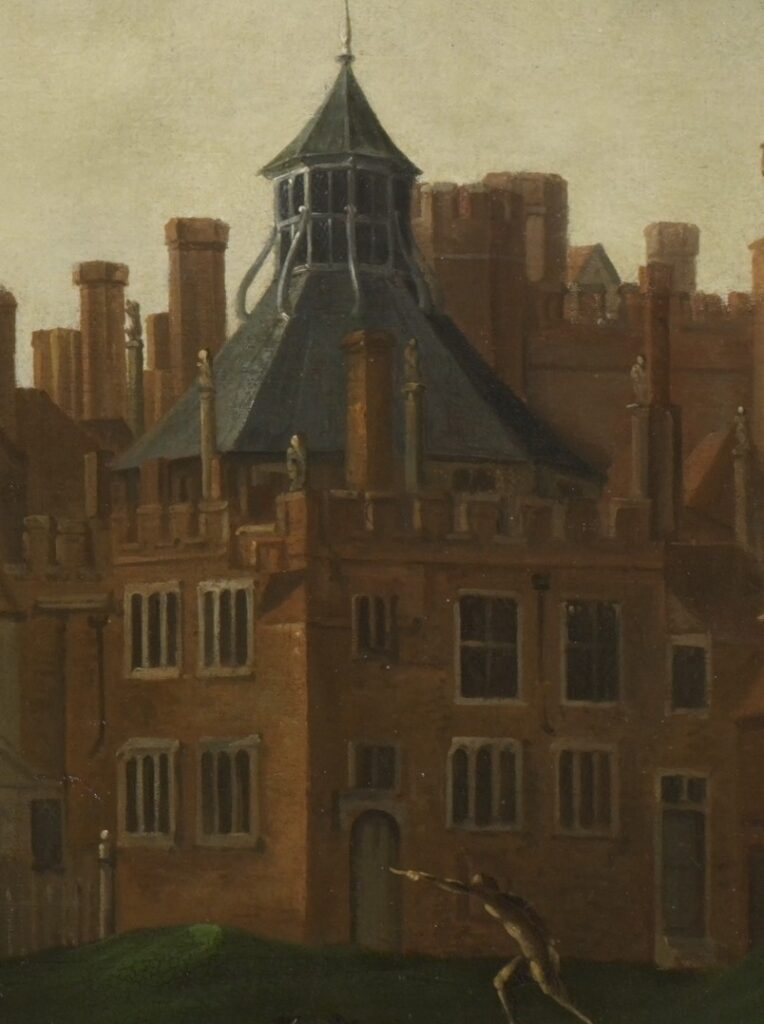
“A testament to Tudor ingenuity: The Cockpit at Court, featuring a pioneering lantern roof that paved the way for architectural advancements like Soulton, close up of the building as shown in Palace of Whitehall from St James’s Park (by Hendrick Danckerts, see caption of last image)
In 1629, Inigo Jones redesigned the Cockpit for Charles I as a private venue for court masques.
Following the Interregnum, the Cockpit reopened under Charles II in 1662, with Samuel Pepys among its notable patrons. The Great Fire of Whitehall in 1698 devastated much of the palace, but the Cockpit, along with the Banqueting House, survived. William III subsequently moved his residence to St. James’s Palace, and the Cockpit site was repurposed for government offices and other buildings. The building housed various government departments over the centuries, including the Treasury, the Foreign Office, and the Privy Council. Today, the site is occupied by the Cabinet Office.
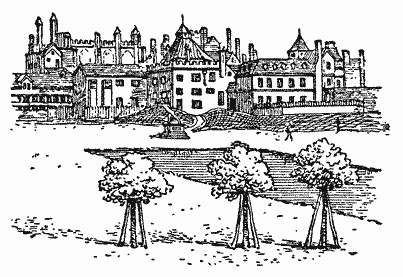
Cockpit-in-Court from an engraving by Mazell in Pennant’s London, reproduced in the London Topographical Record (1903)
The architectural complexity of this older Tudor building highlights the relatively simple design posited for Soulton Hall in 1560.

Scholarly reconstruction of Soulton Hall in accession created by James D. Wenn and James R. Syrett of Byrga Geniht Ltd for Soulton Hall in 2024.
These things being said, Bach-y-Graig’s later Soulton copy is more ornate than our consultant’s proposed design.

Bach-y-Graig, Tremeirchion
The early theatrical use of the Cockpit at Court, a building with visual connections to Soulton Hall, is suggestive of the wider influence upon drama of the legacy at Soulton.
********

Palace of Whitehall from St James’s Park by Hendrick Danckerts – Government Art Collection, Downing Street. Public domain. UK Government art collection. Currently this picture is shown in 10 Downing Street. It is from this image that the close up above is taken.
