

Old Sir Rowland Hill: A Life Dedicated to Harmony, Public Service and the Arts
Either 28 or 29 October marks the anniversary of the passing of Old Sir Rowland Hill.

Portrait of Sir Rowland Hill, Mercer’s Copy
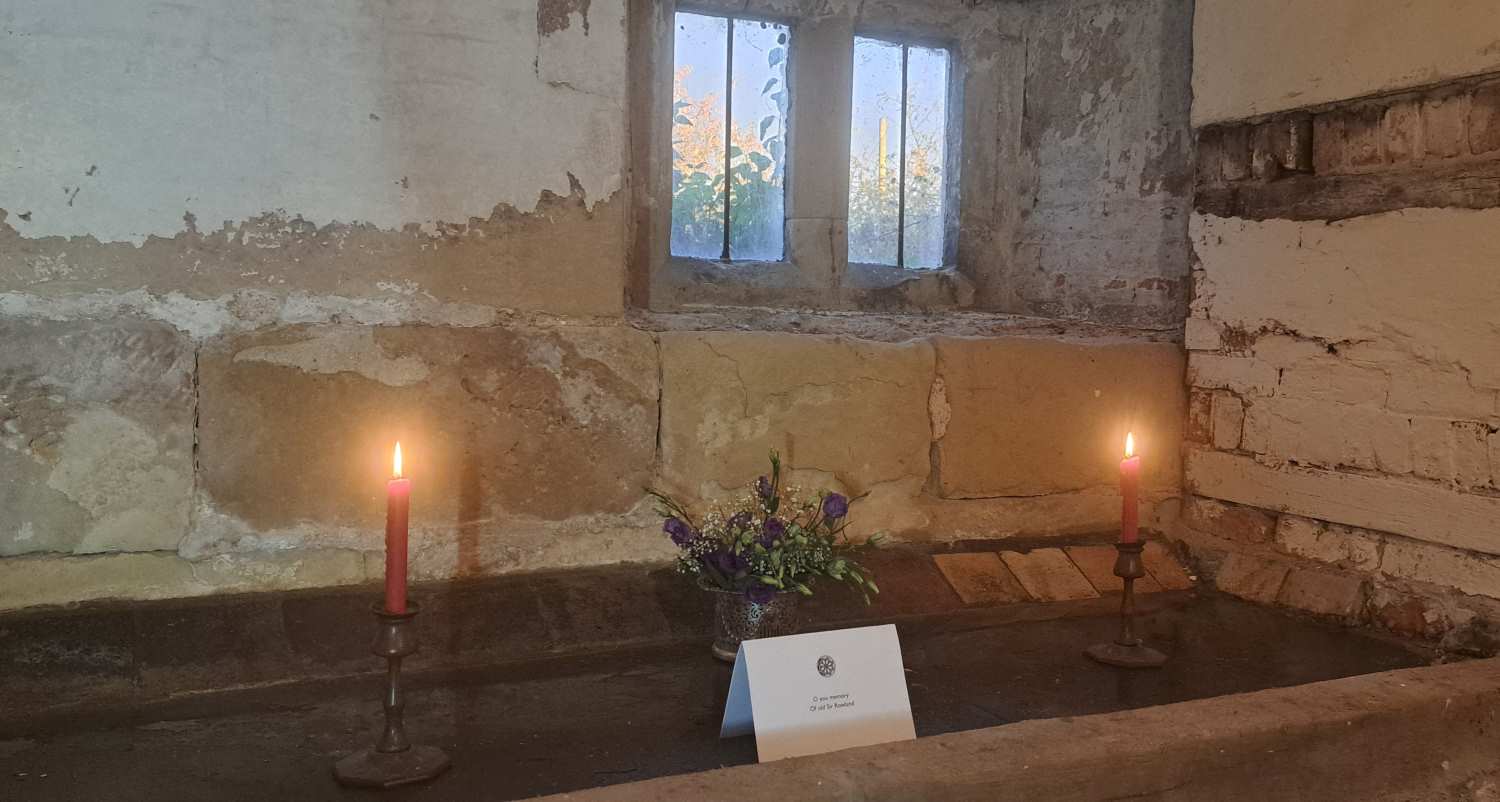
To honour his legacy, flowers are being left in the chapel at his house in Soulton.
My father loved Sir Rowland as his soul,
And all the world was of my father’s mind
Rowland Hill was a prominent figure in 16th-century England, leaving his mark on the worlds of theology, publishing, politics, civics and the arts.
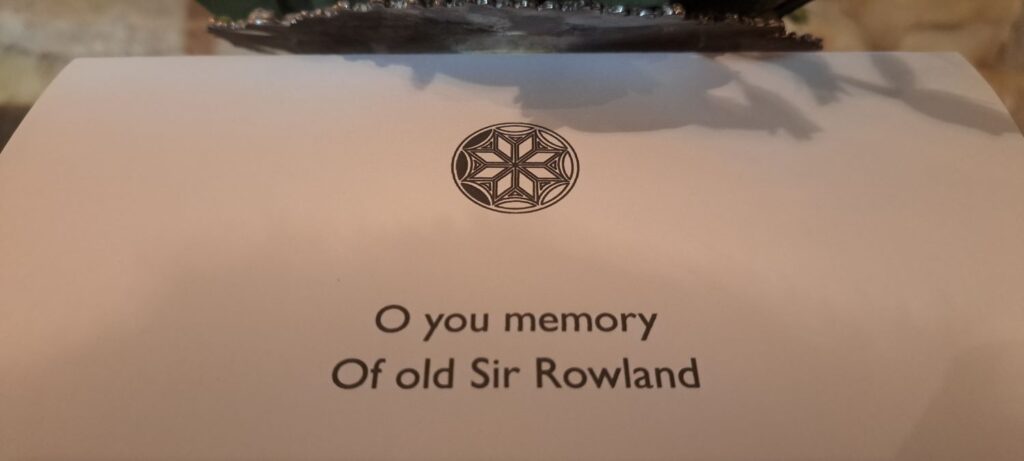
Card for Rowland Hill
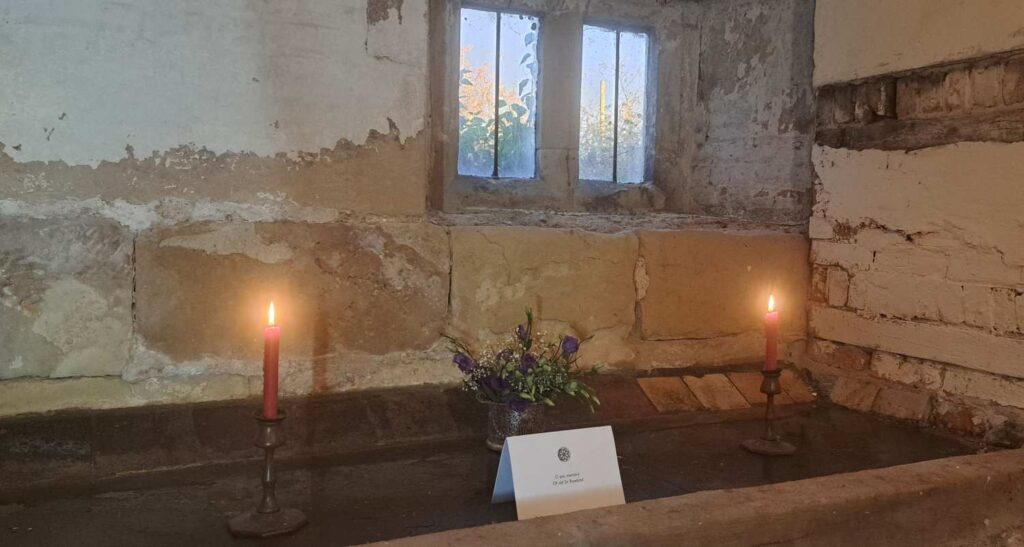
Flowers in the chapel at Soulton Hall, honouring Old sir Rowland Hill
********
His monument in St Stephen Walbrook was lost in the great fire of London: it was a life size stature in marble of him Holding Magna Carta.
In the 1790s a replacement was built, but in Shropshire on a 110 foot tall column (110 foot being twice the 55 foot of the Soulton Hall cube).
The text originally on the Hawkstone pillar which has his statue holding Magna Carta read as follows:
THE RIGHTEOUS SHALL BE HAD IN EVERLASTING REMEMBRANCE.-Psalm cxi. 6.
The first stone of this Pillar was laid by Sir Richard Hill, Bart. Member in several Parliaments for this County, on the 1st day of October, in the year 1795; who caused it to be erected, not only for the various uses of an Observatory, and to feast the eye, by presenting to it at one view, a most luxuriant and ex-tensive prospect, which takes in not less than twelve (or, as some assert, fifteen) counties; but from mo-tives of justice, respect, and gratitude to the memory of a truly great and good man, viz. Sir Rowland Hill, Knt. who was born at the family mansion of Hawkstone, in the reign of King Henry the Seventh, and being bred to trade, and free of the city of London, became one of the most considerable and opulent merchants of his time, and was Lord Mayor of the same, in the second and third years of Edward the Sixth, anno 1549 and 1550, and was the first Protestant who filled that high office. Having embraced the principles of the Reformation, he zealously exerted himself in behalf of the Protestant cause, and having been diligent in the use of all religious exercises, prayerful, conscientious, and watchful (as a writer of his character expresses it), yet trusting only in the merits of our Lord and Saviour, Jesus Christ, he exchanged his life for a better, a short while after the death of that pious young monarch, being aged nearly seventy years. For a considerable time previous to his decease, he gave up his mercantile occupations, that he might with more devotedness of heart attend to the great concerns of another world. His lands, possessions, and church patronage, were im-mense; particularly in the counties of Salop and Chester; the number of his tenants (none of whom he ever raised or fined) amounting to one thousand one hundred and eighty-one, as appears from his own handwriting. But his private virtues, good deeds, and munificent spirit, were quite unlimited, and extended-like the prospect before us, East, West, North, and South, far surpassing all bounds. “Being sensible,” saith Fuller (speaking of him in his “Worthies of England”), “that “his great estate was given him of God,” it was his desire to devote it to his glory. He built a spacious church in his own parish of Hodnet, and likewise the neighbouring church of Stoke, at his own expense. He built Tern and Atcham Bridges in this county, both of hewn stone, and containing several arches each. He also built other large bridges of timber. He built and endowed several Free Schools, particularly that of Drayton. He made and paved divers highways for the public utility. He founded exhibitions, and educated many students at both Universities, and supported at the Inns of Court others who were brought up to the Law. He was the unwearied friend of the widow and the fatherless. He clothed annually three hundred poor people in his own neighbourhood, both with shirts and coats; and in the city of London he gave £500 (an immense sum in those days) to St. Bartholomew’s hospital, besides (saith Fuller) £600 to Christ Church hospital. He also gave most liberally to all other hospitals, and at his death bequeathed £150 to the poor of all the Wards in London. He had no children, but his relations and kinsfolk were numerous, who all partook largely of his bounty, both in his lifetime and at his death. He constantly kept up a great family household, where hi maintained good hospitality. Many resorted to him for his wise and salutary advice; and none who came to him were ever sent empty or dissatisfied away.
Go and do thou likewise, as far as thy ability will permit, without injury to thy own relations.
To suffer such a character to sink into oblivion, would be in the highest degree ungrateful, as well as injurious to posterity, for whose imitation it is held up.

Rowland Hill Monument, Hawkstone Park
