

Soulton Hall boasts a remarkable door case, not just for its beauty, but for its surprising link to the heart of British politics. Added to Old Sir Rowland’s house of the 1550s in 1668 (celebreating the refounding of the English constitution after huge trauma, as well as a happy marriage), it shares the same distinctive stone – Grinshill sandstone – as the famous black door of 10 Downing Street, the residence of the UK Prime Minister.
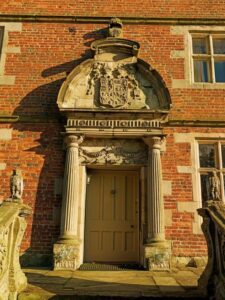
The striking 1668 stone tabernacle doorcase of Soulton Hall
While the distance between Whitehall and Grinshill (over 175 miles!) might seem impractical, the choice might hold a deeper meaning. Traditionally, it’s seen as a tribute to Sir Rowland Hill, a revered figure from Soulton. But there could be more to the story.

10 Downing Street Door Case – Shropshire stone is used in both cases: why?
Scholarship by James Wenn has shown how Soulton, with its use of Grinshill sandstone, represents many things, including Solomon’s Temple, a place of great wisdom. Thus, Grinshill itself becomes Solomon’s Quarry. And so, by using this specific stone, it becomes an allegory – to gain the wisdom of Solomon for their leaders, statesmen took stone from this special source. It is relivant that Pitt was a firm friend of the Shropshire Hill family.
Grinshill sandstone’s use goes back centuries, gracing everything from medieval abbeys to modern landmarks. It’s a material not just of practicality, but of symbolism. Soulton Hall’s doorway, then, becomes a silent testament to this connection between leadership and wisdom, a message carried in stone for over 350 years.
Reference to this is some times made in the House of Commons.
