


The autumn 2024 edition of the Historic House Association’s wonderful magazine is carrying an article about Old Sir Rowlands codes and his links with As You Like It. Many thanks to BYRGA GENIHT Ltd for the ongoing consultancy with the work set out in the article.
The text is shared below.
Setting the Stage
—
Tim Ashton’s family home, Soulton Hall, in Shropshire, contains traces of the intriging legacy of Sir Rowland Hill, a Renaisance patron, arcitect, and Shakespeareian muse.
—
Theatre and historic houses share some surprising connections. Wilton House, for instance, is understood to have been the venue for the premier of As You Like It, a play which is not only a light comedy but a meditation on statecraft.
This image depicts a scholarly reconstruction of Soulton Hall, highlighting its architectural elements inspired by the ancient theater of Epidaurus. The yellow lines trace these features, revealing the Rowland Hill’s homage to the renowned Greek structure.
But there are hidden figures who shaped this distinctive English tradition a generation before Shakespeare. My family have been looking more closely at the life and work of our forebear, Sir Rowland Hill (d. 1561) of Soulton Hall, our home in Shropshire.
We’ve uncovered a man of a more remarkable and complex influence than has been appreciated before now. It emerges that he has left unexplored mark on the works of William Shakespeare and a deeper cultural legacy besides.
Our discoveries began during the COVID-19 pandemic, when Soulton was the refuge of the National Youth Theatre.
Scholarly reconstruction of Soulton Hall in accession created by James D. Wenn and James R. Syrett of Byrga Geniht Ltd for Soulton Hall in 2024
Collaborating with James D. Wenn of the Byrga Geniht consultancy, a new perspective has emerged over the last two years which we have only now begun sharing.
Sir Rowland’s life unfolded during the tumultuous sixteenth century, a period marked by dramatic shifts in power and religious turmoil. Hill served as a statesman at the highest levels to a succession of monarchs Henry VIII, Edward VI, Mary I, and Elizabeth I. This remarkable feat hints at a man of exceptional adaptability and political astuteness. However, the nature of his work remained fogged in secrecy even, to an extent to his heirs because it was so dangerous, and because it went on to have such a profound (and controversial) set of impacts on history, from the Civil War to the American Declaration of Independence.
Beyond his well-documented role in publishing the Geneva Bible (the explosive translation that was supplanted by the Authorised or King James Version, which omitted marginal notes in the Geneva Bible that the King considered seditious) Sir Rowland oversaw the publication of a significant range of esoteric books: on mathematics, statecraft, medicine, theology, the discovery of America, history, law, and classics. These publications suggest a man deeply interested in elite knowledge and intellectual exploration.
The violent upheaval of the Reformation is easy to forget today. Many people from both sides fled the country, and hundreds of them were killed.
Buildings and cultural artifacts were destroyed wholesale.
Some exploited the turmoil for private gain, while civic life (such as education, health care, public works, and care for the needy) suffered and in some areas collapsed (themes well understood to be explored in Shakespeare’s drama).
It is during this time that we find our Old Sir Rowland hidden at Soulton, in the northernmost part of the Forest of Arden, playing a crucial role in safeguarding people, art, and artifacts.
He selfconsciously inhabited an identity of Renaissance magnificence, using his own wealth to plug gaps in social provision and encouraging others to join him.
The Last Harvest was part of Signal Fires. Credit & copyright: Helen Murray
At his ambitious building project, Soulton Hall (a conspicuous construction undertaking for an out-of-favour Protestant under Mary I), current scholarship is uncovering mounting evidence of hidden cyphers in the building. It is now being understood that the building encodes deliberatereferences to humanist concepts drawn from classical antiquity, geometry, philosophy, and scripture. Perhaps most exciting of these is the explicit conjuring (via Epidaurus, site of a famous theatre of Greek antiquity in the Peloponnese) of a theatre,completed by 1560.
It is fascinating to contemplate how Soulton Hall, under Sir Rowland’s direction, might have served as a refuge for books, objects, and individuals in danger.
Most important of these endangered people, another flood toward, coming to the ark, appears to be Mathew Parker: godfather of Elizabeth I and her first Archbishop of Canterbury, whose name is given to a vital collection of books at Corpus Christi College, University of Cambridge, which may have sheltered at Soulton.
Sir Rowland played a significant role in shaping the Elizabethan settlement or Golden Age. His political acumen, connections in Europe and beyond, and huge wealth, combined with his experience under widely differing monarchs, likely proved invaluable in navigating the complex political landscape of the time.
Perhaps the most intriguing aspect of the new research lies in Sir Rowland’s potential connection to Renaissance drama. Newly assessed evidence suggests that Sir Rowland was not merely a passive observer of the theatrical developments the generation before Shakespeare.
He was intimately involved in relaxing regulation of the artform, and himself commissioned theatrical activity on a vast scale, overturning royal prohibitions.
Going further, a compelling case can be made for Sir Rowland serving as an inspiration for the character of Old Sir Rowland in Shakespeare’s As You Like It a connection bolstered by the fact that Shakespeare and the real Sir Rowland were cousins, through Mary Arden.
Examination of Soulton Hall’s deeds reveals another intriguing link. The family of Thomas Lodge Jr., the author of Rosalynde: Euphues Golden Legacie (1590),
the source book for As You Like It, held the manor before Sir Rowland. This provides a definitive connection between Soulton Hall and the accepted source material for Shakespeare’s renowned play.There will be more to say as this work continues perhaps about the enigmatic Dance of Harmony that closes As You Like It, which holds further secrets; the choreography and potential symbolic meanings embedded within this dance appear to have survived.
We continue our work with great excitement!
Watch a recent lecture on the investigation into Soulton Hall’s secrets and connections at youtube.com/@ByrgaGeniht


********

Historic House Magazine cover, autumn 2024
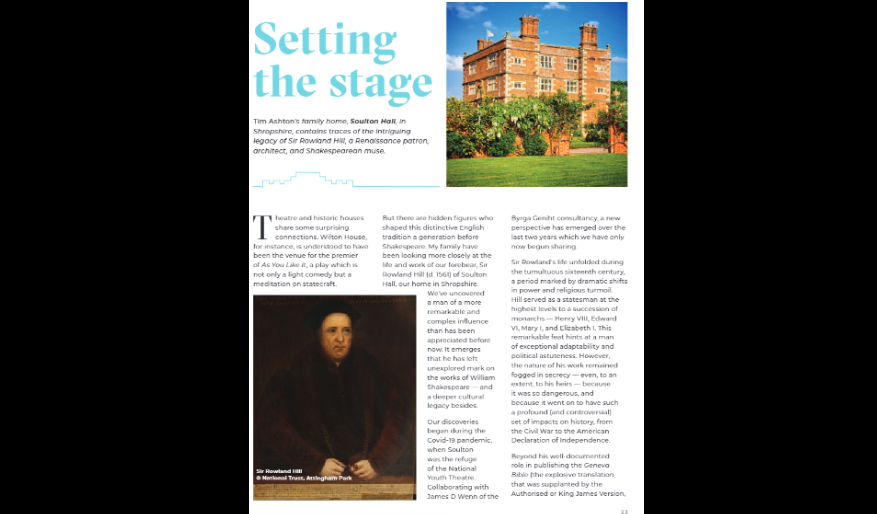
Article – Historic House Magazine
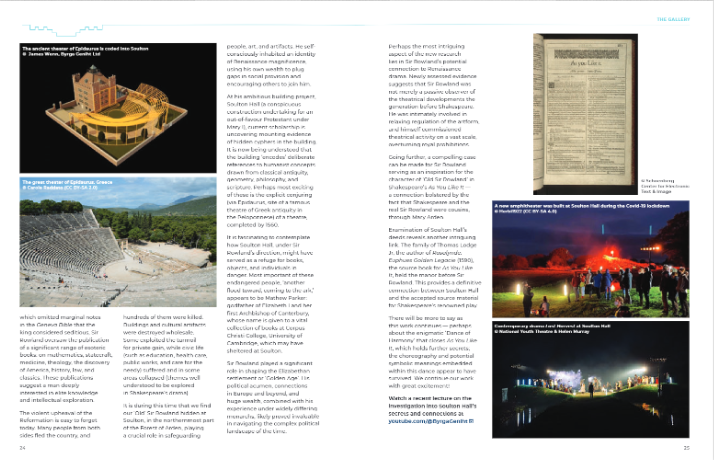
Article – Historic House Magazine
