

This week, billions of people will see King Charles III seated on England’s most important chair, the Edward I Coronation Chair at Westminster Abbey. He will be crowned by Justin Welby, 105th Archbishop of Canterbury, whose even older Cathedra Augustini (throne of St Augustine) at Canterbury also has a claim to the top spot, as it is the throne of the Church of England and Anglican Communion.
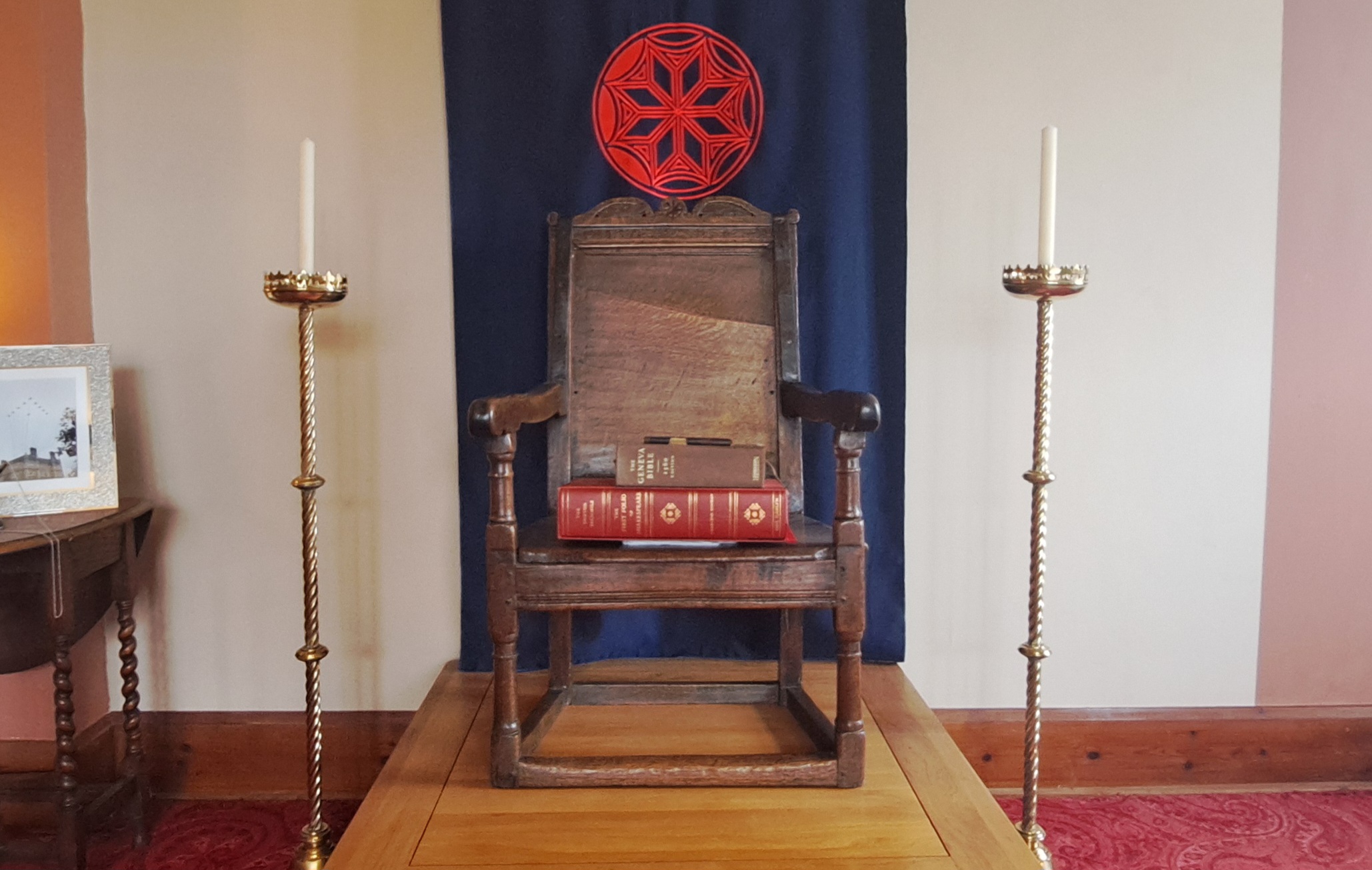
Visitors to Soulton Hall are fascinated to see our own Very Important Chair.

Old Sir Rowland Hill’s Chair of Estate.
The Tudor chair, made for Sir Rowland Hill (c. 1495-1561), the builder of Soulton Hall, is part of a set, along with a large table and one survivor of a pair of benches.

The C16th Justice Table of Sir Rowland Hill, who sat as a jusge in trials for treason
The Sir Rowland Hill Chair was the seat of office of an immensely active judge and statesman, who presided at critical inquests and even treason trials through the Tudor Period. Hill held court in this chair both as Sheriff of London and Lord Mayor, as well as a Member of Parliament at frequently the Warden, or head, of the powerful Mercers’ Company, who led the London guild system.

This sole survivor from a pair of benches once served Sir Rowland Hill’s attendants during Tudor court and state functions at his Justice Table
Hill was also an energetic governor of civic institutions in London’s new city-run hospitals (after the Dissolution of the Monasteries closed the old ones), and educational establishments such as the Grammar School at Market Drayton and the initial petitions to re-found Shrewsbury School.
Perhaps the most thrilling events to have unfolded from this chair were the hiding of Protestant culture during the counter-reformation of Mary Tudor. As ‘great occupier’ in Germany (a sort of de facto monopoly holder of English Rhine shipping), Hill sponsored the Geneva exiles, and was the publisher of the Geneva Bible, which was released to the English market on the accession of Elizabeth Tudor. This popular English language bible became the favourite of William Shakespeare, the Pilgrim Fathers, and Oliver Cromwell. For complex reasons, scholars now also believe that Matthew Parker, Elizabeth I’st Archbishop of Canterbury, who founded the Church of England, was hidden at Soulton during Mary’s reign. There is even a priest hide that visitors to Soulton can see in Sir Rowland Hill’s studiolo (private study)!
The Justice Table is distinctive for having a column of wood in the centre of one side of its base. This is a classic feature of mediaeval-style justice tables. It is there to stop an angry plaintiff or defendant taking a swipe at the judge’s legs with a sword! This column is shaped like an ancient Greek canister, and references the Mysteries of Eleusis which Sir Rowland Hill built into the architecture of the house. Scholarship by James D. Wenn has established how ancient Greek philosophy permeated Anglo-Saxon and mediaeval English culture right down to the time of Sir Rowland Hill, making this not so much a renaissance (rebirth), but a deep cultural continuity.
Part of this continuity is the eight-petalled rose flower on the Sir Rowland Hill Chair, which is a symbol that goes back all the way through Ancient Greece to the earliest days of agriculture and city-building in Mesopotamia. The twin of this flower, the Star, is seen in Soulton Hall’s famous dancing pavement, which is also a must-see when you visit.
Sir Rowland Hill’s collection of manuscripts and court documents were a hot prize during the English Civil War (part of the Wars of the Three Kingdoms, and connected to the Thirty Years War in Europe). Troops on both sides raided Soulton to secure key parts of the constitution. It was during this turmoil that the Sir Rowland Hill Chair was damaged, but was subsequently restored, like the kingdom, in the 1660s, when Soulton Hall also gained its iconic doorcase, which represents a new covenant.
In later centuries the chair continued to be used for local justice. It was from this chair that one of the last witch trials in England was thrown-out, ending that cruel and persecutory period of legal history. The ancient courtroom, which provided the model for the courts at Stafford, and ultimately the US Capitol, is also a part of your stay at Soulton Hall.
To end on a mystery! Sir Rowland Hill’s Chair features the great man’s chain of office inscribed into its pediment. Within each chain link are tiny letters cut into the wood. Can you decipher the code? So far it has baffled scholars and experts, but with a keen eye and the right light, the mystery is ripe for solving….

Old Sir Rowland’s sea chest
********
You may also be intersted in the Rowland Hill staircase.
