


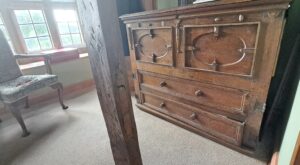
Soulton Hall still has Old Sir Rowland’s 1550s chair of estate, but that is part of a set, which also includes his Justice Table (which we are looking at in ths blog and is pictured below).

The C16th Justice Table of Sir Rowland Hill, who sat as a judge in trials for treason and in the City of London as Lord Mayor. Justice Tables, while often overlooked, are rare and fascinating artifacts that embody the history of legal proceedings. More than mere desks, they were potent symbols within the legal process itself.
Sir Rowland Hill’s Justice Table, a rare survivor of its era, offers a glimpse into this rich symbolic landscape.
You will notice how the Justice Table has a design on only one side, the front, and that that has got a central leg which has the destinctive canister design (which we will come to).
This table features a central leg on one side only, a detail often misinterpreted as purely aesthetic. In Tudor England, however, this design element held a significant symbolic meaning. Protection was paramount. The central leg acted as a barrier against potential sword attacks, a stark reminder of the dangers faced by those wielding legal authority.
It symbolized the power invested in the judge to ensure order and safety within the courtroom.
A closer look reveals another layer of symbolism – the worn rails on the table’s ‘back’ or working side. These are not mere signs of wear and tear, but a physical manifestation of the attendants who sat beside the justice at this table for centuries. The worn surfaces become a tangible link to the human stories that unfolded at this very table – a powerful symbol of the people who interacted with the justice system.
Historical records add another dimension to the symbolic significance of this table.
It served as a stage for landmark cases, like the dismissal of a witch trial as abusive in the late 1600s. This event highlights the evolving understanding of justice ofter Old Hill’s time and a turning away from an atmosphere of persecution. The table itself is a connection with that moment in Soulton’s story of which we are proud.
Additionally, we should not forget that Old Sir Rowland Hill sat in London on treason trials. In this way this table being in Soulton its symbolizes the weight and gravity of the matters in which this houshold has been involved in.
An intriguing detail about the justice table is its lowered height, a modification made at some point in history, which is repeated on the chair of estate.
********
Now let’s look at the linked items in this set and the rest of the house for connections.
Here is old Sir Rowland’s chair of estate, (follow the link for more information about it).

Old Sir Rowland Hill’s Chair of Estate, note the canister design on the legs and supporting the arms.It is usuful now to invite you to look at how all these items we are looking at show an interst in design motifs seen around the Eleusinian Mysteries, as you might notce by reference to the image below.

The design of the whole precinct is intended to evoke the Telesterion (ca. 435 – 421 B.C.), a sacred hall at Eleusis used for the annual initiation ceremonies for the cult of Demeter and Persephone known as the Eleusinian Mysteries. By Haris Christodoulou. CC
As well as these two items there is a bench (again showing the canister design) one of a pair, the other of which is lost from Soulton, possibly damaged when the chair was damaged in the C17th…

This sole survivor from a pair of benches once served Sir Rowland Hill’s attendants during Tudor court and state functions at his Justice Table
His sea chest (which is in his Studiolo) also survives.
Old Sir Rowland’s sea chest
*******
Sir Rowland Hill’s design vision extends beyond furniture. Consistent stylistic choices can be observed in other details.
Consider the paneling (discussed here).

An example of a tiny eight pointed star or flower in the Sir Rowland Hill panneling

Tudor paneling frieze with tiny eight-pointed stars.
Consider also the intricate plasterwork, ceilings (discussed here).

A Secret in the Plaster: This rough pomegranate hints at the hidden passions of Soulton Hall’s builder, Sir Rowland Hill.
And repeated in the remarkable staircase (discussed here).

The Sir Rowland Hill Staircase, from the single phase of construction pre 1560

Eleusinian Enigma on the Rowland Hill Staircase: Look closely at the eight balusters on this upper gallery. Each features a design reminiscent of Eleusinian canisters, hinting at Sir Rowland Hill’s fascination with the ancient mysteries. This part of the house is private.
*********
The above contains commercial consultancy outputs from BYRGA GENIHT Ltd.
