

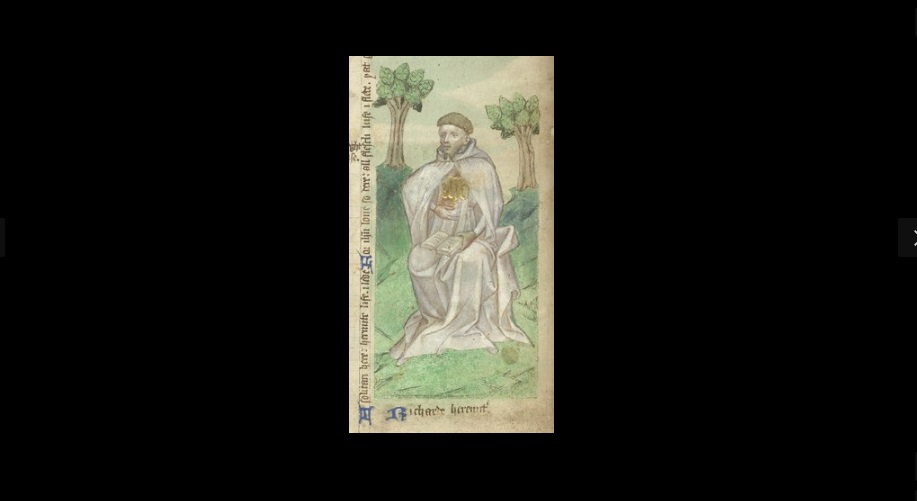
As reported in today’s Telegraph, a routine research project has turned into a significant literary find of the decade.
For centuries, a modest manuscript sat on the shelves of the Taylor Ancient Library at Shrewsbury School. To the casual observer, it was just another relic in a school collection famous for its “monastic things.” But this weekend, the world learned that it is actually a “lost” masterpiece: the only complete surviving copy of the original draft of Emendatio vitae (The Emending of Life) by Richard Rolle.
Rolle, a 14th-century hermit, was once a medieval superstar—a “neglected literary great” who, as the Telegraph notes, was more widely read in his day than Geoffrey Chaucer.
A “Bestseller” Lost to the Reformation
To understand the weight of this find, we have to look back at the Reformation. When Henry VIII dissolved the monasteries, England’s literary history was scattered to the winds. Books by “mystics” like Rolle—who wrote about the “sweetness of eternal love”—were often targeted for destruction or heavily censored to fit new Protestant standards. Until now, every known copy of this work was an abridgment. Scribes had scrubbed away Rolle’s creative, “unusual” language to make it more conventional. By identifying Rolle’s unique “literary fingerprints”—such as his invented word “melliphono” (sweet-sounding)—researcher Timothy Glover has restored the author’s original voice for the first time in over 600 years.
This discovery isn’t just a stroke of luck; it is part of a deep-rooted Shropshire tradition of preserving what the rest of the country discarded.
The county has long acted as a “safe harbor” for England’s textual heritage:
-
The Cotton Family: The legendary Sir Robert Cotton, whose collection founded the British Library (saving Beowulf and the Magna Carta), hailed from Wem and Alkington. His family was at the forefront of rescuing “monastic orphans” during the religious chaos of the 16th century.
-
The St Erkenwald Miracle: In 1757, the only surviving copy of the medieval poem St Erkenwald was rescued from a house in Shifnal just as a maid was about to use its parchment to light a fire. Like the Rolle manuscript, it was written in a North West Midlands dialect, anchoring it to this landscape.
-
The Shrewsbury Bibles: The school’s library itself is a fortress of Reformation history. It houses Bibles that were “difficult” in thier moment, alongside 12th-century Latin texts rescued from Buildwas Abbey.
The Rolle manuscript was gifted to Shrewsbury School in 1607, just as the dust of the Reformation was settling.
For over 400 years, it sat in the School’s possetion not fully understood..
As the Telegraph report highlights, this find reminds us that history is not always what we have always though and found in big national museums…
…sometimes, it is hiding in plain sight in a school library or some other place, protected by the places and institutions of Shropshire that refused to let the past be erased.
Reading this manuscript doesn’t just offer a new text; it restores the craft and creativity of a man who was once England’s most famous author, now finally returned to his original, “sweet-sounding” glory.
