

Love, Wit, and ‘Sermons in Stones’: A Valentine’s Reflection at Soulton Hall
“Hang there, my verse, in witness of my love…”
Orlando’s verses, hanging from the trees of Arden, capture a timeless human need: the vulnerable, unselfconscious expression of love. This Valentine’s Day, at Soulton, the birthplace of Shakespeare’s senior play on love, we’d like explore love through the lens of As You Like It.
The play is saturated with the language of love (the word is used over 160 times!), and offers a compelling context for understanding how this complex emotion intertwines with landscape and community.

Oliver, Audrey, Orlando and Phoebe. As imagined by Jacob Chandler.
Among Soulton’s “sermons in stones,” we can consider how love, in its myriad forms, finds sanctuary and space to develop in the natural world — within such a tranquil haven the initial precariousness and jeopardy can blossom into personal growth, which then strengthens the social bonds that allow it to flourish, creating a virtuous cycle of connection.

Silvius, Rosalind, Touchstone and Celia: 4 of the 8 dancers, as rendered by Jacob Chandler
Rosalind’s observation,
Love is merely a madness
finds expression in Orlando’s verses—a simple yet profound gesture, even in its goofiness, revealing the universal human need to share deep feelings and the vulnerability of such sincerity.

Rosalind: A name derived from rosa linda, “beautiful rose,” reflecting her beauty and the blossoming of love in the Forest of Arden. The rose is also a symbol for the dance that is done at the end of the play.
The earnest, romantic, and exposed act of publishing verses amongst the trees becomes a stage for Shakespeare’s literary playfulness in As You Like It.
Orlando’s verses, a touch clumsy in their youthful enthusiasm, are a playful echo of (even a gentle satire of) the less refined poetry in Lodge’s Rosalynde (1590), a major source for Shakespeare’s As You Like It. whoes boyhood and family are firmly connected to Soulton’s Arden setting as thier forest home away from London, before the arrival of their friend Old Sir Rowland Hill at this manor in the 1550s.
This intertextual resonance adds intrigue, as Jaques wryly observes
I pray you, mar no more trees with writing
love-songs in their barks.
Jaques’s cynicism is born of a personally damaging need to extinguish even the smallest spark of joy, a need readily apparent to the knowing audience. Orlando, his mind on love’s truth, not literary snark, offers a sharp reply to Jaques’s constant, conceited, and agonising superiority.
I pray you, mar no more of my verses with reading
them ill-favouredly.
The conversation between Jaques and Orlando becomes a battleground for competing views on love and wit. Jaques’s sharp tongue accuses Orlando of being preposterous. Orlando’s retort, dismissing Jaques’s cynicism as withering and embarrassing, leaves no room for misinterpretation:
I do desire we may be better strangers.
This playful sparring highlights the importance of genuine expression in matters of the heart. Just as love needs a fertile ground in which to flourish, so too does its expression need to be authentic and heartfelt.
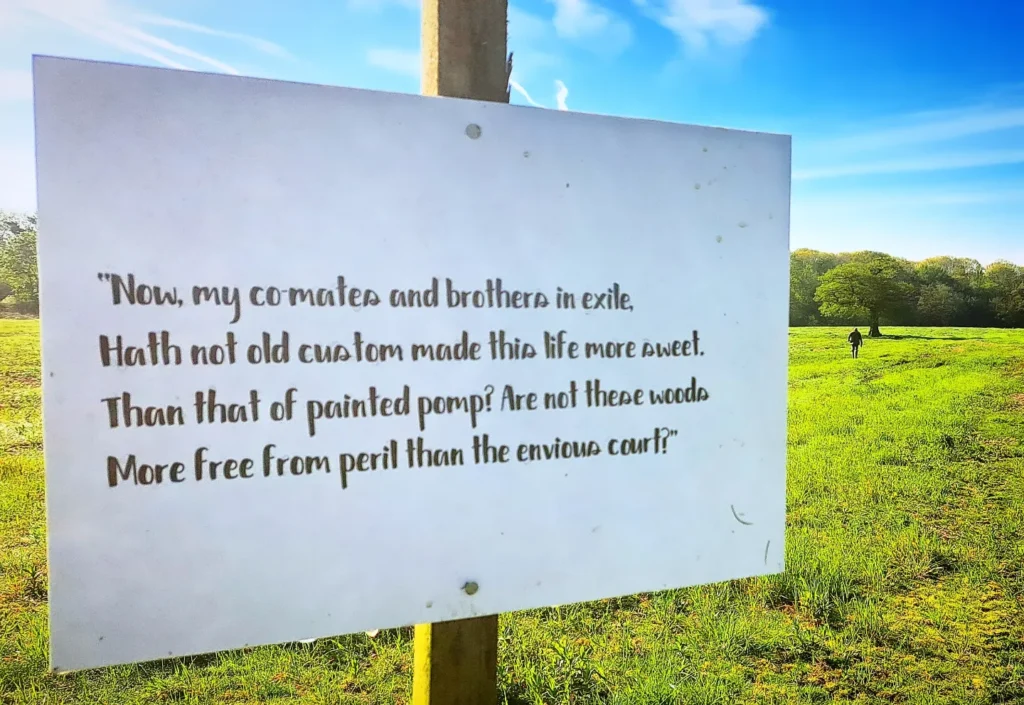
A sign with an AS YOU LIKE IT quotation in the Soulton landscape: Now, my co-mates and brothers in exile,
Hath not old custom made this life more sweet
Than that of painted pomp? Are not these woods
More free from peril than the envious court?
As You Like It also explores self-discovery and communal growth through the theme of exile, and the play examines the intricate connections between romantic love, friendship, familial affection, and their crucial role in building and sustaining a healthy society.
The natural world becomes a place of reflection, allowing characters to shed societal constraints and embrace new possibilities. This theme of personal reset resonates with contemporary audiences who seek escape from modern pressures and a reconnection with nature. The play’s open-ended exploration of love and identity has made it a favourite among LGBTQ+ audiences.
Arden, as a space of exile and transformation, can be seen as a metaphor for the journey of self-discovery and acceptance.
The fluidity of gender roles, particularly through Rosalind’s cross-dressing, and the exploration of diverse forms of affection, including those that blur traditional boundaries, create a space where queer identities and relationships feel visible and validated. In the tranquility of such spaces, hope can flourish, fostering psychological and emotional renewal. Love, in its diverse forms, needs an environment conducive to growth, and nature provides the necessary conditions for affective bonds to thrive.
Even the seemingly irrational aspects of love, its “madness,” find acceptance and understanding here.
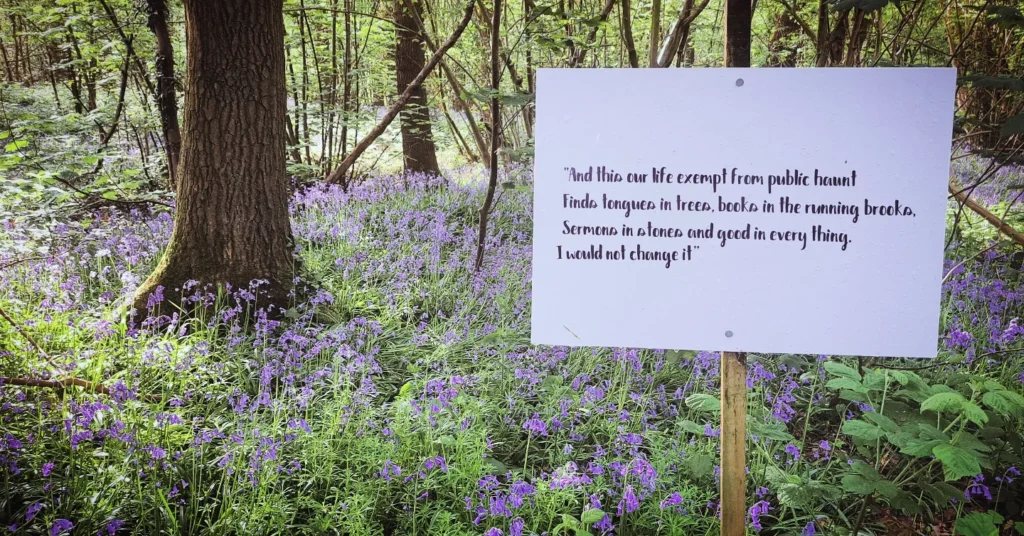
Shakespeare Quote on a sign in the AS YOU LIKE IT wood at Soulton: And this our life exempt from public haunt
Finds tongues in trees, books in the running brooks,
Sermons in stones and good in every thing.
I would not change it.
At Soulton Hall, the architecture beautifully illustrates the same theme of love and harmony that resonates throughout As You Like It, demonstrating how both draw inspiration from the same intellectual and cultural wellspring.

The striking 1668 stone tabernacle doorcase of Soulton Hall
The door case, for example, serves as a powerful symbol of renewal and reconciliation. Created after the tumultuous period of the English Civil War/War of the Three Kingdoms and conflicts in Europe, it represents a “macro” comment about the restoration of order. The broken rainbow, a traditional symbol of covenant, now has a new concord placed above it, signifying a renewed sense of unity. But the door case is also a celebration of a 1668 marriage, inviting us to consider this personal union as part of a wider harmony on a national scale. Just as individual love contributes to the strength of a community, this specific marriage, commemorated in stone, becomes a metaphor for the healing and rebuilding of a nation.

The Soulton Dancing Pavement, showing The Dance, which features in AS YOU LIKE IT
This resonates with the play’s final scene, where Hymen’s dance orchestrates the union of the lovers, a powerful image of social harmony divinely restored. May the tranquility of Soulton Hall inspire not only personal renewal but also a renewed commitment to fostering empathy and understanding within our communities. Love, at its most potent, strengthens both individual lives and the intricate network of relationships that constitute society.
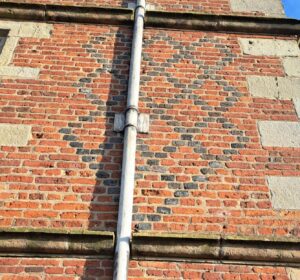
The 16 cell diamond brickwork: on Chess Court: the net with the nodes on it is trying to communicate ideas of mutual aid and fellowship
This Valentine’s Day, let’s consider love’s broader implications, extending beyond the personal. Just as Orlando’s verses become part of Arden, our expressions of care and connection contribute to the social fabric.
