

![[For this] character to sink into oblivion, would be.. ungrateful & injurious to posterity](https://soultonhall.co.uk/wp-content/uploads/2024/01/soulton_rental.jpg)
“To suffer such a character to sink into oblivion,
would be in the highest degree ungrateful, as well as injurious to posterity,
for whose imitation it is held up.”

Old Sir Rowland Hill’s Chair of Estate.
********
A Lasting Legacy: The Memorials of Sir Rowland Hill
Sir Rowland Hill, left an enduring mark on the nation. Known for his philanthropic endeavors and staunch moral character, Hill’s legacy is celebrated through numerous memorials and tributes.
This blog looks over his monuments over 100s of years.
Sir Rowland Hill was renowned for his commitment to public welfare.
As Lord Mayor of London, he championed various charitable causes. He was involved in the establishment of free schools and the construction of bridges. His contemporaries praised his generosity and dedication. Hill was a patron of the arts, particularly drama and was a muse for William Shakespeare, a cousin of his via Mary Arden, expressed most explicitly in As You Like It.
Memorials and Tributes
St. Stephen Walbrook
Hill’s final resting place is St. Stephen Walbrook, a historic church in London. His grand funeral was attended by many notable figures of the time, including an honor guard, two heralds, and the Lord Mayor of London. A magnificent monument was erected in his honor, which was unfortunately lost in the Great Fire of London.
The text of the epitaph survives and reads as follows:
A friend to virtue, a lover of learning,
A foe to vice and vehement corrector,
A prudent person, all truth supporting,
A citizen sage, and worthy counsellor,
A love of wisdom, of justice a furtherer,
Lo here his corps lieth, Sir Rowland Hill by name,
Of London late Lord Mayor and Alderman of same
An account of his funeral also survives in The Diary of Henry Machyn, Citizen and Merchant-Taylor of London, 1550-1563. Originally published by Camden Society, London, 1848 (which you can access on-line here):
The v day of November was bered in sant Stephen’s in Walbroke ser Rowland Hylle, latt mare and altherman and mercer and knyght, with a standard and v pennons of armes, and a cott armur and a helmet, a crest, sword, and mantyll, and xj dosen of skochyons of armes; and he gayff a c. gownes and cottes to men and women; and ther wher ij haroldes of armes, master Clarenshux and master Somersett, and my lord mayre morner, the cheyff morner; ser Recherd Lee, master Corbett, with dyvers odur morners, ser Wylliam Cordell, ser Thomas Offeley, ser Martens Bowes and master Chamburlan althermen, and the ij shreyffes, and master Chambur . . and master Blakewell, with mony mo morners, and a 1. pore men in good blake gownes, besyd women; and the dene of Powlles mad the sermon; and after all done my lord mayre and mony and althermen whent to the Mercers’ (fn. 48) hall and the craft to dener, and the resedu to ys plase to dener, and grett mon mad (fn. 49) for ys deth, and he gayff myche to the pore.
Hawkstone Park
A towering 110 foot tall obelisk in Hawkstone Park, Shropshire, commemorates Hill’s life and achievements.

Rowland Hill Monument, Hawkstone Park
This striking monument offers panoramic views of the surrounding countryside and serves as a lasting tribute to his legacy.
It has a text upon it, which it merits repeating here:
THE RIGHTEOUS SHALL BE HAD IN EVERLASTING REMEMBRANCE.-Psalm cxi. 6.
The first stone of this Pillar was laid by Sir Richard Hill, Bart. Member in several Parliaments for this County, on the 1st day of October, in the year 1795; who caused it to be erected, not only for the various uses of an Observatory, and to feast the eye, by presenting to it at one view, a most luxuriant and ex-tensive prospect, which takes in not less than twelve (or, as some assert, fifteen) counties; but from mo-tives of justice, respect, and gratitude to the memory of a truly great and good man, viz. Sir Rowland Hill, Knt. who was born at the family mansion of Hawkstone, in the reign of King Henry the Seventh, and being bred to trade, and free of the city of London, became one of the most considerable and opulent merchants of his time, and was Lord Mayor of the same, in the second and third years of Edward the Sixth, anno 1549 and 1550, and was the first Protestant who filled that high office. Having embraced the principles of the Reformation, he zealously exerted himself in behalf of the Protestant cause, and having been diligent in the use of all religious exercises, prayerful, conscientious, and watchful (as a writer of his character expresses it), yet trusting only in the merits of our Lord and Saviour, Jesus Christ, he exchanged his life for a better, a short while after the death of that pious young monarch, being aged nearly seventy years. For a considerable time previous to his decease, he gave up his mercantile occupations, that he might with more devotedness of heart attend to the great concerns of another world. His lands, possessions, and church patronage, were im-mense; particularly in the counties of Salop and Chester; the number of his tenants (none of whom he ever raised or fined) amounting to one thousand one hundred and eighty-one, as appears from his own handwriting. But his private virtues, good deeds, and munificent spirit, were quite unlimited, and extended-like the prospect before us, East, West, North, and South, far surpassing all bounds. “Being sensible,” saith Fuller (speaking of him in his “Worthies of England”), “that “his great estate was given him of God,” it was his desire to devote it to his glory. He built a spacious church in his own parish of Hodnet, and likewise the neighbouring church of Stoke, at his own expense. He built Tern and Atcham Bridges in this county, both of hewn stone, and containing several arches each. He also built other large bridges of timber. He built and endowed several Free Schools, particularly that of Drayton. He made and paved divers highways for the public utility. He founded exhibitions, and educated many students at both Universities, and supported at the Inns of Court others who were brought up to the Law. He was the unwearied friend of the widow and the fatherless. He clothed annually three hundred poor people in his own neighbourhood, both with shirts and coats; and in the city of London he gave £500 (an immense sum in those days) to St. Bartholomew’s hospital, besides (saith Fuller) £600 to Christ Church hospital. He also gave most liberally to all other hospitals, and at his death bequeathed £150 to the poor of all the Wards in London. He had no children, but his relations and kinsfolk were numerous, who all partook largely of his bounty, both in his lifetime and at his death. He constantly kept up a great family household, where hi maintained good hospitality. Many resorted to him for his wise and salutary advice; and none who came to him were ever sent empty or dissatisfied away.
Go and do thou likewise, as far as thy ability will permit, without injury to thy own relations.
To suffer such a character to sink into oblivion, would be in the highest degree ungrateful, as well as injurious to posterity, for whose imitation it is held up.
The bust in Market Drayton School
One of the things that suffered much in the churn of the Reformation was access to education, which collapsed with the closure of the monasteries. The frustrations around this can be seen in the opening scenes of Shakespeare’s As You Like It, where Orlando rails about how “old Sir Rowland” directed that there should be good education and it was being denied:
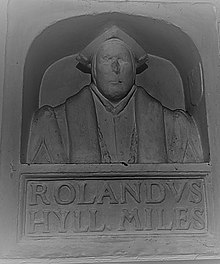
The bust of Sir Rowland Hill at Market Drayton School Tudor Buildings invites us to reflect on his legacy and the lasting impact of his charitable works.
Hill helped to establish Shrewsbury School (a town where there would need to be a Royal foundation), personally founded a school in Market Drayton, and supported a school in London within St. Thomas Acon Hospital near Old Jewry in 1543.
At Saint Mary’s Hall and the Old Grammar School & Saint Mary’s Hall, Phoenix Bank, a Tudor building survives (you can see the Historic England listing here).
It’s interesting for two reasons: (1) because the dedication reads “ROLANDVS HYLL MILES,” which shows us once again a variation in spelling in a period where there was still no standard spelling—even at a school (something many 21st-century dyslexics will envy); and (2) because the monument’s style, popular from the early to mid-17th century, was typically reserved for religious figures, scholars, and professionals with intellectual aspirations.
Portraits
The oldest portrait of Sir Rowland Hill, which may be slightly posthumous, is in the collection of the Worshipful Company of Mercers.

‘Old Sir Rowland’: inspiration ‘Old Sir Rowland’ in AS YOU LIKE IT
There are a further three antique, C17th portraits as follows.
- Tatton Park (see: Listing in National Trust Collection, Tatton Park, Cheshire NT 1298284)
- Attingham Park (see: Listing in National Trust Collection, Attingham Park, Shropshire NT 609006)
- Museam of London (item 51.67, see this biography note and this on Flickr)

Sir Rowland Hill, Attingham Park copy
This carry text on them in in French and Latin.
The French says:
ADIEU MONDE PUIS QUE TV DESCORS TOUT INFAMS…TOUT CHASTES TOUT A LA FIN ORLIVES TOUT.
Goodbye world, for you expose all wickedness/sin… reveal all purity/virtue [but] in the end you forget everything.
The Latin says:
ROVLANDVS HILL . Miles Salopienfis vir bonus & fapiens quondam Maior Civilitatis Londini ac digniffimus Confull cruidem exiftens Qui auctoritatem opibu… / temporibus Regum Henrici octavi & Edwardi fexti florens diuerfas terras praedia ac poffessiones per qui fiuit eaq omnia falua conscientia abiq omni aliorum iniuria v… / damno Qualam fenescate ac in vltima aetatem vergente a rebus acquiredis prari abfinuit ac fuaforta contet fibi quieti vixit neq plura optabat. Multa preferia preclara / magna u..bat fanillia Bona que acquifiuifs et Liberaliter impendil Pauperib dedii, Scotafticis in vtrag academia exhibuit Leguleos aluit atq inalios pios vfus erogaui… / liberos fufcepit nullos ideog terras poffesionefq fuas inter cognates ac confang vinios diuifet Breuiter tanta pictate claruit quod fama faeta extendebat / reliquamq vitam fuani vigiliis timare ac contemplatione contenuit, ad honorem fummi dei ac in perpetuam lui nomins gloriam.
Rowland Hill, a Knight from Shropshire, was a good and wise man, once Mayor of the City of London and a most worthy consul. He flourished in the times of Kings Henry VIII and Edward VI, acquiring diverse lands and possessions, always with a clear conscience and without harming others.
In his old age, he abstained from further acquiring wealth and lived a quiet life, content with what he had. He gave generously to the poor, provided scholarships, supported lawyers, and dedicated his resources to other pious causes.
Having no children, he divided his lands and possessions among his relatives. He was known for his great piety, and his fame spread far and wide. He spent the rest of his life in prayer, contemplation, and devotion to God, seeking to honor Him and ensure his own eternal glory.
Sir Rowland Hill’s legacy was deliberately obscured due to political expediency, his association with the Geneva Bible and its democratic leanings making him a potentially problematic figure. Yet, his contributions to society and his admirable personal qualities were undeniable and deeply loved by many. The poignant sentiment expressed in his portraits within the first century of his legacy reveals the foresight of those who recognized the risk of his memory fading into obscurity.

Unknown Man, by Hans Holbein the Younger — is the Rowland Hill
It is possible there is a Holbine of Hill, which scholarship has not seen him as the sitter for.
As You Like It

Opening of Shakeaspeare’s play AS YOU LIKE IT as seen in the First Folio
Shakespeare’s As You Like It, penned by Sir Rowland Hill’s cousin via Mary Arden, serves as a cultural monument to the esteemed statesman. Both the real Old Sir Rowland and fictional Old Rowland stand as exemplary models of virtue. Their real and fictional estates are both the venues where a quest for the restoration of harmony is undertaken, beautifully represented by a dance.
Seeing him as his contemporaries saw him
Contemporary records provide valuable insights into his personality and character. Here are some glimpses of Sir Rowland Hill as described by his contemporaries, which paint a picture of Sir Rowland Hill as a man of deep faith, unwavering generosity, and strong moral character.
Here is a selection of pen portrais:
1549 Sir Roulād Hyll Mercer
This syr Roulande Hylle, to the great prayse of his vocation, and to the Charitable dedes done by sir Rouland hyll. synguler comfort of the weale publi[c…]e of his countrey, erected many notable monumentes and good dedes, whiche were to long here to write. Wherfore I referre them to my Summarie.
– Stow, John. The summarie of English chronicles (lately collected and published) nowe abridged and continued tyl this present moneth of Marche, in the yere of our Lord God. 1566. By J.S. Thomas Marshe,. London: in Fletestrete, 1566. (You can find the origianl source on-line via University of Michigan Library)
His reputation persisted in the generation that came after Sir Rowland Hill died, as evidenced in a grant of arms to his heirs in the next generation:
..And Wheras Sir Rowland Hyll knight late mayor of London is descendid a gentilman of antiquytie his auncestors bearinge armes notwithstandinge beinge ignorant of the same toke armes to hym selfe and to his posteritie and so died without yssue of his bodie procreate and leauynge behynde hym a good porcion of lande which he hath geuyn determyned and deuyded emonges his Sisters children..to permytt
and auhorise… them to beare the armes of ye saide sir Rowland hyll for a perpetuall memorie of hym.– Grant of arms to Alice Corebt, William Gratewood , James Barke and Rowland Barker, 1562. Crisp, F.A. Frederick Arthur, 1899. Fragmenta Genealogica. London, Printed at the private press of F.A. Crisp. Volume v. XIII
Consider also this note:
‘CHARACTER OF SIR ROWLAND HILL, MAYOR OF LONDON.’
Rowland Hill, was a grave and worthye father of the oitie, and long before his death
he gave over his occupying,* and gave himself wholly to purchasing of landes, having never a child in the world. The greatest part of his landes lay in Shropshire, where he bare great rule, and where also, as I have heard by credible report, he did many good deedes, namely, that he raised no rents, nor took any fines of his tenants ; he suffered the child to enjoy the father’s farm before all other; he was a frend to the widow and fatherless ; he erected a grammar schoole to the profyte of the country ; he repaired many highwayes and bridges ; and whereso-ever a good dede was to be done for the common weale of his countrymen he was ready to further the same. He gave yerelye to the poore people of the countrey three hundred shirtes and smockes, and as many frockes and coates of fryse to cover them withal. And In the citie of London he gave five hundred pounds to St Bartholomew’s Hospital, towards the building of certain new tenements iin St. Nicholas shambles for the relief of the poore. He also gave great reliefe to all the hospitals. And at his death he gave CL to the poore of all the wards in London…
To the foregoing account, the following one from Kimber’s Baronetage may not be unacceptable:- He (Sir Rowland Hill) did great acts of generosity, was an eminent benefactor to the public ; founded Drayton and other free schools ; built Stoke and Hodnet Churches, Atcham and Terne Bridges, at his own expence.
– Shrewsbury Chronicle. Shropshire Notes and Queries: A Collection of Literary, Legendary and Antiquarian, Historical and Biographical and Philological Fragments Relating to of Connected with the County of Salop. Printed by J. Waton & Son, Chronicle Office Shrewsbury. 1886
His legacy continues to inspire and influence people today.
A Lasting Impact
Sir Rowland Hill’s legacy extends beyond his lifetime.
There is still a charity, Sir Rowland Hill’s Educational Foundation, that provides financial assistance to young people in the Market Drayton area to help them further their education. The foundation offers a variety of grants, including:
- University grants, to help students cover the cost of tuition fees, accommodation, and living expenses.
- Sixth form grants, to help students cover the cost of tuition fees and exam fees.
- Vocational training grants: To help students cover the cost of tuition fees and equipment.
- Short course grants: To help students cover the cost of short courses that will help them improve their skills and knowledge.
The foundation is committed to helping young people from all backgrounds to achieve their educational goals.
His charitable works and moral principles continue to inspire generations, and his memorials serve as tangible reminders of his significant contributions to society. Through these tributes, Hill’s memory lives on, a testament to his enduring impact.
