


There are a number of paintings by Hans Holbein the Younger in which the sitter is thought to be unidentified. The painting below is currently known as Portrait of an Unknown Man. It is in the collection of Audley End House, Saffron Walden, Essex, and cared for by Historic England. Their image catalogue reference for it is K980337.
There are several reasons for believing we may have identified the sitter as Sir Rowland Hill (d. 1561).

Unknown Man, by Hans Holbein the Younger – is this Rowland Hill?
Since the Holbein portrait must have been painted before the artist’s death in 1543, Hill would have had to achieve significant prominence by that point. He had. For example, he:
- was knighted in 1542;
- served as Sheriff of the City of London in 1542 and was on his way to becoming Lord Mayor in 1549;
- held the position of Warden of the Mercers’ Company between 1535-6 and again between 1543-4;
- was active at court as a Privy Councillor and is described as a “great occupier of Almayn [Germany]” for trade in the state papers of 1544. These papers also show his involvement in arming the Navy.
Certainly, therefore, he is prominent enough for Holbein to have painted him.
Let’s examine the known portraits of Sir Rowland Hill. We’ll start with the one at Mercers’ Hall. This portrait depicts him later in life than the man in the unkown portrait, and certainly after Hans Holbein the Younger’s death in 1543. The subject appears as an older man, wearing the chains of office signifying his position as Lord Mayor of London.

This painting is one of several similar images of him. The others seem to be copies of this one, and are in the following places:
The Museum of London image and the Attingham Park image are shown below. This helps us understand how this portrait was widely reproduced and became a standard way of depicting Sir Rowland Hill.
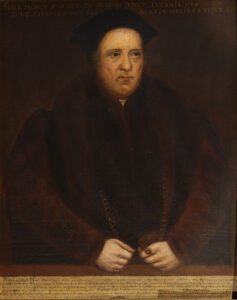
Sir Rowland Hill, Attingham Park copy
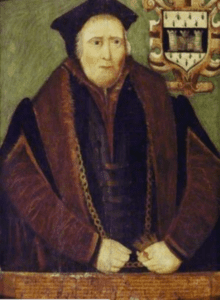
Sir Rowland Hill – Museam of London Image
Now let us put the unknown sitter in the Holbine next to the best known Hill portrait.

Putting side by side the Hill portrait and the ‘unknown’ Holbine
There are some striking similarities, but also some interesting differences. The pose is conspicuously similar, and the sitter holds gloves in both images, potentially indicating judicial office, which Sir Rowland Hill obviously held. Examining the nose, we can see that both sitters have quite a prominent and angular nose with a similar shape. Likewise with the eyes, there’s a slight misalignment, and they are set in a similar way with distinctive folds on the eyelids. Unfortunately, sideburns obscure the ears in the known Hill painting, but there are interesting things to note regarding the facial hair. The unknown sitter’s beard has a German flavor, which aligns with Hill’s mercantile activities. The absence of a beard on the Hill portrait is completely expected, as Lord Mayors did not wear beards. In fact, it was quite remarkable and controversial for a Lord Mayor to wear a beard after Hill’s time. There is a ring in the same possition in the two images; in the known ones the stone is a Garnet and there are good reasons to understand why Hill would be seen with a garent in later images.
The sitter’s clothing is very similar to that of another (very fine) Holbein portrait featuring an unidentified sitter: Portrait of a Young Merchant,* now in the collection of the Kunsthistorisches Museum, Vienna:

Portrait of a Young Merchant by Hans Holbein the Younger
The canonical identification of this sitter as a merchant makes it easy to assume that the Portrait of an Unknown Man is also of a merchant.
However, there’s a significant difference in headwear between the known Hill portraits and the Portrait of an Unknown Man. In the known Hill portraits, he wears a Geneva cap. This change in style is noteworthy, especially considering these images date from after he was celebrated for the Geneva Bible.
Finally, let’s consider the provenance of the “Portrait of an Unknown Man.” It has resided at Audley End House in Saffron Walden for a very long time. This house was the estate of the Tudor Lord Chancellor, Sir Thomas Audley. Interestingly, Sir Thomas Audley was not only a colleague of Sir Rowland Hill in the Privy Council, but also shared a passion for educational philanthropy, as evidenced by his work at Magdalene College, Cambridge.
There’s a strong likelyhood that a Holbein portrait of Hill during his midlife courtly years (say early early 1540s) would have set a sort of definitive tone in his representation.
This original portrait by a renowned artist could then have influenced the composition of later works definitively identified as Hill. These later paintings might possess a more conceptual quality, perhaps honoring him as a statesman, particularly if created after his death. It’s also possible they aimed to rectify a period of disfavor and obscurity he may have experienced in Shropshire.
_____
* For reasons that are set out elswhere, there are several lines of argument that support the proposition that Portrait of a Young Merchant is Thomas Gresham.
The above contains intelectual property of Tim Ashton and is informed by discussions with Liza Giffen and James D. Wenn.
