


We are collaborating with Jacob Chandler on a project related to the dance in Shakespeare’s As You Like It and its links to Old Sir Rowland and Soulton.

The Soulton Dancing Pavement, showing The Dance, which features in AS YOU LIKE IT
Recently, Jacob has been working on a project called FLATLANDS which as come out of a work by Edwin A. Abbott, the novella, Flatland: A Romance of Many Dimensions.
********
Every day, we use three directions to describe where things are: up/down, left/right, and forward/backward. These are called dimensions, and together they make up 3D space.
But in advanced science and math, there are spaces with more than three dimensions! These can be tricky to picture because they’re beyond our everyday experience. Still, these higher-dimensional spaces are crucial for scientists and mathematicians. They help understand complex things like quantum mechanics, string theory, and even analyzing lots of data.
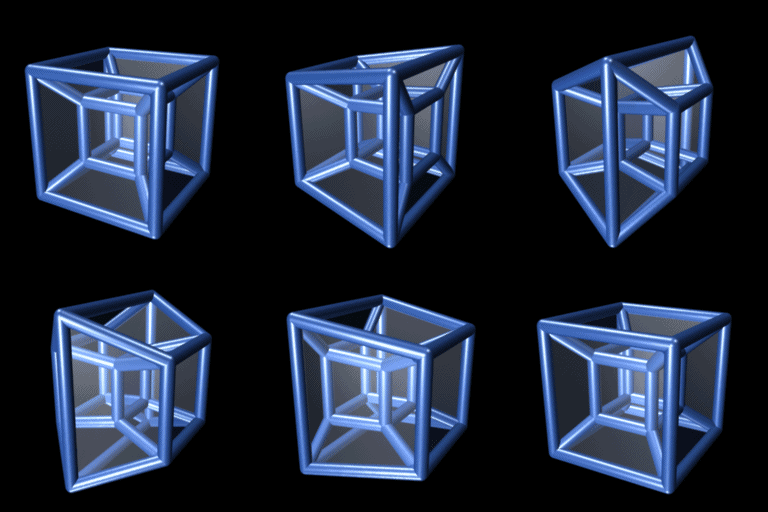
In geometry, a tesseract or 4-cube is a four-dimensional hypercube, analogous to a two-dimensional square and a three-dimensional cube
Published in 1884, Edwin A. Abbott’s novella, “Flatland: A Romance of Many Dimensions,” takes a unique approach to exploring the limitations of human perception.
The story unfolds within a two-dimensional world.
Think of it like this:
A humble Square, experiences existence solely through lines devoid of depth or volume, and a narrative that takes a fascinating turn with the arrival of a Sphere, a being from a higher dimension.
Initially appearing as just another circle to the Square, the Sphere introduces a revolutionary concept – the existence of three-dimensional shapes. This revelation proves as baffling as it is groundbreaking for the Square, whose comprehension is limited by the confines of his flat world.
In a display of scientific benevolence, the Sphere transports the Square to the third dimension. Here, the Square experiences a profound shift in perception. No longer confined to lines, he witnesses the full reality of shapes, complete with depth and volume.
Emboldened by this newfound understanding, the Square inquires about the existence of dimensions beyond the third.
However, this question leaves the Sphere utterly perplexed.
Just as the Square couldn’t grasp the concept of 3D before his encounter, the Sphere is incapable of comprehending a world with more dimensions than its own. This serves as a clever allegory for the reader.
Our brains, like the Square’s, are limited in their ability to perceive realities outside our own three-dimensional experience.
“Flatland” offers a thought-provoking exploration of the boundaries of human understanding. Through the encounter between the Square and the Sphere, Abbott reminds us that our perception of the universe might be far more restricted than we realize. The novella invites readers to consider the possibility of dimensions beyond our comprehension, igniting a sense of wonder and curiosity about the vastness of the cosmos.

A two-dimensional shadow cast by the frame of a tesseract.
This exploration of limited perception in “Flatland” echoes the famous allegory of Plato’s Cave. In Plato’s Republic, Socrates describes a group of prisoners chained within a cave, facing a wall. Their entire reality is constructed from flickering shadows cast by a fire behind them. These shadows represent the limited knowledge gleaned through our senses, a mere fragment of the true world outside the cave. Just as the Square in “Flatland” is initially confined to a two-dimensional existence, the prisoners in Plato’s Cave mistake the shadows for reality.
Both narratives highlight the dangers of a stagnant existence where individuals fail to seek knowledge beyond their immediate surroundings. The Square and the prisoners are content with their limited understanding until a catalyst – the Sphere and escaping the cave – forces them to confront the vastness of what they have been missing. These encounters serve as a powerful call for self-growth and the pursuit of a more complete understanding of the world around us.
********
The above work is also a collaboration with Byrga Geniht, Soden Collection, The RCS, and Shakespeare’s Globe.
