


This blog post, the concluding part of a series (the post before this one can be found here), draws your attention to James D. Wenn’s fascinating exploration of connections between Soulton Hall and the Eleusinian Mysteries of ancient Greece.
Mr Wenn explores the possibility that Sir Rowland Hill, the estate’s owner, held an interest in the Eleusinian Mysteries. This ancient cult centered around rituals believed to offer initiates a path to enlightenment and knowledge of the afterlife.
Mr Wenn suggests that the layout and design of Soulton Hall echo the Telesterion, the central sanctuary where Eleusinian Mysteries rituals were performed. He examines parallels between the two structures, drawing attention to specific features within Soulton Hall that might reflect elements of the Telesterion.
The investigation extends beyond the building’s architecture.
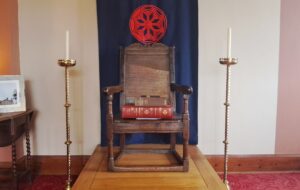
Old Sir Rowland Hill’s Chair of Estate.
Wenn analyzes Sir Rowland Hill’s surviving furniture (Justice Table, Bench, Chair of Estate) and staircases within Soulton Hall, where decorative motifs inspired by iconography associated with the Eleusinian Mysteries can be found.
In this perspective, in building Soulton Sir Rowland Hill sought to manifest his fascination with the Eleusinian Mysteries (and other themes) suggest a deliberate attempt to create a space imbued with deeper meaning, pointing at a desire to build a place that transcends its physical form and just ‘a machine for living’.
