

Navigating the Tides of Tudor Power and Faith
A recent visit to the Mary Rose Museum in Portsmouth provides a striking window into the material world of Tudor England.
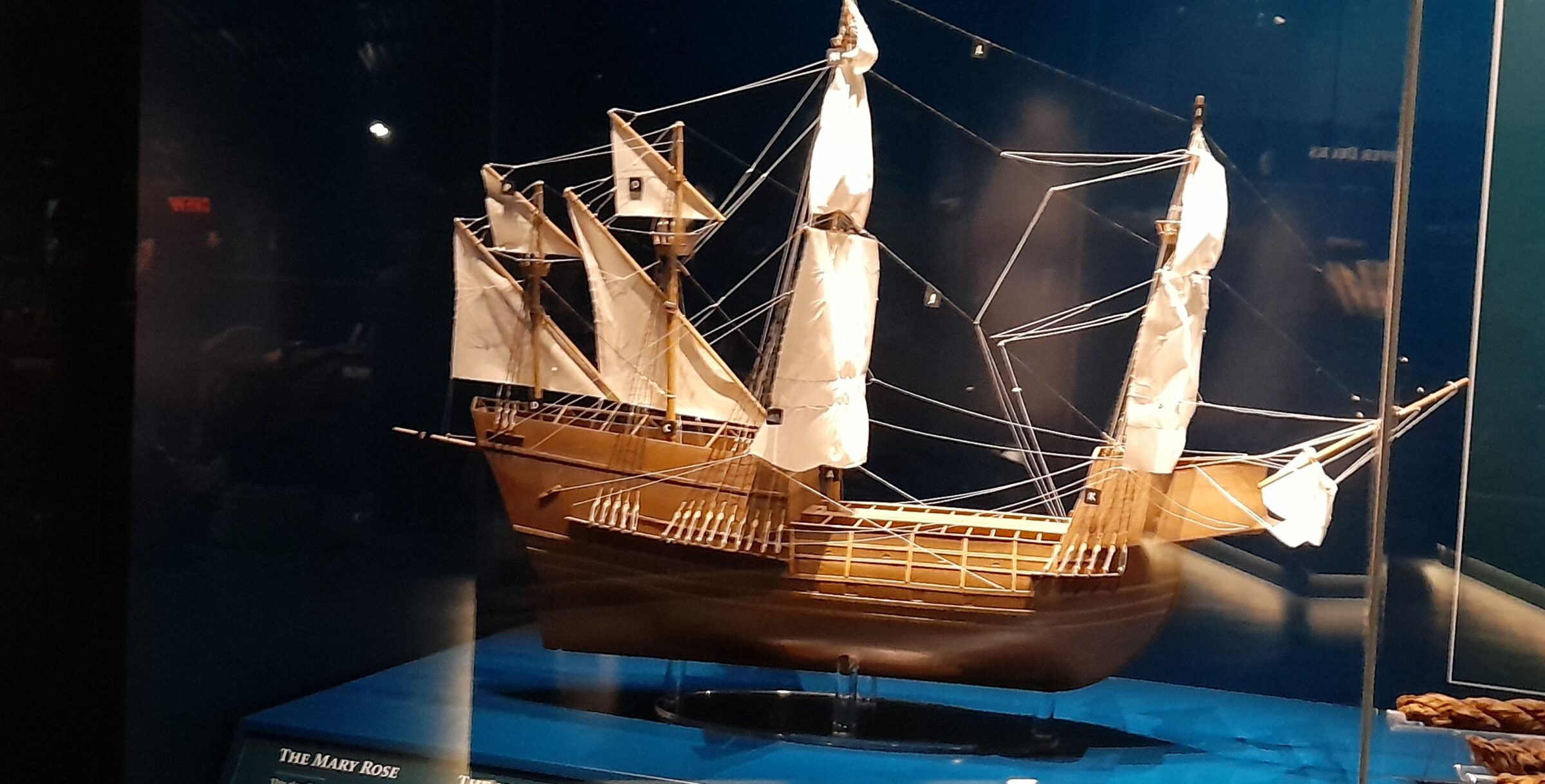
This contemporary model of the Mary Rose captures the name’s dual salience, blending the Tudor heraldic rose with devotion to the “Mystic Rose”—the mother of Christ. It is a striking irony that Henry VIII personally funded this vessel in 1510 to honor such a traditional Catholic image, long before his later break with Rome dramatically altered the nation’s spiritual landscape. As a centerpiece of his naval growth, the ship helped him transform a fleet of five vessels into 53, building the foundations of the Royal Navy.
For those of us connected to the story of Soulton Hall, this remarkable survival is more than a brilliant display of maritime history. It is a direct encounter with the culture, objects, and political realities that shaped the life of Sir Rowland Hill.
-
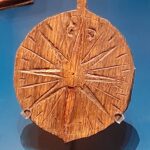
- The small compass rose, incised onto a wooden fob, reflects the essential tools that were as familiar to the day-to-day work of a merchant as they were to a sailor at sea.
-
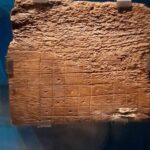
- This Tudor-era artifact invites us to reflect on how such geometric grids—often carved into wooden surfaces like a game board for rythmomachia—served to anchor both navigation and memory within a structured space.
-
- The precision measuring compasses found among the items reveal the careful, deliberate work required to plot distances across unforgiving charts.
As a Privy Councillor during the era of her active service, Sir Rowland Hill oversaw the administration of the realm and would have known the grand vessels of the royal fleet well.
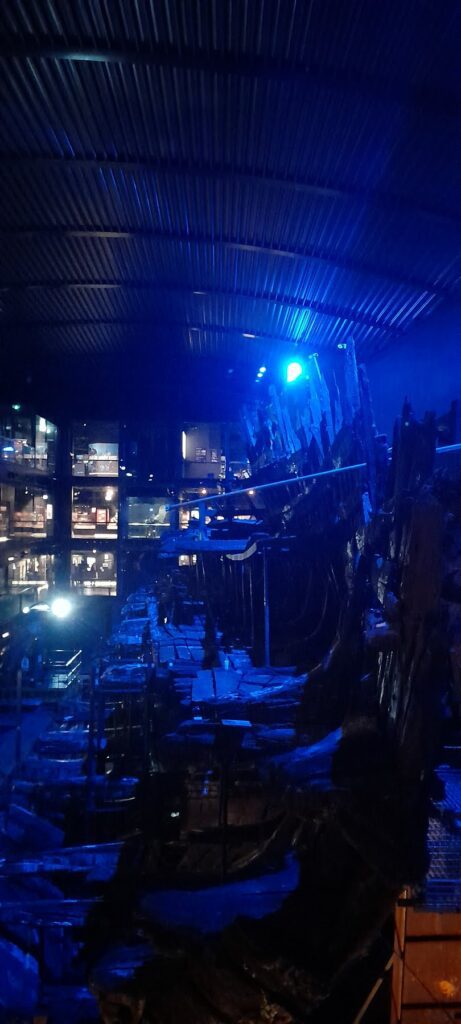
The ship’s massive hull, unseen since the era of Sir Rowland’s service to the Privy Council, was finally reclaimed in the latter decades of the 1900s and has since been fully conserved and presented to the public throughout the 2000s.
It is highly probable that his duties, or his position within the court of Henry VIII, would have brought him aboard such a ship, and perhaps this very ship. Walking through the exhibition brings us face-to-face with the exact environment he navigated.
The sheer scale of this recovery effort is breathtaking, with over 19,000 individual items rescued from the seabed. When these objects are viewed together, they reveal a society caught mid-transition.
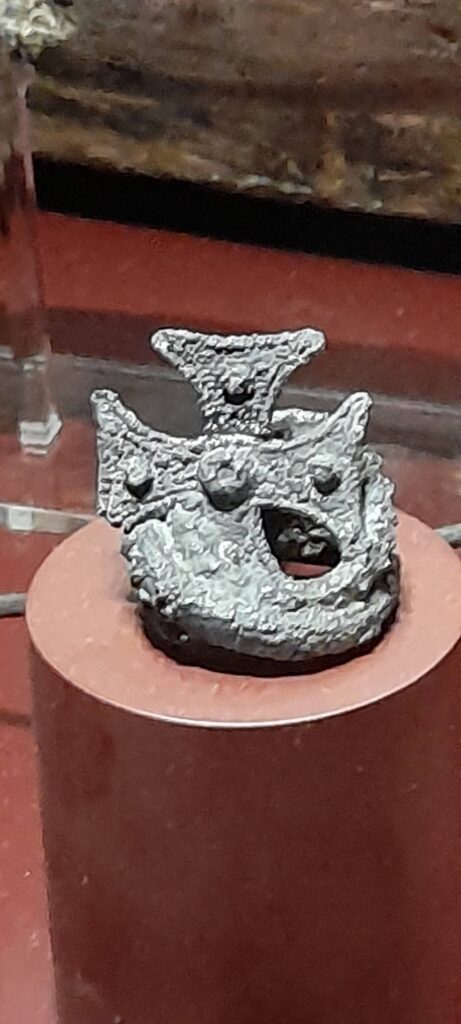
This silver cross, set with garnets in a quinquox arrangement, merges aesthetic luxury with profound meaning; the stones’ deep red color served as a visceral, symbolic link to the Passion, anchoring personal faith at a time when the religious world was being fundamentally rewritten.
The collection captures a unique moment of religious and political flux.
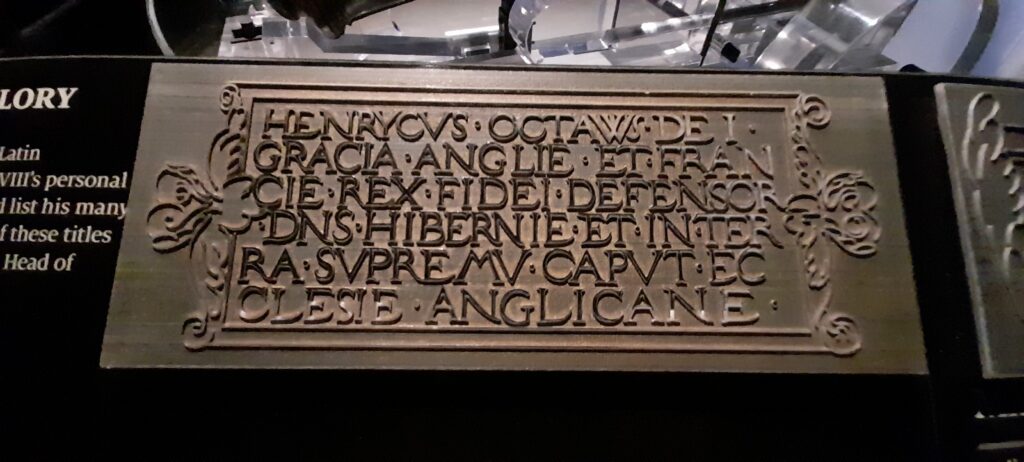
Cast during the mid-1500s, this declaration—”HENRYCVS OCTAVVS DEI GRACIA ANGLIE ET FRANCIE REX FIDEI DEFENSOR DNS HIBERNIE ET IN TERRA SVPREMV CAPVT ECCLESIE ANGLICANE,” translating to “Henry the Eighth, by the Grace of God, King of England and France, Defender of the Faith, Lord of Ireland, and on Earth Supreme Head of the Church of England”—demonstrates how the crown codified a new national identity by legally anchoring the supreme oversight of the realm’s religious life directly to the monarch.
On the great bronze cannons of the ship, cast inscriptions boldly proclaim Henry VIII as the supreme head of the English Church. Yet, tucked away in the personal sea chests of the crew, archaeologists found numerous traditional rosaries. These personal devotional items were not yet outlawed when the ship sank in 1545, but the tide was turning fast.
-
- This carved bone panel, a work of Venetian craftsmanship likely over 100 years old when the ship sank, depicts two angels in a reverent procession bearing candles to symbolize the light of the divine, serving as a cherished heirloom that offered its owner a sense of spiritual constancy at sea.
-
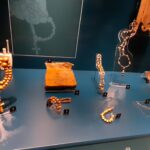
- The rosaries recovered from the Mary Rose capture a time when faith and material life were inseparable yet increasingly contested, much like the portrait of Cuthbert Tunstall at Durham, where his prayer beads were painted in and out four times to mirror the era’s shifting religious tides.
This tension between public state loyalty and private traditional practice is exactly the complex world Sir Rowland Hill managed as a statesman.
-
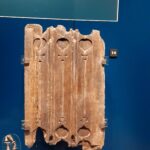
- This fragment of linenfold paneling, a common decorative style in Tudor interiors, features incised crosses that underscore how, in the early modern period, there was no separation between material objects and expressions of belief, as every aspect of daily life remained woven into the fabric of faith.
-
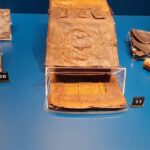
- The Bible cover featuring the “IHS” monogram highlights how personal piety was embedded in daily life, serving as a silent witness to a moment when the status of the English vernacular Bible remained dangerously precarious amidst the volatile shifts of the Reformation.
Among the vast array of longbows, rigging, and everyday tools, the high-status items stand out. The museum houses beautifully preserved pewter tableware and pocket sundials—precise instruments of brass and wood.
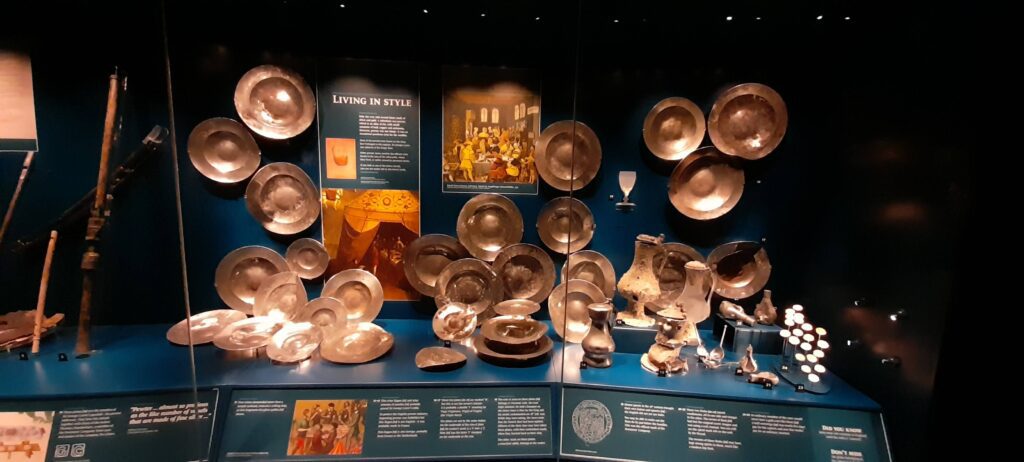
The fine pewter tableware suggests a refined standard of living, and evidence of wine consumption further reflects the gentry’s influence, evoking a setting of familiar domestic comfort that would have mirrored the social world of individuals such as Sir Rowland Hill.
These sundials hold a particular resonance for literature and history enthusiasts. They are the very type of portable timepiece mockingly referred to by Touchstone in Shakespeare’s As You Like It (“And then he drew a dial from his poke…”).
-

- The portable sundial was indeed an elite object, a status symbol that signaled both the owner’s learning and their command over time, much like the one Jaques draws from his pocket in As You Like It to mock the fleeting nature of human life.
-
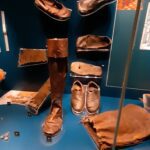
- The display of delicate shoes and boots, clearly not intended for the rigors of daily work on deck, reveals a surprising culture of courtly dress that persisted even on board, proving that the officers sought to maintain their social standing through fine attire regardless of their surroundings.
Seeing these refined pieces gives us an immediate sense of the domestic luxury and intellectual tools that belonged to the lifestyle of Sir Rowland Hill and the elite households of the mid-sixteenth century.
-

- The recovered inkwell closely resembles the one depicted in the lower right of Holbein’s Portrait of a Young Merchant, pulling us directly into the world of individuals like Sir Rowland and the vibrant, literate culture that defined his age.
-
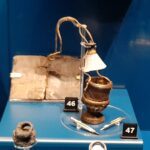
- The recovered inkwell mirrors the one featured in Holbein’s portrait of a young merchant, drawing us directly into the world of individuals like Sir Rowland and the vibrant, literate culture that defined his age.
The presentation of the ship and its contents is a triumph of modern museology.
The galleries are designed to mirror the layout of the ship itself, allowing visitors to view the massive timber hull on one side while looking at the corresponding items found on those exact decks on the other side. The atmosphere is immersive, dark, and deeply respectful. It stands out as an exceptional standard of historical interpretation, seamlessly linking the physical wreckage with wider historical documentation from the Tudor state papers. It transforms what could be a sterile collection of timber into an urgent, living narrative.
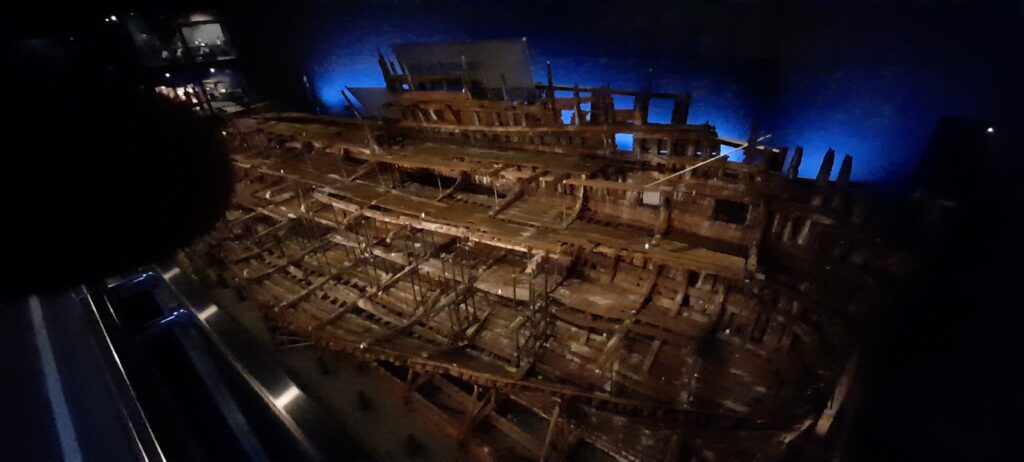
The painstaking decades-long effort to conserve the recovered wreck has transformed a fragile, waterlogged hull into an enduring, stable record of life aboard the Tudor fleet.
The project is a monumental achievement of modern heritage preservation, one that owes an immense debt to the lifelong dedication of HM The King. Long before the hull was raised, while still Prince of Wales, His Majesty became the President and Patron of the Mary Rose Trust. His involvement was far from symbolic; as an accomplished diver, he explored the underwater wreck site himself in the 1970s, witnessing the structure in the silt before it returned to the light of day. He was present on the water when the great timber hull was finally lifted in 1982, and his steadfast patronage across the decades has been instrumental in ensuring these treasures were not only recovered but beautifully preserved for the nation.
Beneath the technical brilliance of the museum lies a somber truth that the presentation never allows you to forget.
-
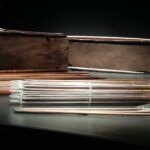
- The recovered arrow shafts serve as stark reminders of the lethal conflict the ship was built to engage in, embodying the brutal reality of naval warfare and the constant, mechanical preparation for battle required by those on board.
-
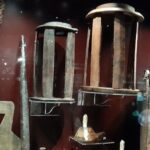
- The lanterns were essential for navigation, safety, and providing light at night within the ship’s dark interior, yet they remained a constant, terrifying peril, as an open flame posed a lethal risk to a wooden structure packed with highly volatile gunpowder.
The Mary Rose is a mass grave: on that July afternoon in 1545, several hundred men lost their lives within sight of the shore.
The museum treats the human remains with immense care and dignity.
-
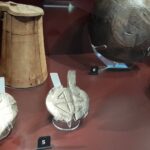
- The elaborate, rune-like marks carved into these wooden items served as personal signatures for men who may not have been literate, acting as potent, singular identifiers that allowed them to assert ownership and presence in a world where writing was often reserved for the elite.
-
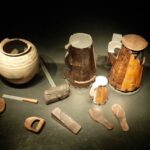
- The humble pots and wooden tankards recovered from the ship offer a rare, intimate connection to the crew, serving as daily companions that humanize the men behind the historical record by revealing the simple, tactile realities of their everyday lives.
As we look upon the personal belongings, the shoes shaped to the feet of individual sailors, and the tools worn by the hands of craftsmen, we are reminded of the human cost of empire and conflict.
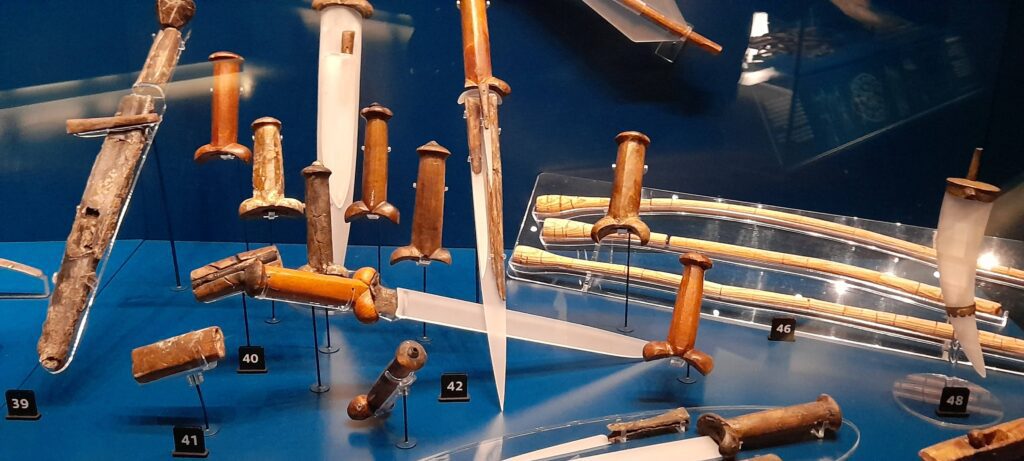
The ubiquity of the bollock dagger among the recovered artifacts underscores its status as an essential, everyday accoutrement, reflecting a culture where carrying such a weapon was a common and unremarkable aspect of personal attire for men of nearly every rank.
It is a place of memory, demanding that we honour the dignity of those who were lost, whose sudden departure left behind a fragment of their world for us to contemplate centuries later.
-

- The skeleton of the carpenter’s dog, preserved in the wreckage, offers a haunting glimpse into the personal companions who shared the cramped, isolated life of the crew.
-
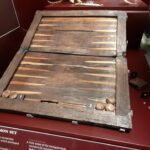
- The backgammon board provides a rare look at the moments of leisure aboard, serving as a reminder that even in the midst of a naval voyage, the men sought to pass the long hours with familiar games of strategy and chance.
