

Stones, Ships, and Statehood: How England Defines Its Heroes
A visit to HMS Victory in Portsmouth introduces a fascinating contemplation on the creation, handling and endurance of national heroes.
This magnificent vessel still serves proudly as the afloat flagship of the Royal Navy, used for high diplomacy and honouring service.
The status of the ship is normally marked by the presence of the sword of the First Sea Lord, kept aboard to denote its high operational standing. On the day of our visit, however, the sword was away—we were told it was required for a matter of high state liturgy. This subtle detail underlined the ongoing reality of the ship’s active, high-status use for state purposes.
This living role is further emphasised by the fact that the ship is currently undergoing a massive, multi-million-pound conservation effort. Walking through the site, one can see the sheer scale of the engineering and resources required to keep this symbol alive, proving that its preservation remains an ongoing act of national identity.
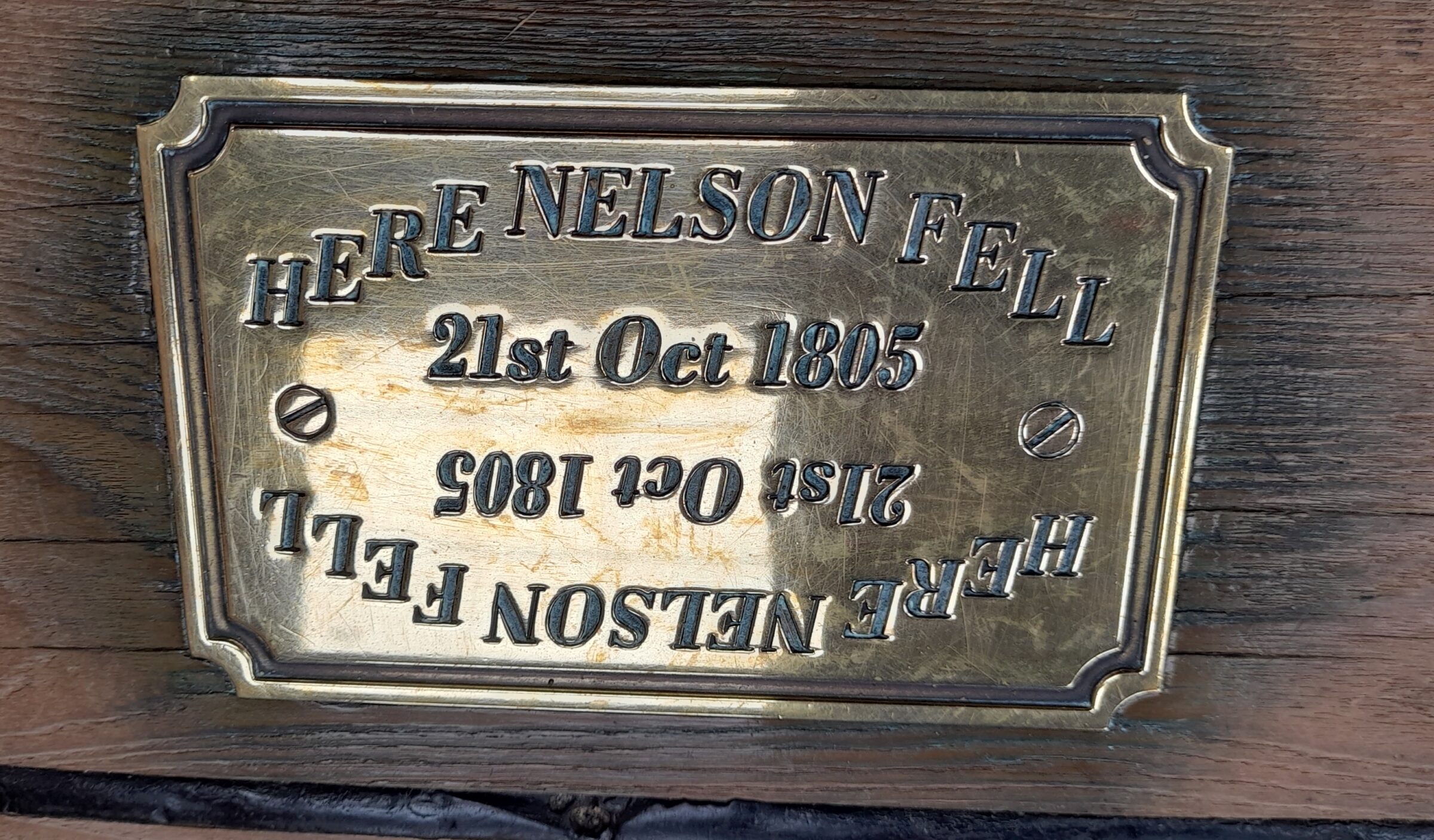
On the open quarterdeck, exposed to the elements and the chaos of engagement, a simple brass plaque set into the timber marks the exact, prominent spot where Nelson fell when a sniper’s bullet struck him down at the height of the battle.
From the decks of HMS Victory to the lost Anglo-Saxon shrines of St Paul’s, England has consistently used specific sites to anchor its identity, acting as stages where we build our history.
Reconciling the legend of Trafalgar with the reality of Nelson’s body preserved in a cask, and having earlier that day looked at the contents of the Mary Rose sea chests—where rosaries show an expression of faith that was becoming less acceptable to the authorities and less safe to display—reveals how often people find a need to pull a shared story from moments of tension.
We are always, or at least often, in a messy negotiation over what we value; in a quiet way, it helps to think about how we carry our history with us, repurposing fragments of the past—like the sarcophagus intended for Cardinal Wolsey, which eventually housed Nelson—to give weight to the present in spaces where earlier physical histories have vanished. We are constantly negotiating change, and perhaps total clarity is never really the point, as Tom Stoppard observed:
“We cross our bridges when we come to them and burn them behind us, with nothing to show for our progress except a memory of the smell of smoke, and a presumption that once our eyes watered.”
Ultimately, we use these stories, values, and landscapes to anchor our identity because the theater—for want of a better word—of that sense of order is the lattice that many in a culture need to feel stable, orientated, and to have a place to fit into.
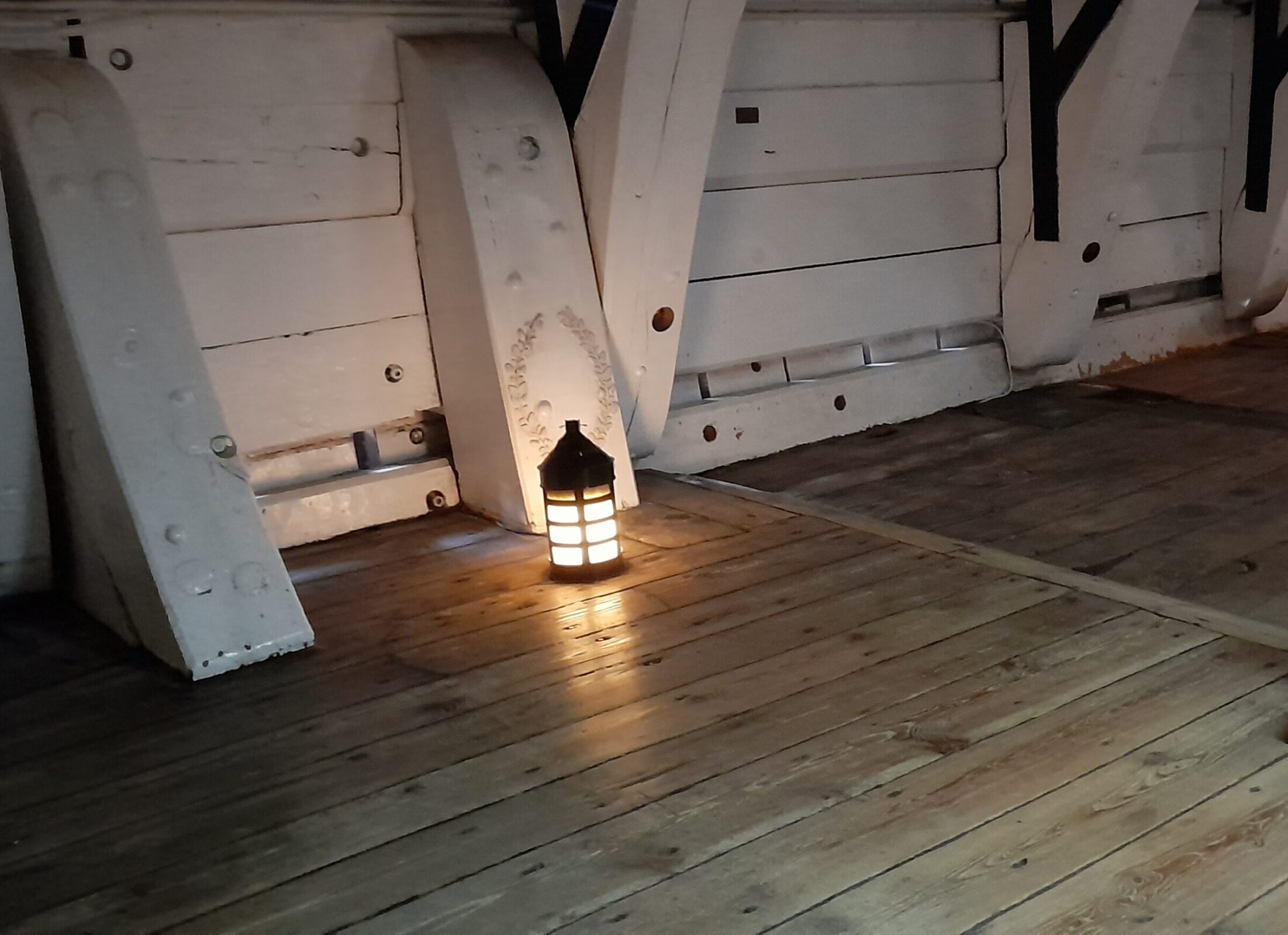
The emotional core of the ship rests where the public, canonical narrative of heroism was forged in the passing of Vice-Admiral Horatio Nelson. On the upper deck, a simple brass plaque marks the exact spot where he was shot during the height of the fighting.
Below, in the dim, cramped orlop, a single lantern illuminates the place where he died after learning of the historic victory. This quiet, localised commemoration marks the site where he expressed his desire not to be buried at sea, but instead returned to England for burial. This request implies that the concept of receiving high funeral honours was certainly not out of mind for Nelson as he faced his end.
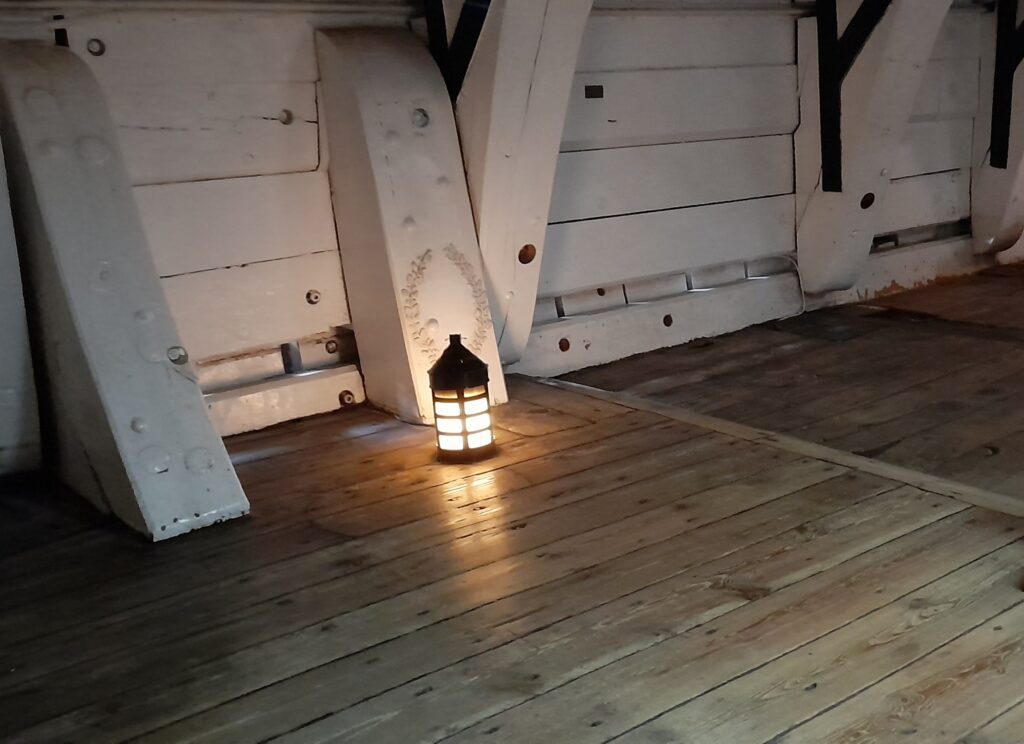
A single lantern illuminates a quiet place of honour on the dim, cramped orlop deck, marking the specific site where the hero died after learning of the historic triumph at Trafalgar.
Indeed, the state funeral that followed was designed on a scale to permanently solidify his identity as a national saviour. Yet, the journey to secure that lasting legacy was fraught with a strange, immediate folklore. While King Arthur’s legend speaks of a king sleeping until his hour of return, or Sir Francis Drake’s legend stems from a supernatural deathbed pledge to return and protect his homeland whenever his famous drum is beaten, Nelson’s myth took a much more literal, immediate turn amongst his crew. To honour Nelson’s wish to return home, the ship’s surgeon, William Beatty, oversaw the preservation of the body for the long voyage. The presence of the Admiral, held in state on the deck and under constant watch by a Royal Marine sentry, created an atmosphere of deep intensity. A fortnight into the voyage, the sudden settling of the cask in the shadows of the deck startled the watchman, who cried out that the Admiral had stirred. This moment instantly created a ghostly naval legend that shadowed the ship all the way to the Thames, reflecting the profound, almost supernatural impact Nelson had upon his men.
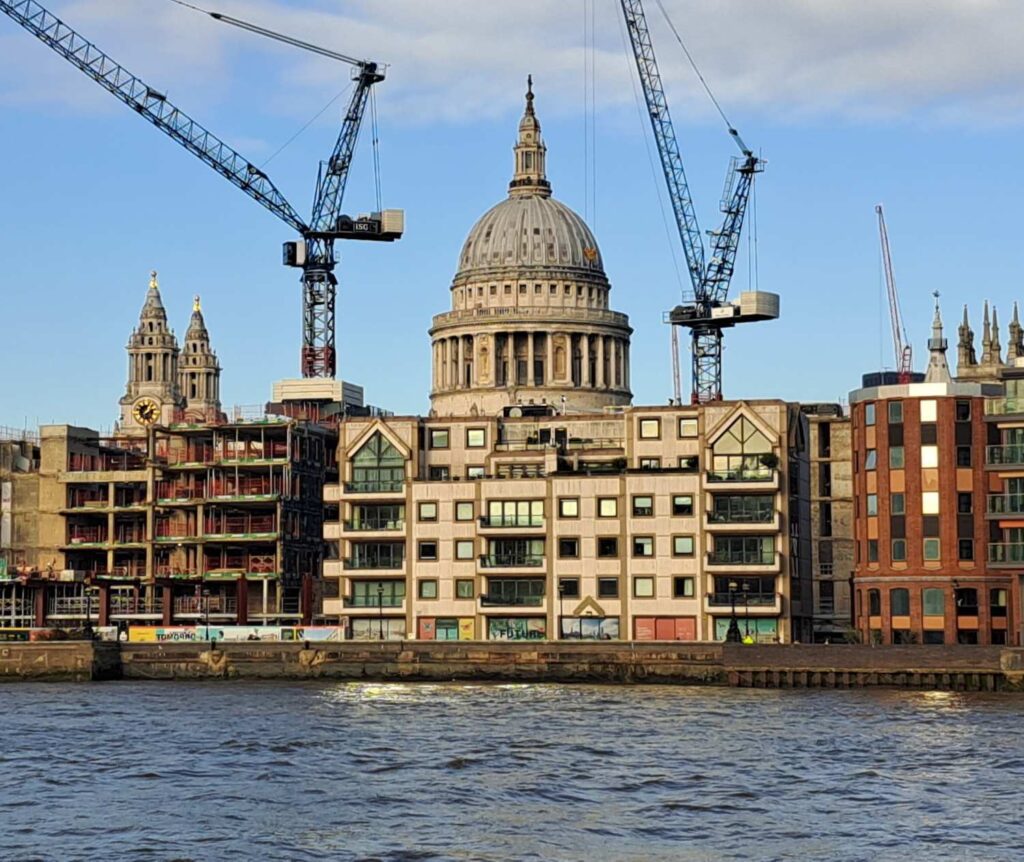
St Paul’s Cathedral from the Thames
Following this long journey, Nelson was finally laid to rest in the understory of St Paul’s Cathedral.
He was placed within a striking black marble sarcophagus with a remarkable history, which had been carved in the 1520s by the Florentine sculptor Benedetto da Rovezzano for Cardinal Thomas Wolsey. After Wolsey fell from grace, King Henry VIII claimed the tomb for his own intended burial. However, it was never used for the Tudor monarch and sat empty for centuries. It was not until 1806 that King George III donated the sarcophagus to hold Nelson’s remains, a placement explicitly calculated to elevate and secure his legacy for eternity beneath the centre of the cathedral dome.
This particular method of establishing a physical space for remembrance within St Paul’s holds a striking resonance for Soulton Hall.
The ancient, medieval St Paul’s Cathedral, which was eventually lost in the Great Fire of 1666, had for centuries held the magnificent shrine of Saint Erkenwald. Just as people today travel to see Saint Chad at Lichfield or Saint Cuthbert at Durham, medieval crowds sought Erkenwald at the heart of the cathedral. These seventh-century Anglo-Saxon figures were foundation stones for what became England; they were lawgivers and identity forgers who helped establish the legal and cultural framework for the nation to cohere.

The lost Shrine of Erkenwald
In the mid-sixteenth century, during a period of significant national restructuring, Sir Rowland Hill was directly involved in the administrative and civic shifts that saw the cathedral’s focus move away from these traditional shrines.
This transition reflects England’s changing values and its ongoing negotiation with virtue and faith across different eras.
The layout of the modern building physically demonstrates this progression, illustrating a process of discernment and cultural negotiation. On the main floor of the present cathedral, Erkenwald is physically gone, yet his example and a kind of cognitive technology are preserved at a side chapel. This balances with the distinct approaches found elsewhere: at Lichfield, where the memory of Chad is once again held with a dedicated shrine and relics, and at Durham, which stands in deep continuity because Cuthbert was never removed from his location—his grand medieval shrine simply being replaced by a plain, dignified slab.
At St Paul’s, however, during the extensive archaeological and clearance work following the Great Fire of 1666, Sir Christopher Wren noted that the ancient relics of Erkenwald were not there.
Following this phase of an empty place of honour, a new choice was made after the death of Nelson to bring a sense of presence back to the heart of the building. Now, the understory holds the primary place of remembrance, where Nelson rests in a space aligned directly below the great dome.
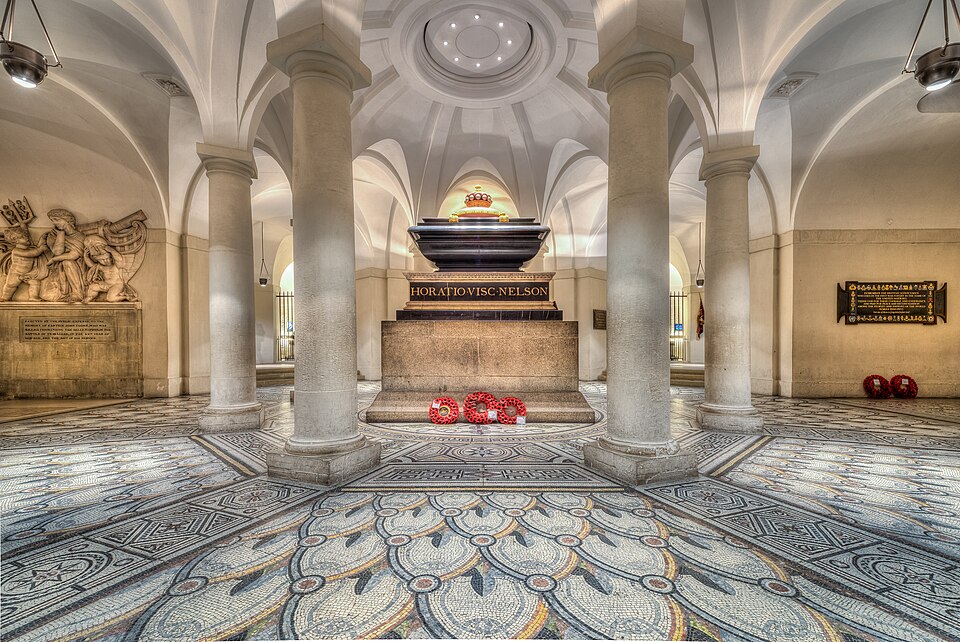
The Sarcophagus of Horatio Nelson in the understory of St Paul’s Cathedral (Photo: Wilfredor, CC BY-SA 2.0).
What does the choice to place Nelson within a Tudor tomb, originally crafted for a Renaissance cardinal and claimed by a king, invite us to meditate on?
Furthermore, what is the separation of these civic examples in the understory, away from the devotional focus on the main floor, telling us about the evolving nature of memory and legacy?
********
Beneath this grand theatre of state memory lay the raw human machinery that achieved the triumph.
The physical reality of Georgian seafaring becomes immediate as one enters onto the decks.
At the stern of the upper deck, the formal quarters of leadership presented a contrast to the conditions of the crew.
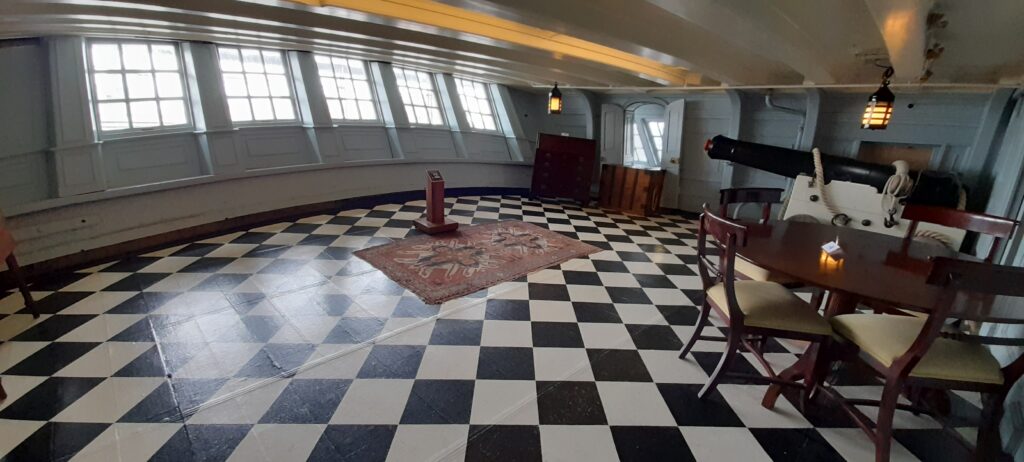
Situated directly above Vice-Admiral Nelson’s quarters, Captain Thomas Hardy’s day cabin was a bright, orderly, and geometric space at the stern that served as the crisp administrative center for managing the daily operations of the flagship.
Here, Captain Thomas Hardy lived and worked alongside Vice-Admiral Nelson, their adjacent cabins (one above the other) functioning as the operational brain of the flagship.
Across these cabins, which served as accommodation, his office and strategy room, the deck was covered with a painted canvas floorcloth decorated in a black-and-white geometric tile square pattern known to the navy as Nelson’s checker.
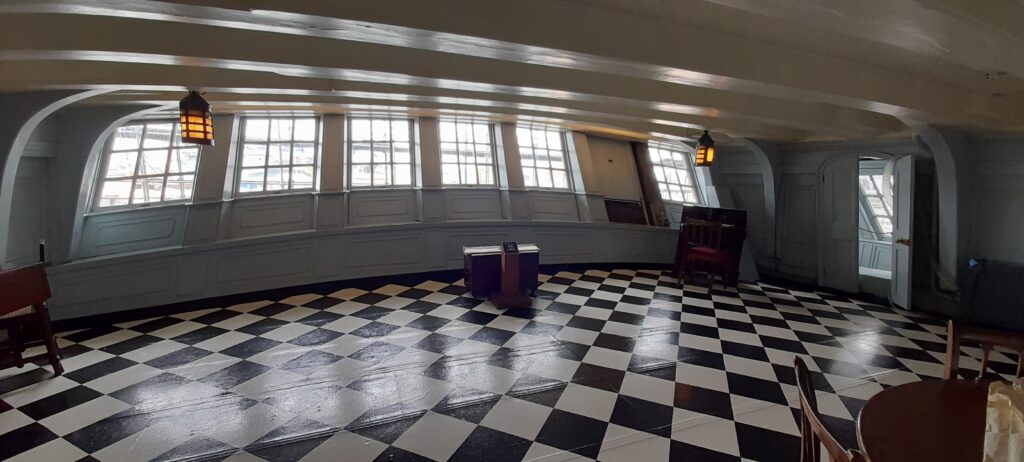
In his private day cabin, which served as his office and strategy room, the deck was covered with a painted canvas floorcloth decorated in a black-and-white geometric tile square pattern known to the navy as Nelson’s checker.
Yet, even these fine spaces were entirely subservient to the ship’s martial purpose; the bulkheads separating Nelson’s dining, day, and bed cabins from Hardy’s quarters were designed to be completely dismantled within minutes, clearing the entire deck for action when the drums beat to quarters.

The Admiral’s Dining Cabin was the large space where Vice-Admiral Nelson explained his radical tactical plan to his captains ahead of Trafalgar, an intimacy of command mirroring Shakespeare’s King Henry V that led Nelson to write—as he first did after the Battle of the Nile—that he “had the happiness to command a band of brothers.”
The vulnerability of this command centre was demonstrated in the heat of the engagement when the ship’s wheel was completely blown apart by enemy fire, forcing the surviving crew to rig up ropes below decks to steer the massive vessel by hand. This dynamic of command and community persists directly into the present day. HMS Victory maintains a small, dedicated modern crew, and she is still assigned her own commanding officer and a chaplain. The traditions of the vessel remain fiercely protected; children of the ship’s company are still baptised aboard using the time-honoured naval custom of filling the ship’s upturned bronze bell with water to serve as a font. Every year, this living community gathers on the quarterdeck for a formal Trafalgar Day service to remember the fallen and lay wreaths where Nelson fell, ensuring the human connection to the battle remains unbroken.
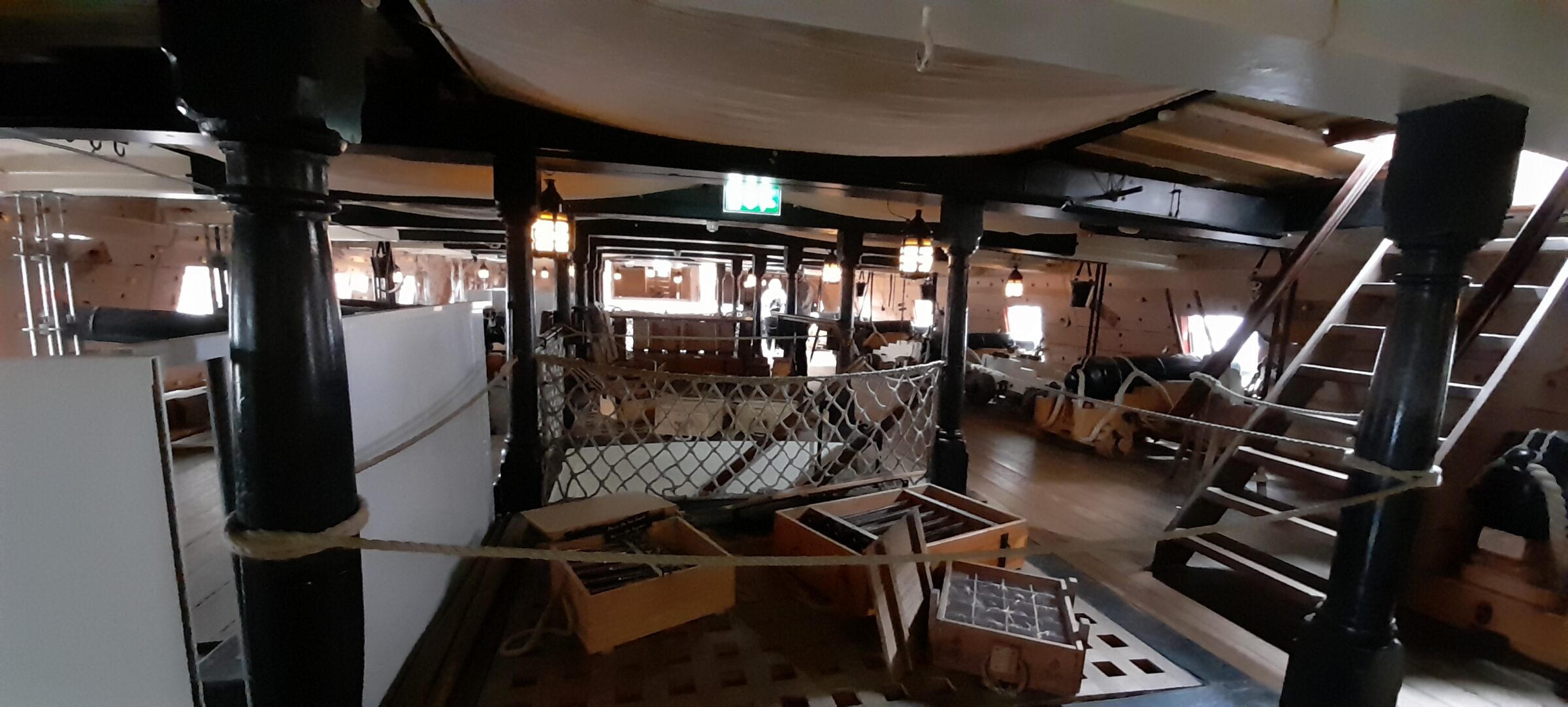
The cramped quarters of the gun decks stood in stark contrast to the stern cabins, with hundreds of men living, eating, and sleeping slung a mere 16 inches apart amidst the heavy weaponry.
Further down, the density of the ship’s company is captured by the sight of the hammock hooks, where men slept slung a mere 16 inches apart. Within this crowded lower gun deck, the hierarchy of the ship was maintained by thin, functional boundaries; the lieutenants and the chaplain slept in small spaces merely tented off with canvas screens.
-

- Lozenge Mouling in the Bridge area of HMS Vicory
-

- The origianal rudder with copper sheets
-
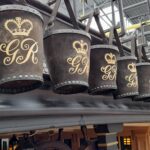
- Royal cyphers on fire buckets
-
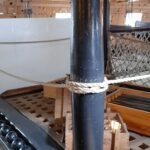
- Intersting cloumns all across HMS Victory
This vast company was drawn together at a time when there was no standing navy in the modern sense. It was an extraordinary moment of early nineteenth-century national crisis and shifting identity, where the burden of defense fell upon a mobilized populace.
Many of the men aboard were pressed into service, creating a crew that was an extraordinary cross-section of ordinary families. This reality connects directly to the contemporary stewardship of Soulton Hall, where James Wenn, a heritage consultant for the estate, traces his own ancestry back to the families that formed this wider company. It is amongst these very decks that we can also recall characters like James’s people whose names evoke the long, intergenerational human ties to the navy’s story. Men from all backgrounds shared these tight confines, building the close-knit company that held the line during the nation’s hours of crisis.
While these men fought on the rolling decks of the fleet, this sweeping struggle against Napoleon was matched simultaneously on land by other branches of these same families. The Hill family dynasty, deeply connected to this generation of national service, saw four brothers—including Wellington’s trusted general, Rowland Hill—fight across the battlefields of Europe, a collective family sacrifice culminating in their presence on the fields of Waterloo.

Lord (Rowland) Hill’s Column in Shrewsbury
The fate of the ship itself was nearly as fragile as the lives of her crew. Following the brutal pounding she took during the engagement, Victory was many times near to being lost. It required a monumental, desperate effort by her surviving crew to tow her to the safety of Gibraltar, ensuring she could be saved and preserved for the nation.
This tension regarding who is recognised as a hero, how they are held up, and what values a society chooses to celebrate remains central to the work of nation-building. It was a core question in the Anglo-Saxon days of Erkenwald, Chad and Cuthbert, it was true during the legacy days of Trafalgar, and it continues to shape our cultural landscape today.
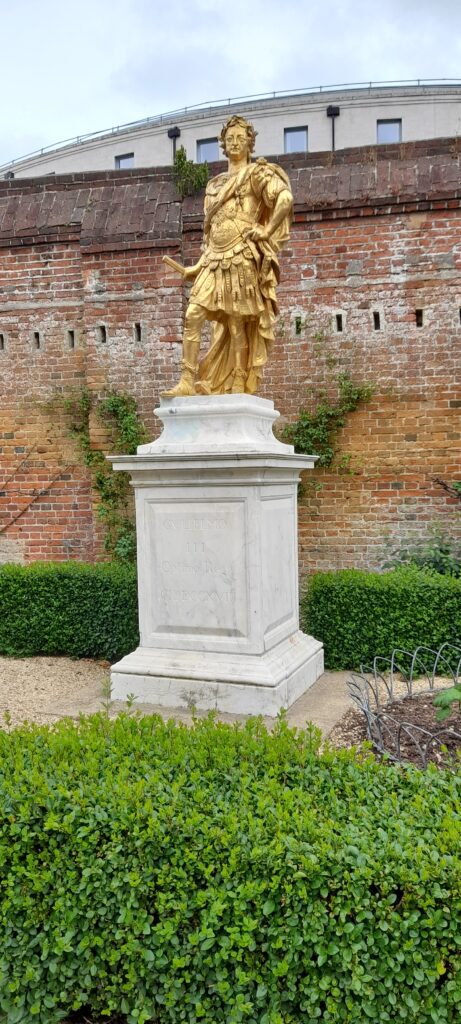
Inscribed by a commoner as “the best of kings,” this gold-gilt statue of William III as a Roman Emperor reveals how ordinary citizens actively shape the national legacy via arts commissioning.
