

The July/August 2026 issue of Land Business magazine presents an illuminating feature on Soulton Hall, titled “Hidden relics at the heart of the HOUSE”. Written by architectural historian and podcast producer Matthew Lloyd Roberts, this article offers a fresh perspective on the estate by synthesising the family’s anthropological history with the expert findings of heritage consultancy Byrga Geniht. The following text constitutes the complete original article.
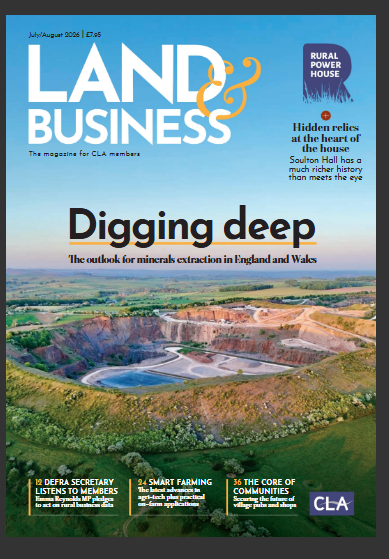
July 2026 CLA Magazine Cover
Hidden relics at the heart of the HOUSE
Soulton Hall in Shropshire has a far deeper and richer history than meets the eye, writes Matthew Lloyd Roberts
Have you ever felt your house is trying to tell you something? This sense has long dogged Tim Ashton, the incumbent of Soulton Hall, Shropshire, who has started to make sense of his home’s complex and misunderstood history in recent years with the help of historical research. Soulton Hall sits outside Wem in the verdant, wide-open landscape typical of the Welsh Marches. The house is stout and cubic, made of red brick with stone dressings and sited on a slight rise, giving it authoritative prominence in the surrounding landscapes. As you pass over a humpback bridge on the Isom and get your first look at its flatly symmetrical east façade, it seems pensive, considered. It suggests there might be something more going on below the surface.
Beneath the bricks For a long time, the house languished in relative obscurity. Architectural historians engaged in the great surveying and tabulating of England’s heritage in the 20th century didn’t quite know what to make of it. When visiting in 1996 to write the house’s entry in ‘The List’, English Heritage followed Nikolaus Pevsner’s dating and dating the building to the late 17th century, possibly with some vestiges of an earlier structure buried in the walls. However, a cursory look at the fenestration’s mullions and the curious deep blue diamonds of diapered brickwork trouble so late a dating. John Newman’s revision of Pevsner in 2006 pushes it back to an ‘unusual and impressive late Elizabethan or Jacobean house’, conceding that the lavishly baroque doorcase of 1688 was a later addition, commissioned to mark an important wedding in the family tree.
In recent years, several discoveries made by James D Wenn of heritage consultancy Byrga Geniht have suggested a much richer and nationally important story beneath the bricks, if you know how to look. The most important of these is the building’s origin; the house was in fact built earlier than architectural historians had previously asserted. Soulton Hall was constructed in the mid-16th century, between the reigns of Edward VI and Elizabeth I, as a country escape for a prominent but largely overlooked Tudor courtier called Rowland Hill. Hill was a member of the Worshipful Company of Mercers in the City of London and rose to prominence in the City. An astute businessman who was an important connection between the city, Crown and continental financiers, Hill charted a course through the turbulent years of sectarian recrimination that defined Tudor England. Having rapidly risen through the ranks of the Mercers’ Company in the 1540s, he was the first avowed Protestant to be elected Lord Mayor of London in 1549. As mayor, he was tasked under the religious reforms carried out by Edward VI with the removal of altars and shrines in the City’s churches, including the cathedral of Old St Paul’s.
Relics of Saint Erkenwald The research undertaken relating to Soulton Hall has suggested for the first time that, in this role, Hill might have secreted certain artefacts away from the cathedral during this period of iconoclasm – including the relics of Saint Erkenwald, the first Bishop of London during the seventh century. New discoveries indicate that the house might have been built in part to securely hide some of these liberated artefacts from the earliest days of Christianity in England – a question of great interest for the Anglican, Roman Catholic and Orthodox churches alike. The fabric of the house reflects the complex and uncertain political and religious climate of the time. A priest hole might have been a hiding place for Protestant cleric Matthew Parker, later Archbishop of Canterbury, when Mary I sought to reverse the religious changes and return England to Catholicism. It testament to Rowland Hill’s political acumen that he served in high office under Mary, despite later returning to his open Protestantism, supporting the publication of the vernacular Geneva Bible under Elizabeth I.
Hellenistic mystery cults The house’s inscrutable and curious codes are a testament to the need for secrecy and care in this febrile political environment. They also speak to an esoteric enthusiasm for cryptic symbols common in the cultures of Renaissance humanism. Byrga Geniht’s reading of the house links together Old Testament scripture, the geometry of the Rhombic Dodecahedron, Platonic conceptions of social harmony and the ritual practice of Hellenistic mystery cults into a dense language of form.
A landscape presenting the relics of Saint Erkenwald. A baroque doorcase marked a family wedding.
Living Amid Mystery Growing up at Soulton Hall, I always knew things were kept back – a mystery that bugged my family for generations, ever since my six-times-great-grandmother, Hannah Deakin, last saw the whole picture clearly. The Hill family tree, of which I am a cousin, which has grown, been pruned, and notoriously sprawling – very much like that of J.R.R. Tolkien’s hobbits. When dynastic fame drifted to Hardwicke in the 17th century, the sedentary arrival of the Ashton family and its Lancashire focus provided a crucial counterweight. It is allowed Soulton to be maintained quietly as a private museum, safely shielded under the practical cover of a working farm. Maintaining this century, made sense given the physical danger stretching into the 20th century. Yet, over that, that unwritten narrative fractured into a library with no shelves, its books jumbled in boxes. I am not qualified to be a curator; that takes outside expertise, which is why I bring in specialists to build the shelves. When you are familiar with a place from birth, you cannot see that the things right around you are unusual. These codes were traditionally never written down. Being dyslexic helps me embrace that non-linear, visual thinking, but modern scholars demand I write everything out – which is absolute agony. – Tim Ashton
It seems highly likely that Old Sir Rowland de Boys, a crucial character in As You Like It, was based on Rowland Hill.
Inspiration for Shakespeare The rich humanist culture that clearly attended Soulton Hall’s community in the 16th century has a striking afterlife in literary history. Shakespeare’s As You Like It, first performed in 1599, was derived heavily from a text by Thomas Lodge, Randynde. In circumstances of severe financial challenge, Lodge’s father, a City merchant in the Grocers’ Company and a Lord Mayor who sicced own grandfather had also been a Grocer and Lord Mayor, to preserve the Lodge family’s dignity. It seems highly likely that Old Sir Rowland de Boys, a crucial character in As You Like It, was based on Rowland Hill, and that the harmonious pastoral landscapes of the play were inspired by the house’s setting and in humanist vision of a concordant society.
Telling the story today In recent years, Soulton Hall has hosted services to mark the house’s connections to England’s turbulent Christian history. This is committed to maintaining a culturally and historically engaged multi-faith space, and even recreated a Neolithic long barrow on his land, now used as a burial place by various ancient religious communities. He makes the crucial point that telling the stories of historic buildings well can bring huge opportunities for cultural programming, heritage grants and tourism – but only if you know the story and how to tell it. – Matt Roberts is an architectural historian.”
By publishing this research, Soulton Hall has been successfully transitioning from a collection of fragmented family memories to a formal, documented historical narrative. The article highlights the importance of using external expertise to audit family histories, ultimately allowing the estate to share its rich cultural and historical significance with the wider public.
