


Tom Holland has just shared the news that The Rest Is History is turning its attention to The Tudor Cold War, the announcement was met with genuine delight here at Soulton Hall.
Starting next week on @TheRestHistory, spies, spy chiefs, Jesuits, sea dogs & rival queens: THE TUDOR COLD WAR.
Featuring:
– The Virgin Queen!
– Sir Francis Drake!
– Sir Francis Walsingham!
– Mary, Queen of Scots!All the episodes will be here: https://t.co/NNgwZQX0q7 pic.twitter.com/66xW4DW7RV
— Tom Holland (@holland_tom) July 25, 2026
We have long been respectful admirers of the podcast, following Tom and Dominic Sandbrook’s work with great appreciation.
Beyond that, Soulton has enjoyed a long-standing friendship with Tom over the years. To see the show bring its characteristic energy and deep narrative drive to this pivotal historical era is wonderful news.
As Tom and Dominic explore the statecraft, secret networks, and covert operations of the period, we are reminded that the Elizabethan “Golden Age” did not simply materialise out of thin air.
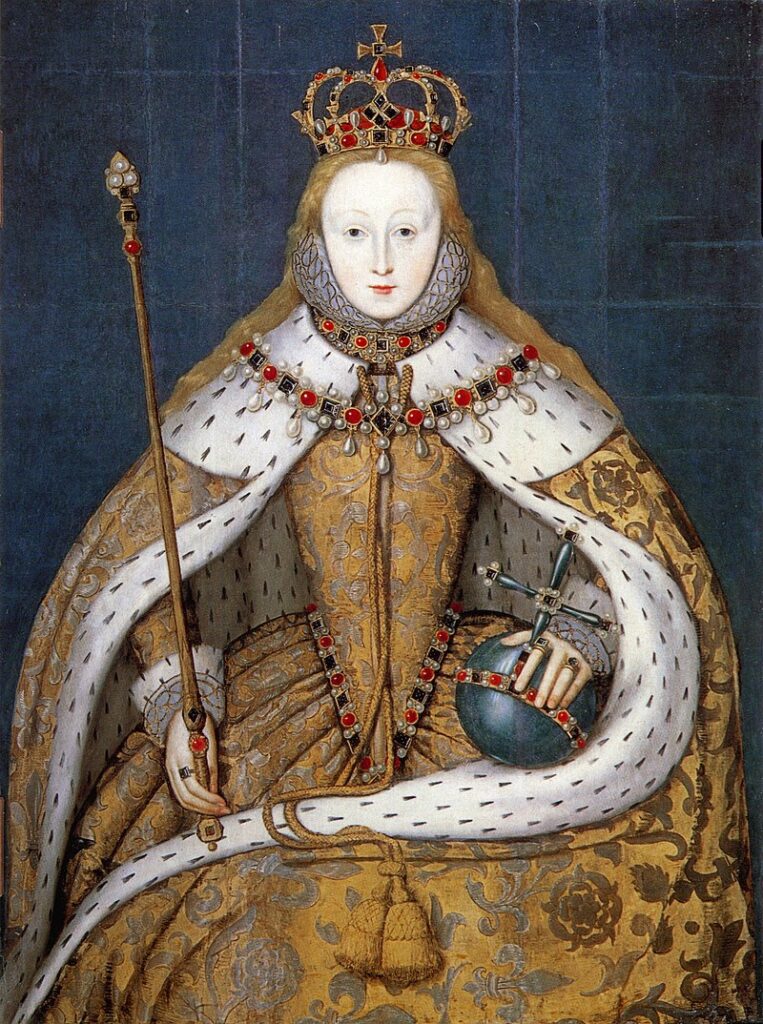
Elizabeth I’s ‘godfather’ Matthew Parker (who had been chaplain to her mother Anne Boleyn) appears to have been kept safe by “Old” Sir Rowland, at Soulton. Hill also would have been able to keep a close eye on Elizabeth I’s safety in the troubling household of Thomas Seymour.
Its true wellsprings lie further back, in the deeply fraught decade of the 1550s.
During the mid-sixteenth century, England was a realm under severe pressure.
Religious upheavals, economic instability, and the shadow of continental powers created an environment where every move had profound consequences.
It was a period when survival required exceptional care, discretion, and forward planning.
At Soulton, this fraught era is in the foundations of the house.
Built in the 1550s by Sir Rowland Hill—the first Protestant Lord Mayor of London—the hall is a physical witness to how thinkers, statesmen, and scholars navigated those dangerous years before the Elizabethan Golden Age.
The quiet resistance, intellectual preservation, and subtle design choices embedded into Soulton reflect a time when people learned to protect ideas while the political winds shifted around them.
When Elizabeth I took the throne, the lessons of those turbulent 1550s bore immediate fruit.
The statecraft that defined her reign embodied by Lord Cecil and Sir Francis Walsingham, was forged in the crucible of mid-century anxieties.
As The Rest Is History dives into this world of spy chiefs, Jesuits, sea dogs, and rival queens, we will be listening with immense interest.
The story of how England navigated its cold war with Spain is thrilling, and understanding its roots in the fraught years of the 1550s makes the narrative all the richer.
We raise a glass to Tom, Dominic, and the whole team at The Rest Is History (which you can join here) as they bring this remarkable chapter to life.
The Apple Podcast links are as follows, and we are adding notes of refections on them as they are listened to:
-

William Cecil: receives a dedication in a text from the Rowland Hill/Hall press (The History of the Gothic War): TO THE RYGHTE HONORABLE SIR WILLIAM SICI• KNIGHTE PRINCIPALL SECRETARIE TO THE QUEENES MAIESTIE &C — William Cecil, 1st Baron Burghley (from NPG)
LINK: Elizabeth I vs The Catholics: The Queen’s Spymaster (Part 1)
-
-
Note from Soulton Hall on Part 1:
-
William Cecil’s Character & Origins: Tom Holland calls out Cecil as a hugely talented and pre-eminent English statesman. We are ourselves often particularly struck by his closeness to Matthew Parker (godfather to Elizabeth I). Tom also went to great pains to walk through Cecil’s origins in the Welsh Marches—a background that resonates strongly with our local regional history surrounding Sir Rowland Hill. There was also commentary on Cecil House being newly built on Strand in London as his ordely HQ between London and Wesmister. Tom also talked about publication of things without obvious links to the source being a mode of Cecil as well as his intersts in codes.
-
Stability Over Soap Opera: While people often view the Tudors as mere soap opera, Dominic Sandbrook rightly highlights how Cecil and his circle kept the country stable and united, actively working to stop that threatening march of history from reaching these shores.
-
The Low Countries & The Refugee Crisis: Following the Beeldenstorm (the Protestant mob actions in Belgium and Holland), Philip II moved aggressively in 1567 by sending the hardest man in Spain, the Duke of Alba, along with his Council of Troubles (“Court of Blood”) to execute Protestants on a massive scale. Huge numbers fled to England, triggering the Dutch Revolt. In England, this slaughter across the Channel provoked outrage, solidarity, and a warm welcome for refugees, consolidating the idea of Tudor England as a realm of peace while people looked across the water at an arch of slaughter—leading many to view Elizabeth almost as a “Fairy Queen,” as Garrett Mattingly noted regarding the English belief that she was warding off the threatening march of history.
-

Louis I, Prince of Condé whose Declaration was published by the Rowland Hill/Hall press.
The French Crisis & Toleration: Tom discussed the French descent into turmoil starting with the Wassy Massacre of 1562, orchestrated by François, Duke of Guise, which quickly turned into a complete disaster and created the bogeyman status of Henri I de Lorraine, Duke of Guise.
-
We would like to spotlight a link to this broader intellectual milieu was the publication by the Rowland Hall Press—an emanation of the culture surrounding old Sir Rowland—of A Declaration Made by the Prince of Condé (1562), which stood as a crucial early call for tolerance amidst continental bloodshed.
-
-
-
-
LINK: Elizabeth I vs The Catholics: A Massacre in Paris (Part 2)
- Note from Soulton Hall on Part 2:
-
-
- The Paris Crucible & Walsingham’s Mindset: Tom and Dominic provide a graphic account of the St. Bartholomew’s Day Massacre of 1572—a horrific event witnessed firsthand by Francis Walsingham while serving as ambassador in Paris. The trauma of seeing streets run red with Protestant blood completely forged Walsingham’s unyielding worldview. For William Cecil, news of the slaughter was the ultimate confirmation of his worst fears: that European Catholicism posed an existential, apocalyptic threat to the realm.
-
Treason vs. Religious Recalcitrance: A vital distinction highlighted in the episode is how the Crown established the lawful basis for moving against people. The state drew a deliberate line between mere religious recalcitrance (recusancy, or refusing to attend Anglican services) and secular high treason. While recusancy incurred heavy fines, it was the charge of active treason—plotting against the sovereign, aiding foreign powers, or denying the Queen’s legal supremacy—that provided the legal authority to crack down on underground networks.
-
The Frame for the Jesuit Mission: This continental bloodbath and legal framing explain the profound sense of urgency that greeted the arrival of Jesuit priests. Viewed through the trauma of 1572, these covert networks were not treated by the Privy Council merely as men delivering sacraments, but as an advance guard engaging in treasonous subversion. By framing their actions as threats to national security rather than matters of simple conscience, Cecil and Walsingham justified deploying spymasters, double agents, and informants to infiltrate the network.
-
-
-
-
*Applied Science, Magic, and State Security: Looking beyond the episode into the broader story of informant Charles Sled, his placement inside Dr. John Dee’s household reveals a crucial element of the Elizabethan state’s paranoia. To Cecil and Walsingham, applied science, alchemy, and “spirit channeling” were not viewed as harmless intellectual curiosities—they were seen as grave national security risks.
-
*The Intelligence Threat: Men like Dee and Edward Kelley operated with codes, foreign correspondence, and advanced mathematics. The Crown feared these esoteric practices could be used to cover foreign conspiracies, subvert the economy through counterfeiting, or leak military and navigational intelligence to rival Catholic powers across the Continent. Sled’s presence at Dee’s table highlights how the Elizabethan intelligence network drew little distinction between political subversion and dangerous, unsupervised intellectual science.
- *These notes expand on the wider historical story beyond the scope of the episode.
-
-
-

Portrait by Gheeraerts of Francis Drake (1591), Public Domain
LINK: Elizabeth I vs The Catholics: England’s Greatest Hero (Part 3)
- Note from Soulton Hall on Part 3:
-
-
- Limited Regional Connection: Unlike Sir William Cecil or Sir Philip Sidney, Sir Francis Drake has no direct local ties to Soulton Hall or the Welsh Marches. His presence in the episode belongs to the broader global narrative of Elizabethan naval history rather than our local regional story.
- The Beginnings of the Transatlantic Slave Trade: It is crucial to note that Drake’s early career in the 1560s, sailing alongside John Hawkins, marked the formal start of English participation in the transatlantic slave trade. While his later Caribbean raids altered European financial markets, these early slave-trading voyages are sobering to remember.
-
-
LINK: Elizabeth I vs The Catholics: A Treacherous Conspiracy (Part 4)
- Note from Soulton Hall on Part 4:
-
Francis Drake’s Predicament: Drake’s return from his global circumnavigation in 1580, laden with plundered Spanish silver, plunged the Privy Council into a massive debate. Handing the treasure back meant appeasing Spain, but keeping it meant funding the Crown while risking open war. Elizabeth I ultimately handled the crisis through strategic diplomacy: she knighted Drake aboard the Golden Hind, framing his voyage as a state triumph while simultaneously courting the Duke of Anjou to secure a French alliance against Philip II.
-
Conspiracies and the Bond of Association: Episode 4 tracks the escalation of Catholic plots—including the Throckmorton Plot—aimed at assassinating Elizabeth I and replacing her with Mary, Queen of Scots. This existential threat led William Cecil and Francis Walsingham to draft the Bond of Association (1584), a legal trap designed to execute anyone in whose name a plot was made, regardless of their direct knowledge.
-
Giordano Bruno and “Henry Fagot”: The theory advanced by historian John Bossy—that the French embassy spy code-named “Henry Fagot” was actually the radical philosopher Giordano Bruno—offers a fascinating perspective on Elizabethan intelligence. Bruno was a charismatic intellectual whose esoteric theories on an infinite universe and alternative cosmology eventually led to his execution at the stake in Rome in 1600. While most mainstream historians treat the “Fagot” identity as circumstantial due to a lack of direct archival proof, his presence in Sir Philip Sidney’s circle underscores the deep overlap between Renaissance intellectual philosophy and state espionage.
-
- Note from Soulton Hall on Part 4:
-

Sir Philip Sidney, after Antonis Mor
LINK: Elizabeth I vs The Catholics: The Shadow War (Part 5)
- Note from Soulton Hall on Part 5:
-
-
-
-
The Generation Raised in Siege & A Royal Namesake: Tom Holland and Dominic Sandbrook highlight how Sir Philip Sidney (born November 1554) represents a generation that grew up knowing nothing other than an embattled, threatened England. In a striking historical twist, Sidney was named after his godfather—King Philip II of Spain, then joint ruler of England following his marriage to Mary I. Born into the upheaval of the 1550s, Sidney’s entire worldview was forged in an atmosphere of existential struggle against continental Catholic powers. This lifelong sense of siege gave him an aggressive, uncompromising Protestant zeal that directly collided with Queen Elizabeth I’s cautious diplomacy and defensive restraint.
-
The Fall of Antwerp & The Financial Realignment: When the Duke of Parma captured Antwerp in August 1585 and Dutch rebels blockaded the River Scheldt, the international credit system collapsed overnight. While London was not yet fully equipped to absorb Antwerp’s massive trade volume, the institutional preparation laid decades earlier by Mercers like Sir Rowland Hill and Sir John Gresham—and carried forward by Sir Thomas Gresham at the Royal Exchange—positioned England to adapt. However, the immediate capital flight fled north to Amsterdam, transforming it into the financial heart of Northern Europe, while London laid the groundwork for its own long-term rise.
-
The Treaty of Nonsuch & The Cautionary Towns: The fall of Antwerp triggered an immediate response: the Treaty of Nonsuch (August 1585). Elizabeth agreed to send an expeditionary force of 6,400 foot soldiers and 1,000 cavalry under the command of Robert Dudley, Earl of Leicester. In return, the Dutch handed over key strategic strongholds—the “Cautionary Towns” of Flushing (Vlissingen), Brill (Brielle), and Fort Rammekens—to be garrisoned by English troops (with Sir Philip Sidney appointed Governor of Flushing). Holding these ports gave the English joint control over maritime traffic leading into Antwerp, effectively choking off Spanish trade routes and turning a defensive alliance into an active blockade.
-
1585: Vindication of the Hawks: By 1585, the catastrophic collapse of Protestant fortunes in Europe proved that Sidney and Sir Francis Drake had been entirely justified in their warnings about Spain. Following the assassination of William the Silent in 1584 and Parma’s advances in the Low Countries, the threat of a Spanish invasion ceased to be a paranoid fantasy. Elizabeth’s strategy of defensive delay reached its limit, forcing her into direct military conflict with Philip II.
-
The Continental Crucible & Walsingham: During his youthful Grand Tour of Europe (1572–1575), a seventeen-year-old Sidney arrived in Paris to stay at the embassy of Sir Francis Walsingham. King Charles IX of France warmly received the young courtier, appointing him a gentleman of the royal bedchamber and creating him “Baron de Sidenay” (a French title Elizabeth I naturally ignored). Just days later, Sidney witnessed the horrors of the St. Bartholomew’s Day Massacre from the safety of Walsingham’s residence—a terrifying ordeal that cemented his radical Protestant conviction and forged a lifelong bond with Walsingham, whose daughter, Frances, Sidney later married in 1583.
-
Venice, the Occult Emperor in Prague, and William the Silent: Traveling onward through Italy and Germany, Sidney met Henry III in Venice (then on his way to assume the French crown). In 1577, he was sent as Elizabeth’s envoy to Prague to meet the newly crowned Holy Roman Emperor, Rudolf II—the reclusive, eccentric Habsburg monarch famously obsessed with alchemy, astronomy, and the occult. Sidney also met William of Orange (“William the Silent”) in the Low Countries. Orange was so deeply impressed by Sidney’s intellect and diplomatic stature that he called him one of the finest statesmen in Europe and even discussed a marriage alliance between Sidney and his own daughter.
-
Intelligence Debriefing, Esoteric Circles, and Spenser: Upon returning from his continental missions, Sidney was thoroughly debriefed by William Cecil (Lord Burghley), who carefully weighed the young man’s sharp observations on foreign courts and Catholic alliances. Back in London, Sidney immersed himself in the leading scientific and philosophical currents of the age. He studied chemistry, navigation, and mathematics with the Queen’s astrologer and polymath Dr. John Dee, and became the principal English patron of the radical Italian philosopher Giordano Bruno during his London years (1583–1585), with Bruno dedicating two major works to Sidney (The Expulsion of the Triumphant Beast and On the Heroic Frenzies). Sidney also championed the young poet Edmund Spenser, who dedicated The Shepheardes Calender (1579) to him.
-
Economic Warfare: Drake Undermines Philip II’s Credit: Sidney formed a strong bond with Sir Francis Drake, sharing a vision of attacking Spanish power at its economic source. When Queen Elizabeth ordered Sidney back to court, Drake sailed for the Caribbean alone—inflicting psychological and financial devastation on the Spanish Empire. Beyond sacking Santiago, Santo Domingo, and Cartagena, Drake’s rampage struck at the heart of Philip II’s international financial standing. By seizing treasure fleets and ransom bullion, Drake choked off the flow of New World silver that underwrote Philip’s imperial debt. The panic sent shockwaves through the financial houses of Genoa, Venice, and Augsburg; Spanish credit ratings plummeted, interest rates on royal loans skyrocketed, and major merchant banks in Northern Italy collapsed. Drake proved that Spanish hegemony was built on a fragile foundation of leveraged credit, severely impairing Philip II’s ability to finance his military campaigns in Europe.
-

Portrait of Mary Sidney (1561–1621), wife of Henry Herbert, 2nd Earl of Pembroke (1538-1601)
Wilton House & the Literary Circle: The episode opens with a spotlight on Wilton House, the estate of Philip’s sister, Mary Sidney Herbert, Countess of Pembroke. When banished from court for his outspoken political advice, Sidney retreated to Wilton House to write. This household became a monumental hub of English literature: Mary’s son, William Herbert, 3rd Earl of Pembroke, became a primary patron of William Shakespeare, and local tradition holds that Shakespeare’s company performed As You Like It at Wilton House in 1603.
-
Friction with the Crown: Elizabeth I held deeply conflicted views on Sidney. Recognizing his brilliant mind, she nonetheless viewed him as headstrong and insolent—particularly after he wrote her a direct letter opposing her proposed marriage to the Catholic Duke of Anjou. This friction kept him away from core administrative power until 1585, when the escalating crisis in the Low Countries forced her hand.
-
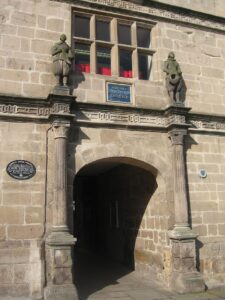
The entrance to the Old Shrewsbury School buildings – an instutution renewing the Saxon traditions of education, which Sir Rowland Hill helped to set up
Shropshire Connections & Regional Governance: We are particularly drawn to Sidney’s deep roots in our local Shropshire landscape. Sidney was educated at Shrewsbury School (entering in 1564 alongside his biographer, Fulke Greville). His father, Sir Henry Sidney, served for over two decades as Lord President of the Council in the Marches of Wales—governing from Ludlow Castle and the Council House in Shrewsbury alongside prominent regional figures linked to old Sir Rowland Hill.
-
The Low Countries, Zutphen, and “Thy Necessity”: Sidney’s death at the Battle of Zutphen in 1586 came during England’s direct military intervention in the Dutch Revolt, as the Protestant north (the Union of Utrecht, forming the modern Netherlands) split from the Catholic south under Spanish pressure. His death cemented his legend: mortally wounded by a musket ball to the thigh, Sidney allegedly offered his water bottle to a dying foot soldier, uttering the immortal words, “Thy necessity is yet greater than mine.” Sidney’s sacrifice marked a decisive turning point where England’s cold war with Spain—led by his former godfather, Philip II—erupted into open warfare.
-
-
-
-

La mort de Marie Stuart, 19th-century painting by Abel de Pujol (Public Domain)
LINK: Elizabeth I vs The Catholics: Killing the Queen of Scots (Part 6)
- Note from Soulton Hall on Part 6:
-
The Gruesome Execution at Fotheringhay (8 February 1587): Elizabeth I’s immense reluctance to execute a fellow anointed sovereign delayed the signing of the death warrant for months. When the execution finally took place, it proved infamous: the executioner required multiple blows to sever her head, and when he raised it by the hair, her wig came off in his hand to reveal short grey hair beneath. Following the execution, her small skylark terrier was discovered hiding beneath her voluminous skirts, refusing to leave her body.
-

Coughton Court Base Court; the manor is the gateway to the Forest of Arden
Local Connection & Physical Relic (Coughton Court): Stripped of her black outer mourning clothes, Mary revealed a deep crimson velvet petticoat—a calculated act framing her death as Catholic martyrdom rather than state treason. While her outer garments were burnt to prevent them from becoming relics, a significant surviving physical artifact connected to that morning sits locally to us at Coughton Court in Warwickshire: a fine linen execution chemise (smock) reputed to have been worn by Mary on the scaffold.
-
- Note from Soulton Hall on Part 6:
Bonus Content
There will be some bonus content too, and it includes an episode about Old Sir Rowland Hill and Soulton Hall; you can find out more about that here.
