


“A Really extraordinary story.. an incredible story…
an authentic link to Shakespeare”
– Tom Holland, The Rest Is History podcast
“Wow.”
– Dominic Sandbrook, The Rest Is History podcast

James Wenn and James Syrett of the Byrga Geniht Consultancy recovered the forgotten geometrical language and Renaissance mathematical frameworks hidden within historic British architecture, exemplified at Soulton Hall but extending widely across historic buildings.(Byrga Geniht/PA)
Uncovering the Tudor Secrets of Soulton Hall
We are pleased to report that Soulton Hall and the story of “Old” Sir Rowland Hill is now featured in a newly released bonus episode of The Rest Is History, hosted by Tom Holland and Dominic Sandbrook, as part of their series on the Tudors.
You can stream the newly released bonus episode of The Rest Is History on your preferred podcast platform to hear Tom Holland and Tim Ashton explore this story, which Tom describes as
“an amazing story, obviously an amazing ongoing process of discovery with perhaps further surprises awaiting to be found…”
Having known Tom Holland for a long time, we have shared many conversations over the years about this special place. As Tom remarked during the recording, it is
“one of the most amazing houses you will find anywhere in England.”
-

- Soulton Hall: “house of mystries”
-
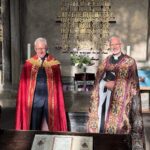
- Tom Holland at Durham Recently
________
Useful links at a glance
- Soulton Hall x The Rest Is History Press Release 12 August 2026 (PDF)
- Statement from the Ashton Family Ahead of The Rest Is History Episode
- History Overview on the Soulton Hall website
- Videos for conference proceedings on these matters have been placed on the home page under the heading “A LEGACY OF RESILIENCE AND REDISCOVERY”
- View video lectures and wider historical interpretation provided by heritage consultants Byrga Geniht Ltd on their YouTube Channel.
- Selected coverage to this point on these matters (updated as matters develop)
________

Like us, Tom was long intrigued and puzzled by the deeper, hidden story of Soulton Hall and felt there was much more beneath the surface waiting to be understood, noting that it has been observed that
“once you understand [Soulton Hall], it talks to you…”
How to Find the Podcast Episode
Listeners can access the newly released bonus episode of The Rest Is History right now.
-
Streaming Platforms: Available on major podcast players including Spotify, and via The Rest Is History official website.
-
Details: Hosted by historians Tom Holland and Dominic Sandbrook, this special release features a deep dive into the Tudor secrets, coded architecture, and hidden history of Soulton Hall.
Pioneering Research: James Wenn and James Syrett of Byrga Geniht

This image depicts a scholarly reconstruction of Soulton Hall, highlighting architectural elements inspired by various references. Image created by Byrga Geniht Consultancy for Soulton Hall
Unlocking these long-held secrets would simply not have been possible without the extraordinary work of James Wenn and James Syrett of Byrga Geniht.
As Tom Holland observed during their exploration, this represents
“something… a little unexpected, a little bit mysterious… We are going to be exploring the nearest to a Tudor ‘Da Vinci Code’ I have ever come across…
A story in the process of being told.”
We owe James and James massive credit and deep gratitude for their groundbreaking research, brilliant architectural analysis, and tireless dedication.
Their revelations have transformed our understanding of Soulton Hall, demonstrating how intellect, coded design, and quiet determination were used to protect the shared past of the nation during a period often remembered only for widespread Tudor destruction. Tom Holland remarked in the podcast that Soulton was:
a kind of profoundly Humanist response to what has been going on – the sectarianism…
The Preservation of Saint Erkenwald
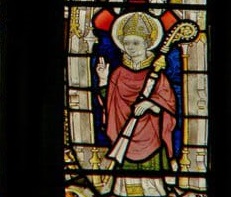
St Erkenwald, C7th Prince of the East Saxons, Bishop of London, Saint.
Saint Erkenwald was the seventh-century bishop and patron figure of medieval London.
When royal orders directed the dismantling of his famous tomb at Old St Paul’s Cathedral, Sir Rowland Hill stepped in behind the scenes.
James Wenn and James Syrett uncovered two remarkable connections right here at Soulton. First, they proved that the proportions and structural geometry of Soulton Hall directly echo the recorded dimensions of the Erkenwald monument in London. Second, they identified that parched ground marks in the central court reveal a hidden square structure, marking the location where sacred material was secretly reinterred.
Bringing this to light, Tom Holland questioned in the podcast:
There is one kind of final mystery, isn’t there? And that is perhaps the most intriguing aspect of your research – Rowland Hill was the Lord Mayor at the height of the iconoclasm in the capital … Woah! So, he brought the High Altar and what? And what of Saint Erkenwald’s tomb do you think he might have brought?
Summarising:
the relics of Saint Erkenwald – the first Bishop of London – and the Altar Stone of St Paul’s Cathedral – both dismantled when he had civic responsibility for St Paul’s… you think he brought them to Soulton Hall.”
The Lost Altar Stone of Old St Paul’s

The St Paul’s-linked stone at Soulton Hall
In 1550, while serving as Lord Mayor of London, Sir Rowland was tasked by Bishop Ridley and the Crown with taking down the High Altar of Old St Paul’s Cathedral, coming to power, as Tom Holland put it:
at a time of violent iconoclasm under Edward VI when the bones of saints are being tipped out…
Official accounts led people to believe these key structures were destroyed.
However, the research by Byrga Geniht into the architectural language of Soulton showed that the entire planning of the Hall honoured a central basement room planned around a stone whose dimensions match a medieval altar.
Easter Sunrise in the Aedicule (small chapel) at Soulton Hall. This is the most senior room, containing an altar stone linked to Old St Paul’s Cathedral. The St Paul’s-linked stone at Soulton Hall.
It is now believed that Old Sir Rowland Hill wished the building to be understood as a statement that he did not destroy, but rather smuggled out and preserved this focal piece of London’s heritage, operating as, Tom Holland said in the Rest Is History Podcast:
a monument to the idea, no matter the doctrinal or denominational difference, these differences may be reconciled.
A Sanctuary of Resistance and As You Like It
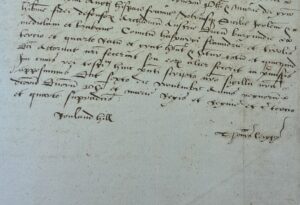
The Signatures of Old Sir Rowland Hill and Sir Thomas Lodge (father of the As You Like It source text writer, Thomas Jr.) on the 1500s Soulton Papers
Sir Rowland Hall created Soulton Hall around 1556 as a place of safety, scholarship, and quiet resistance, forming what Tom Holland stated was:
a house FULL of mysteries.
Beyond its hidden spaces used to protect forbidden texts, the hall holds profound ties to English literature.
The Signatures of Old Sir Rowland Hill and Sir Thomas Lodge on the 1500s Soulton Papers.
The estate directly inspired the setting and spirit of reconciliation found in Thomas Lodge’s work and William Shakespeare’s As You Like It.
As Tom Holland noted of its builder,
Sir Rowland Hill lives to a ripe old age. By the time he died, he is a figure of immense authority, and to a degree – I guess – of mystery. Perhaps a sense that he has been embroiled in great things. And adding to the aura around him is the fact that there is a Shakespearean connection… His name appears in one of Shakespeare’s plays.
The character of Old Sir Rowland de Boys in the play honors the memory of Sir Rowland Hill, celebrating a legacy of wisdom, shelter, and peace during turbulent times.
Here are thehighlighted quotes from Tim Ashton in the podcast:
-
On the hidden nature of his childhood home:
“No one knows what’s normal outside of their own sort of experience… quite how unusual this house is is not that easy to discern without getting an external perspective.”
-
On Sir Rowland Hill as an enigmatic figure:
“I think living in his house and being familiar with his legacy… he’s a riddle inside an enigma. It’s very hard to get to the bottom of his motivations.”
-
On building a memory palace in reality rather than just the mind:
“It’d be very shocking that you would sort of build a memory palace in your head to pass an exam… But he built a real one in the real world.”
-
On the danger of theological debates and the use of classical alternatives:
“In a period of political emergency where people are suffering for their faith, talking directly on theological bases is quite dangerous. But you can do.. comparative religion [via] classical religious mysteris.. It’s a way of talking without getting danger.”
-
On Shakespeare’s As You Like It as a cultural monument:
“I would go further and say that As You Like It is a cultural monument to Sir Rowland Hill and the projects he was involved in.”
-
On the survival and relocation of the high altar stone from St. Paul’s Cathedral:
“The night that the altar stone in St. Paul’s Cathedral was taken out was the eleventh of June, 1550, in the mayoralty of Rowland Hill. He had to change the public holidays and cancel a public holiday that day ’cause he knew there’d be a riot… three people died that night [in a fight in Old St Paul’s] The stone [thought to be the lost altar] is broken in three bits. It would have to be if it was being visibly… desecrated.”
-
On what visitors should expect from a tour of the property:
“At the moment they’re offered once a month. They sell out consistently. They take two hours: don’t expect any prisoners to be taken: you will have to know about Shakespeare and Plato and four-dimensional space by the end of it!”
Experience Soulton Hall Firsthand
If you wish to move beyond the podcast and step directly into the history, you can experience Soulton Hall by trading with us and booking onto our specialist heritage tours. Walk the grounds, examine the coded Tudor geometry, and see the remarkable spaces where these centuries-old secrets were preserved. Details and tour bookings are available directly through the Soulton Hall website.
