

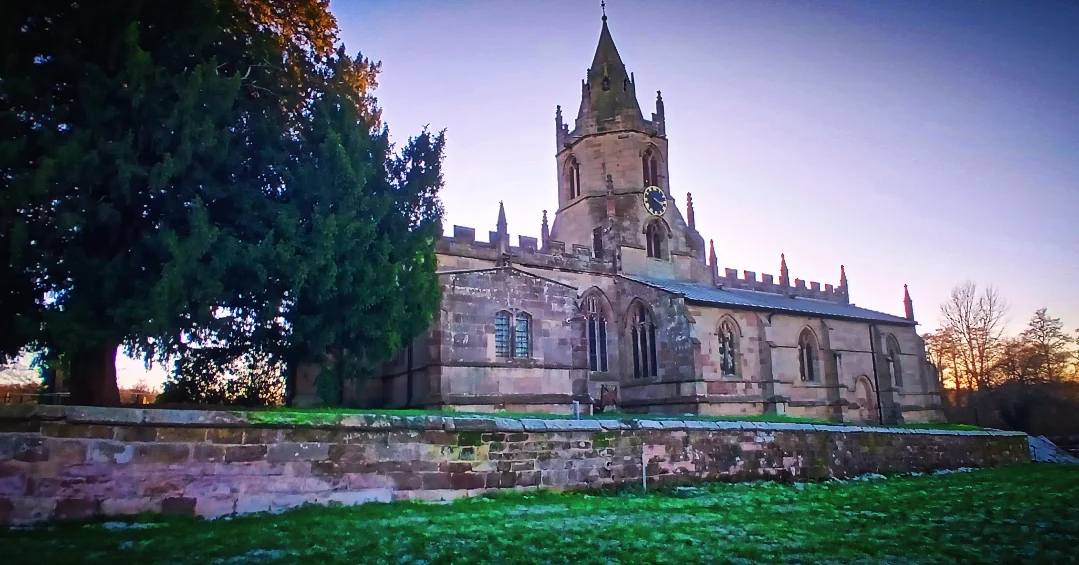
There is an overlooked geography to Shropshire, written into the masonry of its churches. While visitors often flock to the county’s more famous ruins, a true “heartbeat” of the Tudor era pulses through a network of villages stretching from Tong to Hodnet, and directly to the doorstep of Soulton Hall.
A recent journey to the collegiate church of St. Bartholomew’s at Tong provided a perfect opportunity to unpack why this corner of the county is so significant—and why a heraldic device known as the “Vernon Fret” remains a key to reading it. The Vernon family—the legendary “Kings of the Peak”—are most famous for Haddon Hall in Derbyshire. However, their influence in Shropshire was also profound. If you look closely at the architecture of this region, you will find the Vernon Fret—a distinctive, interlaced heraldic pattern—etched into the fabric of these buildings.

Elizabeth Vernon, Countess of Southampton attributed to Marcus Gheeraerts the Younger. Her family were from Shropshire, and some link her to Shakespeare’s works as a muse.
This wasn’t mere decoration; it was the “brand” of a family at the center of the Tudor inner circle and it carries geometric menaings you can folow via the work of Byrga Geniht Ltd.
Sir Henry Vernon was a trusted advisor to King Henry VII and governor to Prince Arthur (the elder brother of Henry VIII). Through his marriage to Lady Anne Talbot, daughter of the Earl of Shrewsbury, he solidified a power base that merged courtly influence with local land ownership. They find their last resting place at Tong in an incredible chantry chapel—a masterpiece of Tudor devotion.

‘THE DANCE’ in the chantry chapel of Tong Church – a Vernon family monument
A Shared Intellectual Language
In the architecture of this period, we see a shared “Renaissance code” as Byrga Geniht Ltd has been exploring.
In the ceilings of these churches, one finds a distinctive eight-fold geometry—a circle sectioned into eight.
This is no mere aesthetic choice; it is a symbolic signature.
This same geometry appears elswhere (such as on the tomb of Bishop’s Waltham in Winchester) and throughout the works of the Hill family.
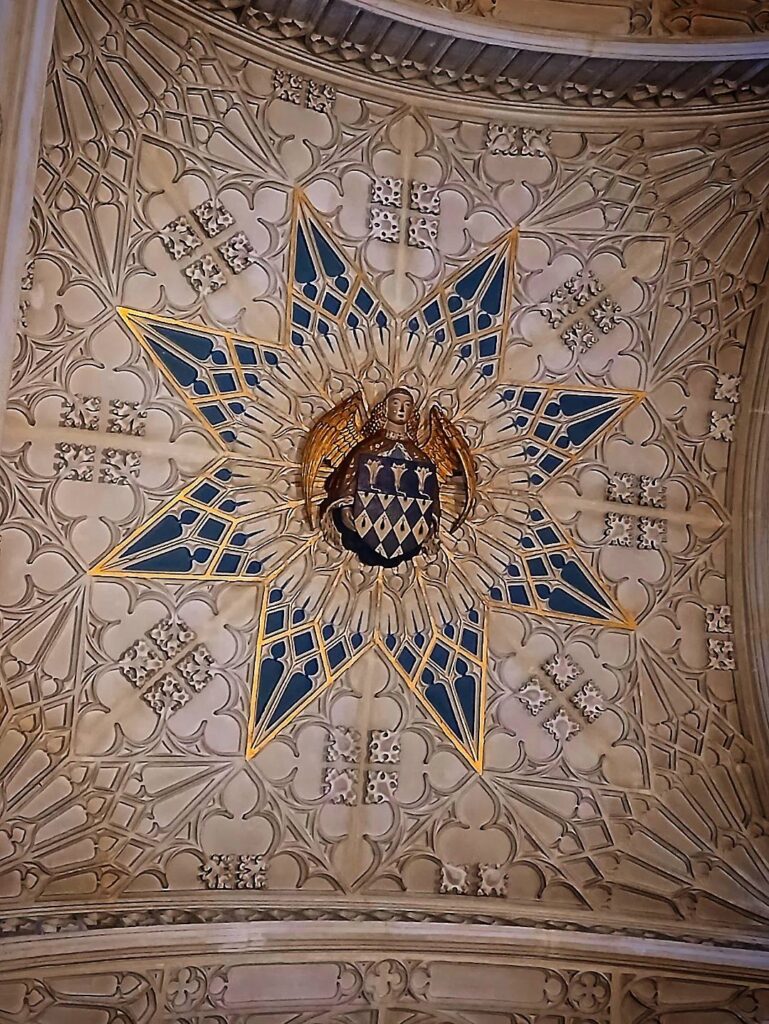
The chantry chapel and tomb of William of Waynflete, Bishop of Winchester, distinguished by its intriguing carvings.
It is a geometry of order and Renaissance thought that informs the settings of Shakespeare’s As You Like It.

The famous Soulton Dancing Pavement
The Vernons were the contemporaries and close friends of “Old” Sir Rowland Hill, the master of Soulton, the first Protestant Lord Mayor of London, and the publisher of the Geneva Bible.
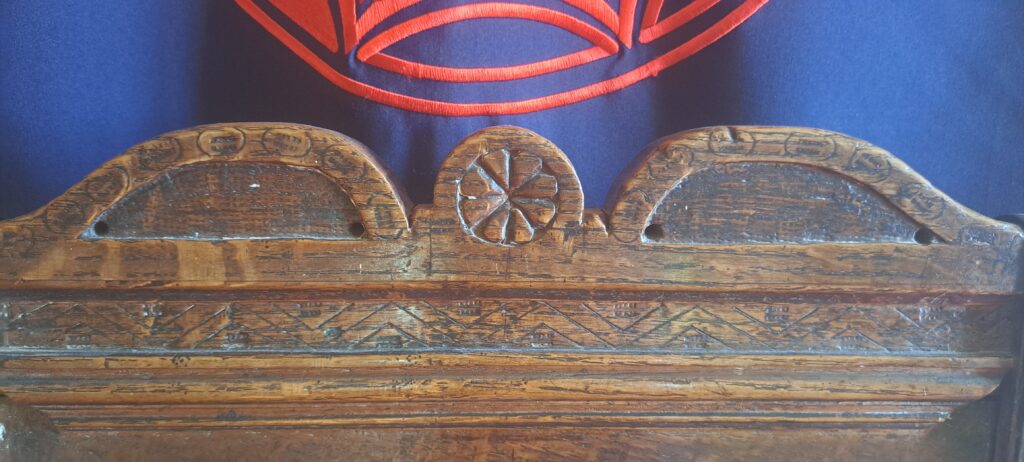
The dance and barley chevrons seen on the top of the Sir Rowland Hill chair.

Old Sir Rowland Hill’s Chair of Estate.
The “Ecclesiastical Footing”
The bond between these families was so deep it moved stone. Local history remembers how a baptismal font was transferred between Tong and Hodnet—a physical symbol of the shared spiritual and political footing of the Hills and the Vernons. This unity is mirrored in the landscape’s silhouette through two matching, yet geologically distinct, landmarks:
-
The Octagonal Tower at Tong: A striking, unusual design rising in the warmth of the local stone.
-
The Octagonal Tower at Hodnet: A matching feature that echoes its counterpart across the county, rendered in the paler, cooler tones of its own local quarry.
The Shakespeare Epitaphs: Poetry in Stone
At the heart of Tong Church stands the Stanley Monument, a “double-decker” tomb that houses a literary secret.
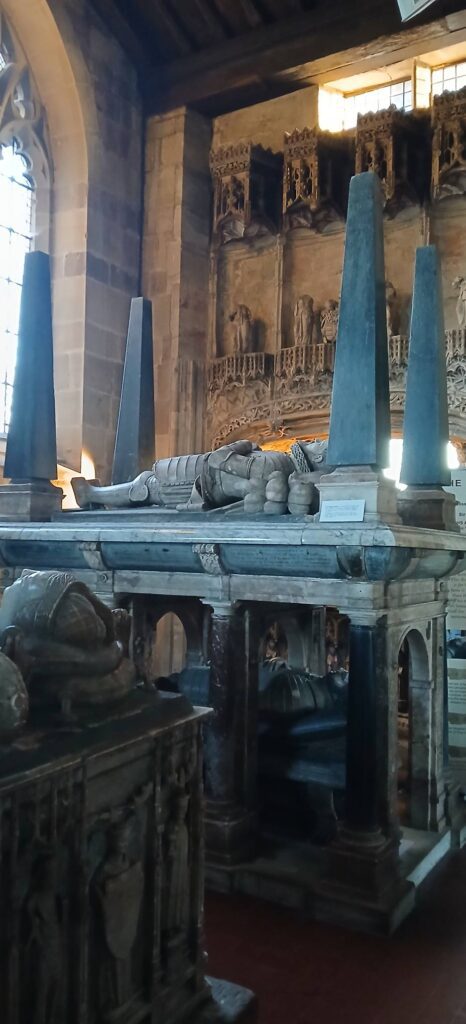
Sir Thomas (died 1576) and Lady Margaret Stanley (died 1596),
At the head and foot of this monument are epitaphs that many scholars, including Sir Sidney Lee and the editors of the Oxford Shakespeare, believe were penned by William Shakespeare himself.

Many scholars, including the editors of the Oxford Shakespeare, identify the hand of William Shakespeare in these lines. Note the recurring theme of the “living monument”—a central pillar of his sonnets—etched here intomrble in Tong for the Stanley family.
 These verses serve as a physical bridge between the Bard and the Shropshire landscape.
At the Head of the Monument:
“Not monumental stone preserves our fame, Nor sky-aspiring pyramids our name. The memory of him for whom this stands Shall outlive marble and defacer’s hands. When all to time’s consumption shall be given, Stanley, for whom this stands, shall stand in heaven.”
At the Foot of the Monument:
“Ask who lies here, but do not weep; He is not dead, he doth but sleep. This stony register is for his bones, His fame is more perpetual than these stones; And his own goodness, with himself being gone, Shall live when earthly monument is none.”
Writing for the “Tribe”
This is not a random literary curiosity; it is physical evidence of the “Inner Circle.” The Vernon, Stanley, and Hill families were the cultural architects of the English Renaissance.
The connections are profound: Sir Rowland Hill was a cousin by marriage to Mary Arden, Shakespeare’s mother. Furthermore, the Earl of Southampton (Shakespeare’s famous patron) married Elizabeth Vernon in a notorious court scandal that shook the Elizabethan establishment. When you see these verses at Tong, you are seeing the Bard writing for his own “tribe” in the Northern Marches.
Why This Matters Today
To follow the trail of the Vernon Fret from the poetry of Tong to the intellectual legacy of Hodnet is to walk through a landscape carefully constructed to protect and promote the ideals of the Reformation and the Renaissance.
In Shropshire, our history isn’t just local; it is part of a grander, often overlooked map of Tudor power, architectural code, and intellectual courage.
