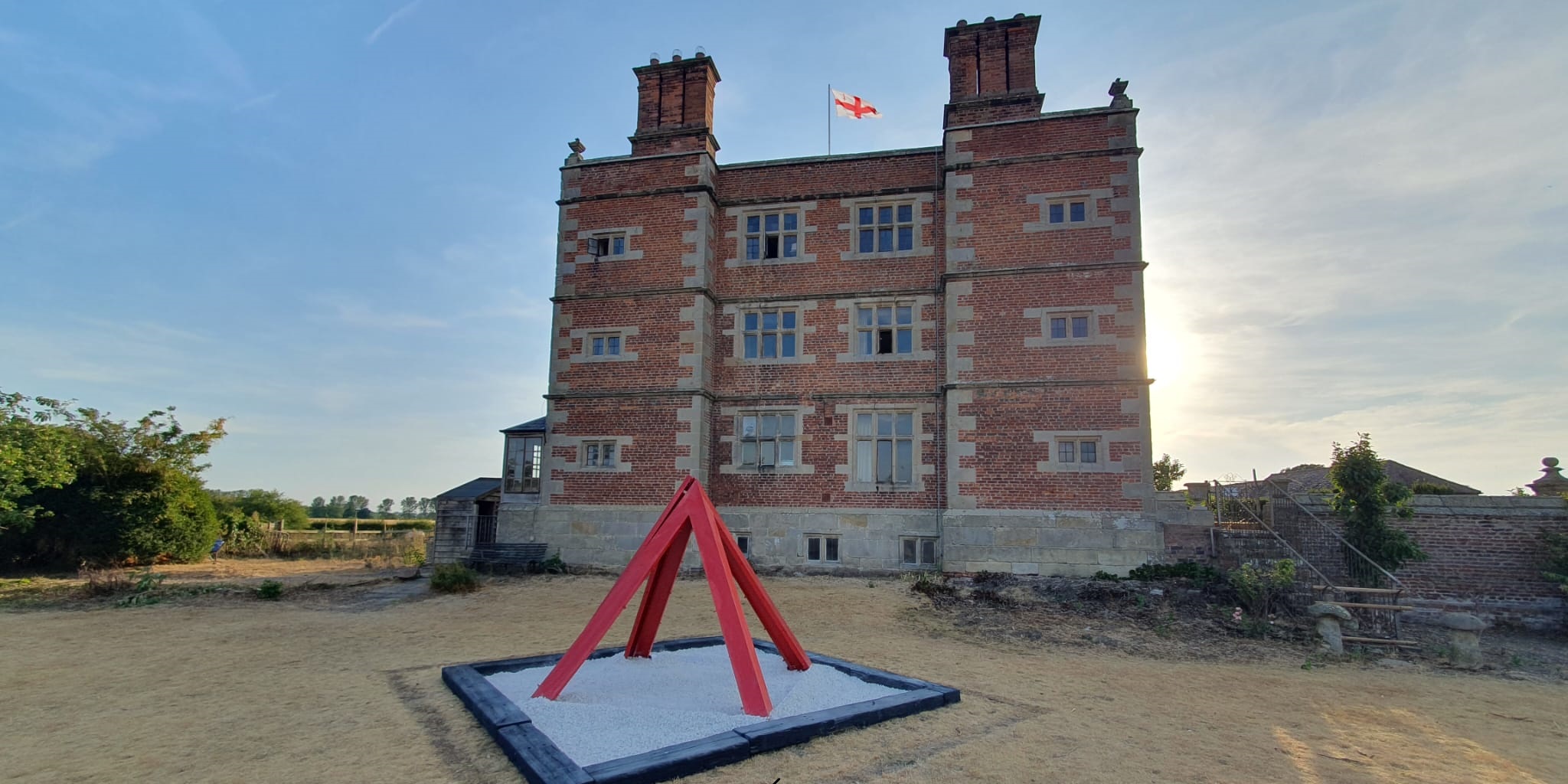
Epidaurus Court, Soulton Hall, with the Feretory Sculpture protecting the Erkenwald site of memory
In the Press
We are delighted to share a recent article published in the Shropshire Star detailing the ongoing developments at Soulton Hall. The piece highlights the exciting historical discoveries, advanced geophysical research, and artistic collaborations surrounding the site holding the memory of St Erkenwald.
Below is the full article as featured here below:
A SAINT PROTECTED AND RESPECTED AT SOULTON
Soulton Hall near Wem has been making international headlines as the newly rediscovered final resting place of a seventh-century bishop — St Erkenwald, the Patron Saint of the City of London.
‘Feretory’ from the ground, where it resembles a pyramid; and from above, where it resembles the arms of the City of London.
Soulton was built by Old Sir Rowland Hill, Lord Mayor of London and native of Shropshire, who is the subject of an episode of ‘The Rest is History’ podcast this summer. According to research led by Byrga Geniht consultancy, who have been working with Soulton, the house was built to evoke the shrine of St Erkenwald just after Old Sir Rowland had been ordered to destroy the relics and the high altarstone during the reformation, showing that he took them under his wing.
The rooms containing the stone have recently been conserved and registered as a Place of Worship, with ecumenical services across the Anglican, Roman Catholic and Orthodox churches embracing all. The spot identified by James D. Wenn as the burial place was investigated through photographic evidence of marks in the lawn, as well as advanced geophysics from the University of Exeter.
Since the winter, Tim Ashton (the incumbent at Soulton) has joined with others to secure the burial spot using some very heavy art.
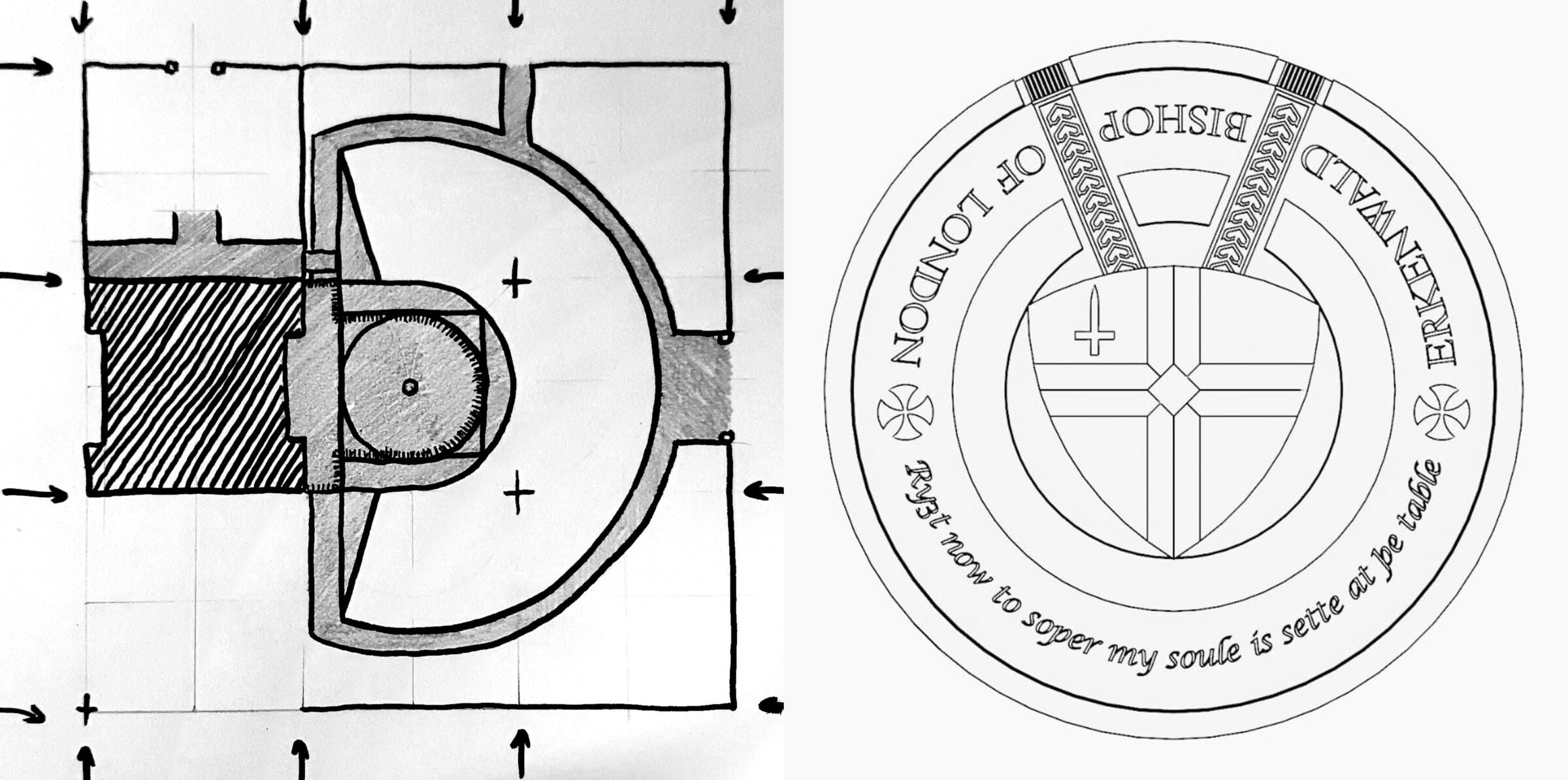
Design drawings from Byrga Geniht: a sketch of the Precinct at Soulton with the way of calculating the proposed scheme, based on Greek theatre geometry; and the proposed bronze tablet to Erkenwald.
‘Feretory’ is a welded sculpture made from steel farm roof trusses, painted red like the cross in the flag of the City of London — a flag which flies every day from the roof of the Hall. It was made with advice from James D. Wenn and James Syrett from Byrga Geniht, along with internationally renowned sculptor Jamie McCarney. The sculpture’s welding is by Phil Wheeler, the Engineer for Soulton Farm, and so ‘Feretory’ also nods to the way the working farm has taken care of Soulton’s secrets all the way to the Hall’s new chapter in visitor welcome.
Wenn describes some of the clever features of the work:
‘Old Sir Rowland’s Soulton is a red cube which had a pyramid on top, and if you add pyramids to each face of a cube you get this special shape called a rhombic dodecahedron that was a symbol for virtue and the eternity of the soul in the middle ages and beyond. It is the ‘multifaceted polyhedron’ the Pope referenced in his recent Encyclical, where he talked about harmony across a diversity of perspectives. The sculpture hints at a pyramid on top of the lined box in the soil found by the geophysics that contains St Erkenwald.’
McCartney reflects that ‘the strength of ‘Feretory’ is how strongly it answered the immediate security needs at the time, in advance of the story breaking. Plans are underway for a permanent solution for which I understand the fundraising is in progress.’
Jacob Chandler, another well renowned sculptor associated with Soulton, presented a landmark series of works inspired by the links between Soulton and Shakespeare’s ‘As You Like It’ in 2024. ‘My permanent works capture fleeting moments in time as can be seen in my study focused on the dance of harmony at the end of ‘As You Like It’, ‘Feretory’ is something temporary that references deep eternal truths.’
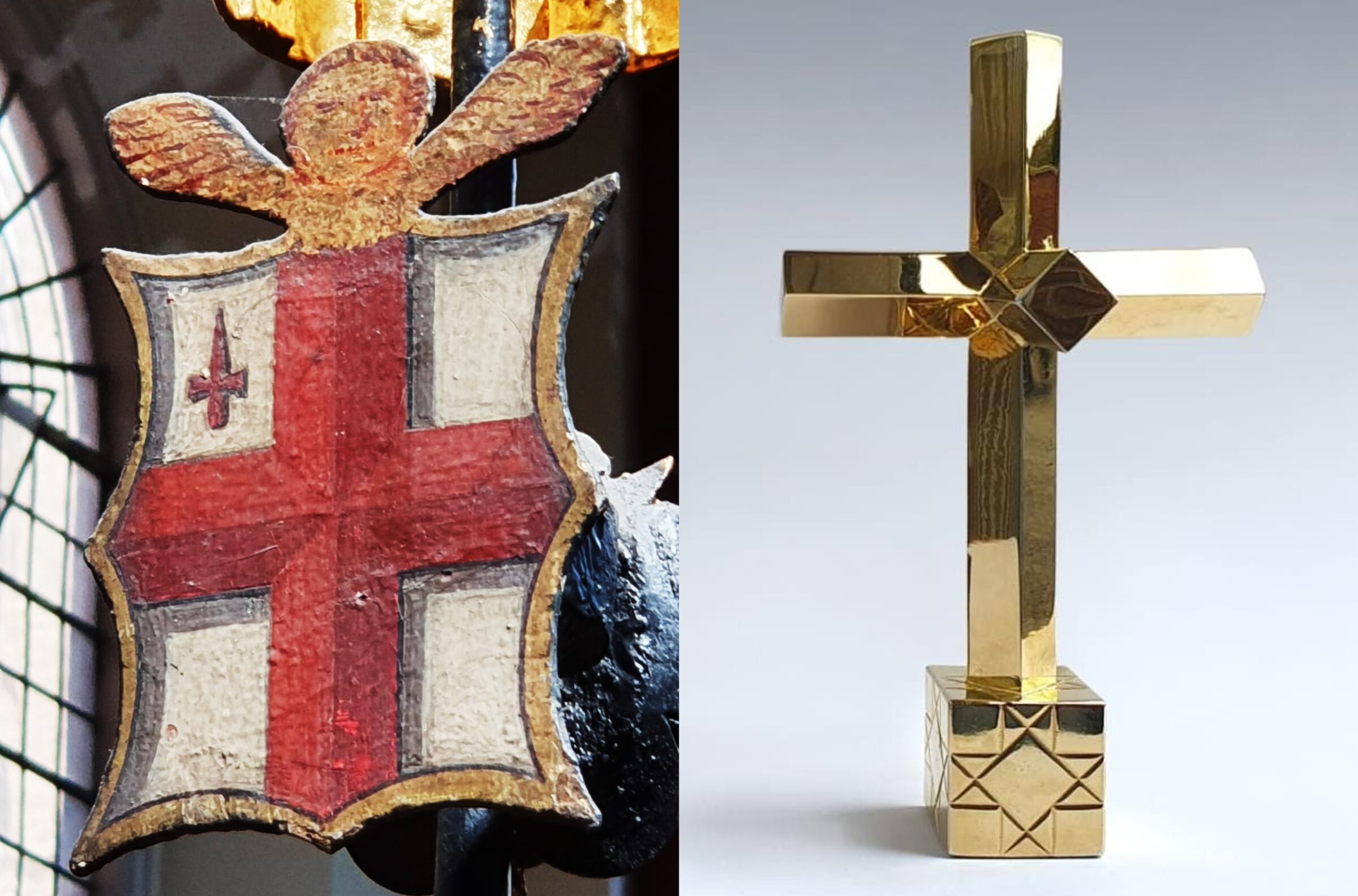
Chandler has collaborated with Byrga Geniht in the work ‘In Hoc Signo’, part of which explains the 3D geometry in the Flag of London, Soulton’s Tudor design, and also in ‘Feretory’.
The arms of the City of London (from St James Garlickhythe); and the golden sculpture ‘In Hoc Signo: II, Trinity’ (Chandler, Wenn and Syrett, 2025).
Byrga Geniht has drawn up plans for a permanent relandscaping solution for the site at Soulton, incorporating a bronze memorial tablet to honour St Erkenwald. This received approval in ecumenical conference meetings in Westminster and Whitehall, but will be the culmination of a fundraising campaign that is in its early days.
Syrett says ‘James Wenn and I are based in Essex, and Erkenwald was a prince and a bishop of the East Saxons. It is deeply meaningful to contribute to honouring one of our own in this way — a story that touches hearts across the country.’