

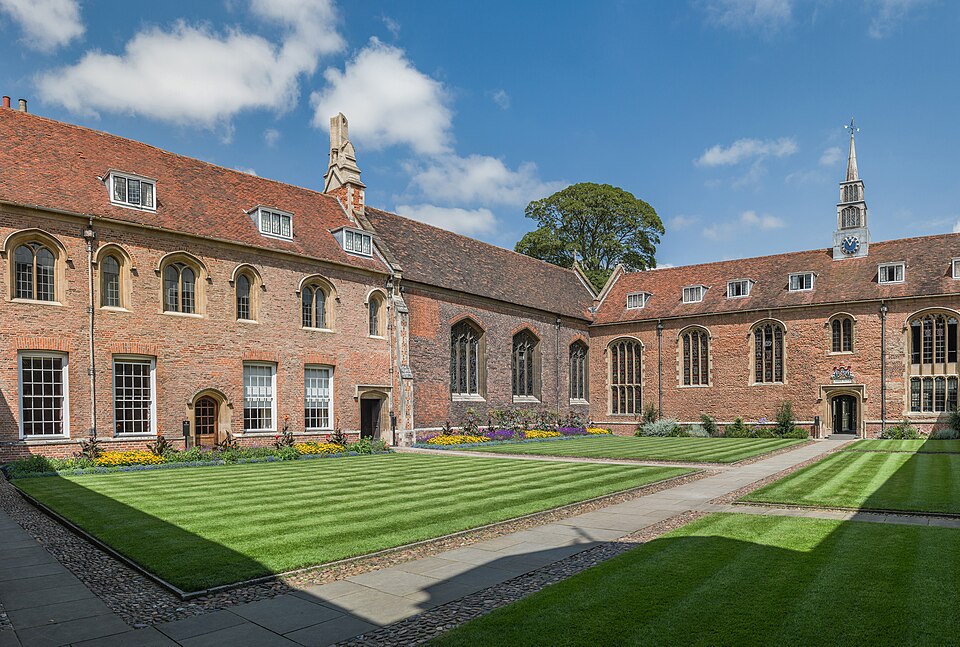
News reaches us that the extraordinary In Hoc Signo sculptures have arrived at Magdalene College, Cambridge.

IN HOC SIGNO in the Chapel of Magdlen College, Cambridge
These gilded bronze works, which made their initial debut at Soulton Hall, are now being hosted in the serene and historic setting of the College Chapel.
Created in 2024 through a collaboration between James D. Wenn, James Syrett, and sculptor Jacob Chandler, these pieces are far more than traditional statuary.
-

- In Hoc Signo in Magdalen College Cambridge
They are a physical exploration of Renaissance geometry and the “New Learning” that shaped the 1550s.
The two sculptures—one based on a cube and the other on an octahedron—function as an intellectual puzzle. By observing the way the gilded bronze beams intersect, the viewer is invited to mentally project a rhombic dodecahedron.
This process reflects the Platonic idea that the most perfect forms exist within the mind and the laws of mathematics. The work also references the eight-pointed star (auseklis) and the Cartesian coordinate system, highlighting a time when geometry was seen as a way to understand the harmony of the universe.
Placing these works within the Magdalene College Chapel creates a powerful dialogue between the architecture and the 16th-century geometry the sculptures represent.
Visiting the Display
The display is available for a very limited time:Dates: Available now through March 24, 2026.
-
Location: The Chapel, Magdalene College, Cambridge.
-
Access: Visitors are invited to ask at the Porter’s Lodge at the main entrance for access to the Chapel to view the pieces.
This is a unique opportunity to see how gilded bronze and ancient mathematics can illuminate the “lost knowledge” of the Tudor era.
-

- This cubic interpretation of “IN HOC SIGNO,” situated in Soulton Hall’s Epidaurus Court, powerfully demonstrates the underlying geometric harmony present in both the artwork and the surrounding architecture.
-

- The octahedral “IN HOC SIGNO” at Soulton Hall: Imagine the lost pyramidal roof above to understand how the building and the art share a common geometric language.
