

At Soulton Hall, we are currently “tuning” a specific interior space—stripping back twentieth-century administrative layers to allow the building’s deeper, more complex history to speak. In doing so, we are initiating a 120-mile “high-five” to our architectural cousins in Northamptonshire.
The Lyveden Connection
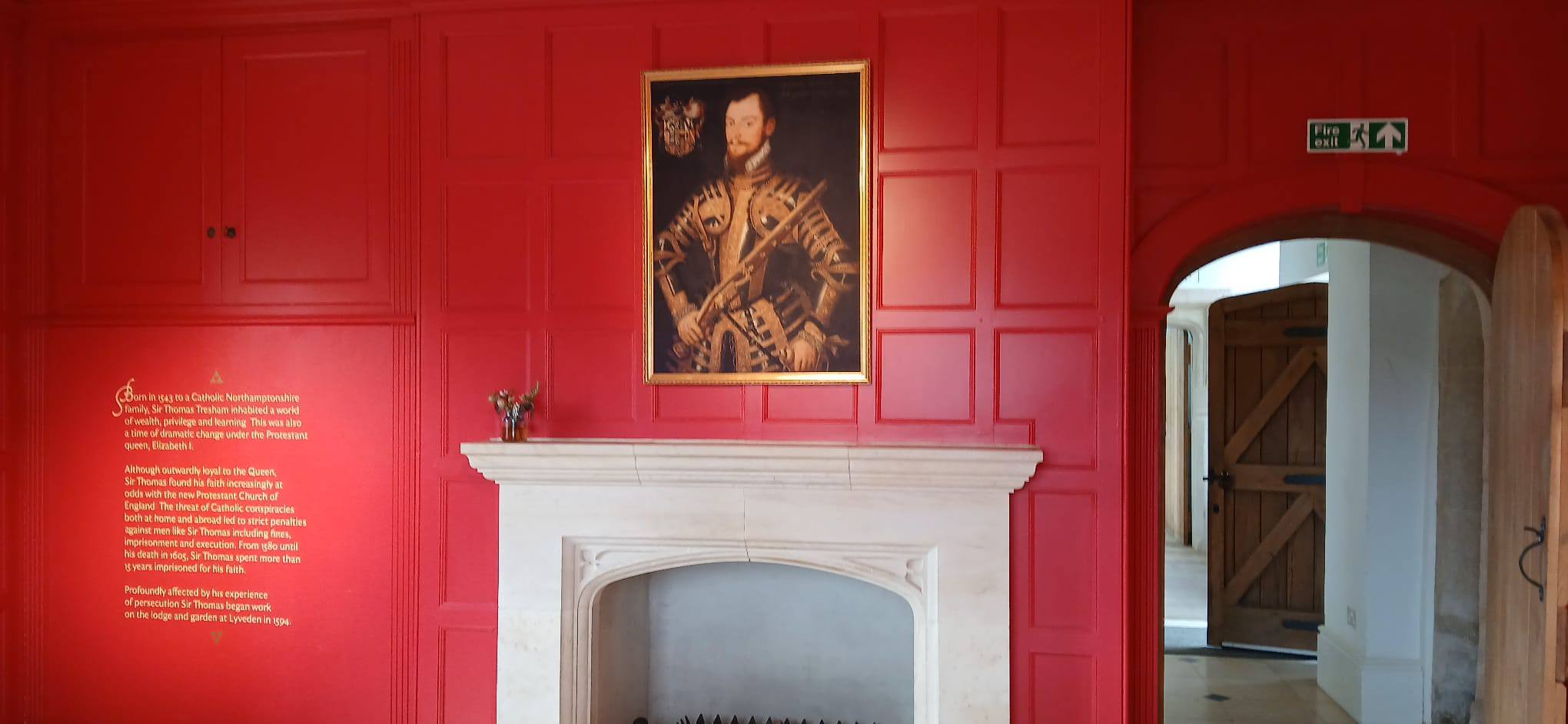
If you’ve visited Lyveden New Bield recently, you’ll have seen their striking new heritage presentation. The curators there have used a bold, saturated red—specifically Little Greene’s “Atomic Red”—to frame the history of Sir Thomas Tresham’s Elizabethan masterpiece.
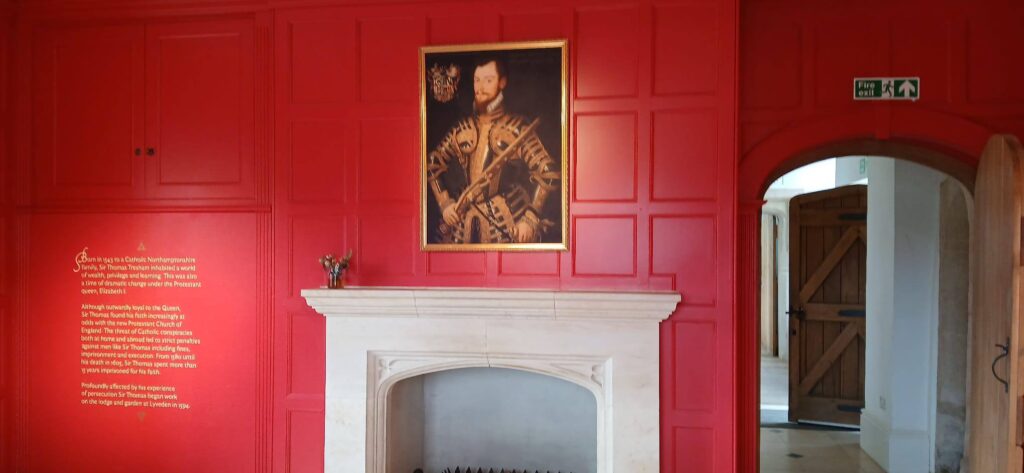
Lyveden New Bield 2021 interpritation in the Manor
There has long been a deep, intellectual link between our two homes. Scholarship now confirms that Lyveden is significantly derivative of Soulton Hall. From the unique geometric “block intersections” in our window mullions to the stone used in our Soulton Long Barrow (sourced from the same Churchfield Quarry in Oundle used for Lyveden), the two estates share a “coded” language born in the sixteenth century.
Reading the Walls: Architectural Detective Work
We are using this same “Atomic Red” to perform a bit of honest surgery on our own walls.

Atomic Red in the Undercroft of Soulton Hall – sampele
Soulton is a living organism, but it hasn’t always grown in a straight line. Sir Rowland Hill’s original 1550s design utilized internal timber-framed walling. During the 17th century, many of these timber partitions were swapped out for brick.
How do we know they are “intruders”?
-
The Keying: These brick walls do not “key in” to the outside masonry.
-
The Skeleton: They don’t share the same skeletal structure as the original Tudor house.
By applying this vibrant red specifically to these non-keyed-in brick insertions, we allow the visitor to “read” the building at a glance. The red distinguishes the later seventeenth-century evolution from the original sixteenth-century “bones.”
Renaissance Swagger: The Cochineal Spirit
This isn’t merely a decorative choice; it is an act of Renaissance Swagger. We are drawing on a tradition seen at the highest levels of Tudor power—such as at Hampton Court—where brickwork was “dressed” with rich pigments like cochineal to create a glowing, prestigious finish.
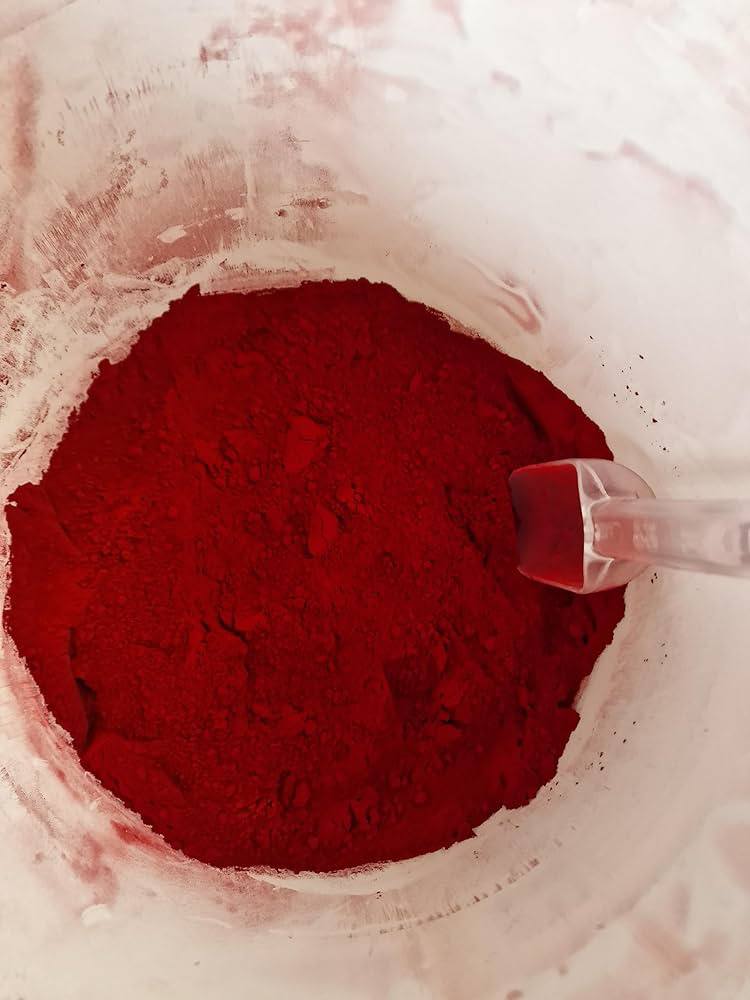
Cochineal Spirit appled to walls it was aan act of Renaissance Swagger.
By “dressing” our seventeenth-century brick in this unapologetic shade, we aren’t hiding the building’s changes; we are highlighting them with a flourish. It is a scholarly nod to the National Trust’s work at Lyveden, acknowledging that while Tresham’s “New Bield” captures the public imagination, Soulton provided the original fire.
We are returning this space to a state of intellectual and spiritual significance, using a 21st-century color to illuminate a 17th-century evolution of a 16th-century masterpiece.
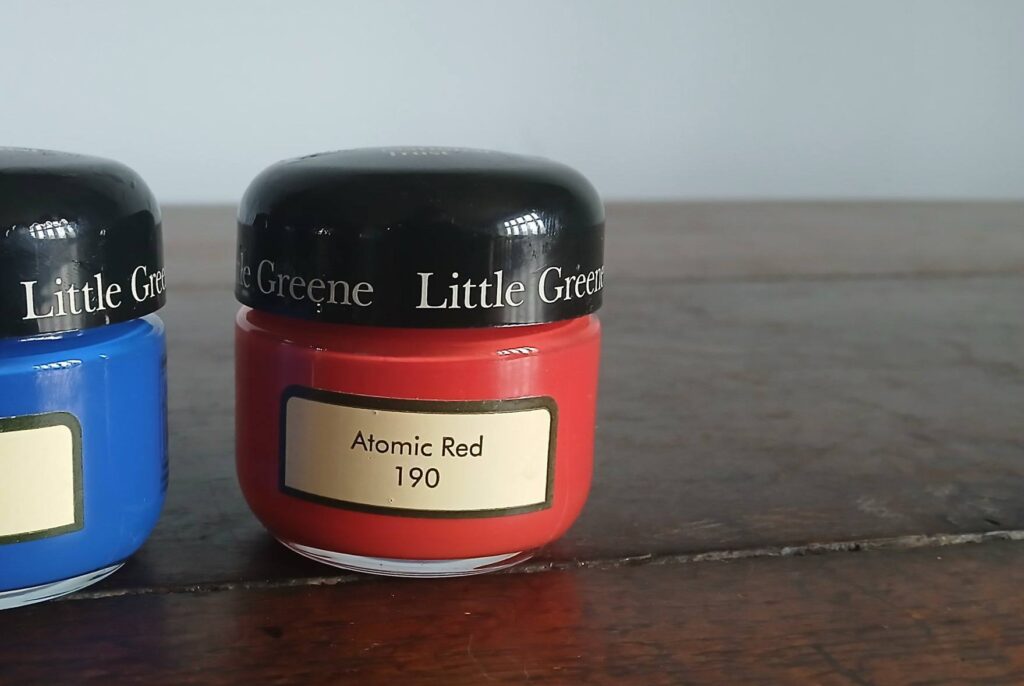
tle Greene’s “Atomic Red”
