

A Silent Witness Recalled: Intellectual Sovereignty and Material Culture from Erkenwald to Wren
Customarily, it is the Tudor-era material culture that calls people to Soulton. This is only natural: the estate’s physical history connects directly to Sir Rowland Hill, the man who ignited the English Renaissance, published the Geneva Bible, and saved important treasures—including the St. Paul’s altar stone—amidst the “blizzards” of the Reformation. These links to the memory of a Saxon saint and the foundational stones of London’s spiritual history are the bedrock of the site.
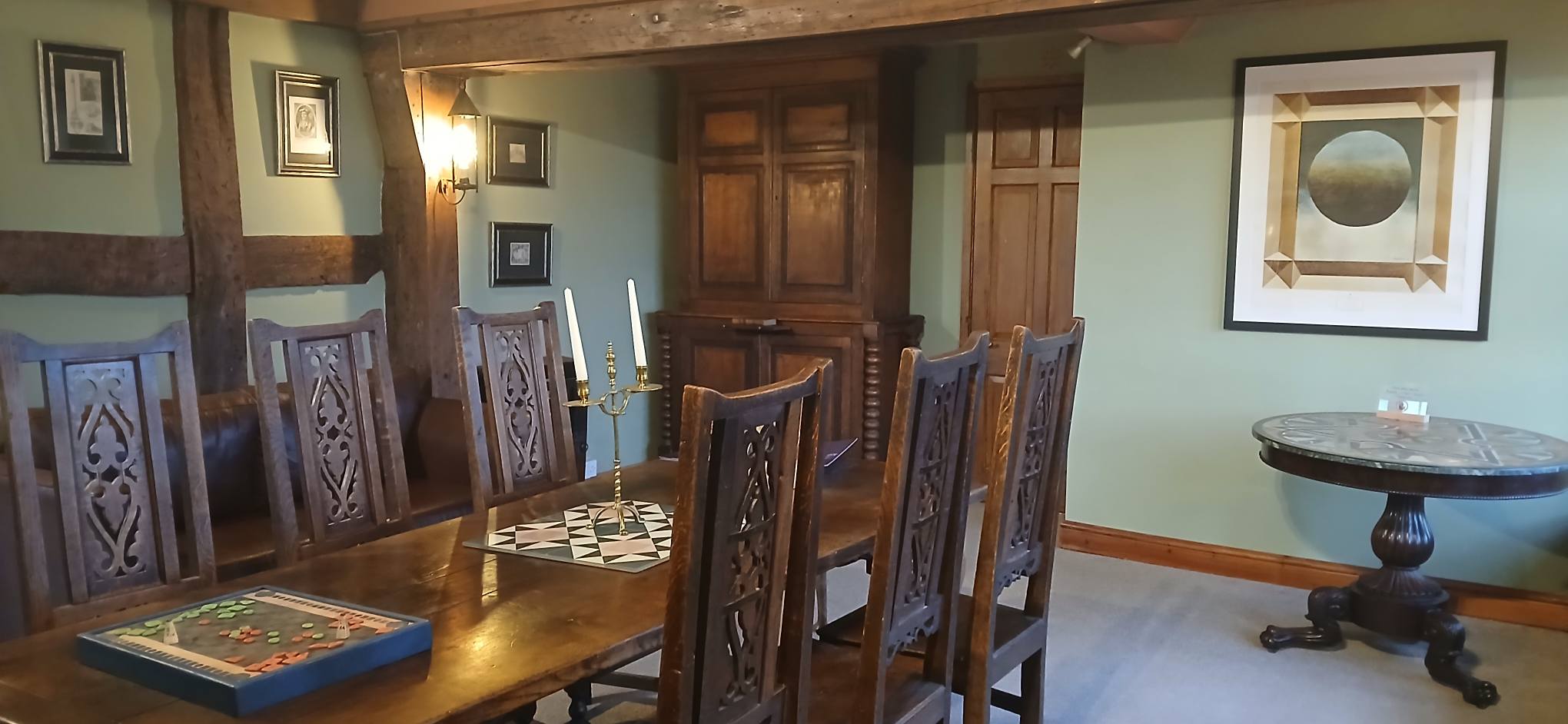
However, standing alongside chairs from the Civil War in Old Sir Rowland’s studiolo is a standout piece of Restoration furniture that, in any other context, would be the primary exclamation point of a collection. It is time to spotlight the Thomas Hill Bookcase.
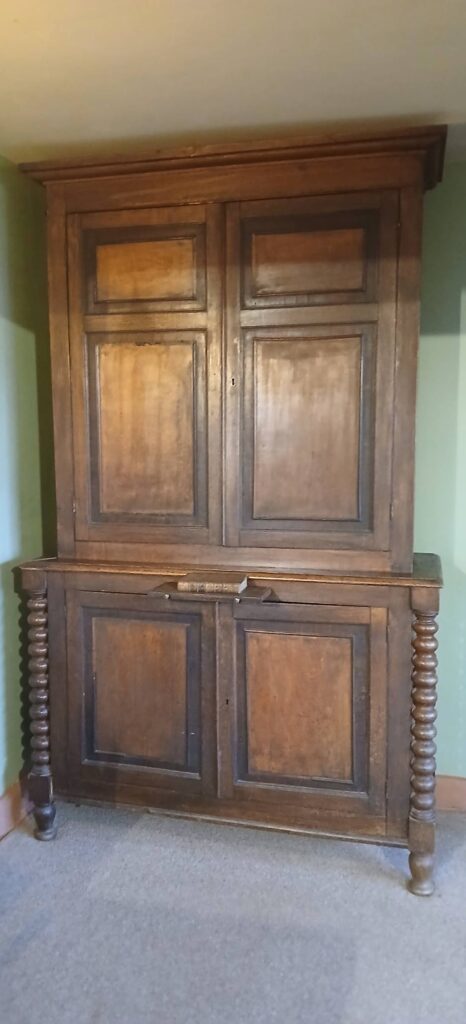
The Restoration Book Press in the Studiolo Soulton Hall
A Monument to the Life of the Mind
The Restoration period was more than a political return to monarchy; it was a profound intellectual “reset.” The Thomas Hill Bookcase, dating to the mid-17th century, is a contemporary of the Wren-steps—the monumental entrance to the hall that signals a renewed focus classical logic and Saxon influences.
Together, they represent a unified vision of restoration: one that builds upon the “monumental construction of the vision of Ezekiel,” turning the estate into a physical space where divine order and human reason meet.

The Thomas Hill Book Press in the Studiolo Soulton Hall
The Harmony of the Spheres: Ptolemy and Music
One of the most striking features of the bookcase is its intricately turned legs. These are not merely decorative; they are an exercise in music and harmony. Reflecting the classical theories of Ptolemy, the proportions of the turnings are designed to mirror musical intervals and the “Harmony of the Spheres.”
In the 17th century, geometry was seen as frozen music, and these legs serve as a silent, mathematical hymn to the order of the universe—a physical manifestation of the Quadrivium.
A Precursor to Greatness
The Thomas Hill Bookcase represents an early and sophisticated leap in furniture design. Notably, it is older than the famous “twelve presses” (bookcases) in the Pepys Library at Magdalene College, Cambridge, commissioned by Samuel Pepys in 1666.
While Pepys was pioneering the concept of the freestanding library, this bookcase was already integrating deep theological and mathematical narratives into its frame, predating the more famous examples found in the hallowed halls of Cambridge.
A particularly ingenious feature of the Thomas Hill Bookcase—one that highlights its practical role in the “Life of the Mind”—is the integrated pull-out platform. In the mid-17th century, large scholarly folios were often stored on their sides rather than vertically. This specialized sliding shelf allowed the resident scholar to safely rest these heavy volumes immediately as they were withdrawn from the armarium.
This ergonomic detail mirrors the scribe’s workspace in the Ezra miniature of the Codex Amiatinus, ensuring that the act of study was as fluid as it was reverent, protecting the fragile bindings of the family’s most precious texts.
The Scholars’ Discovery: “Remembered” by BYRGA GENIHT
For centuries, the bookcase served as a quiet witness to family life.
In fact, until approximately five years ago, it remained in active use within a private family study, its significance hidden in plain sight.
It was through the diligent scholarly work of the consultancy BYRGA GENIHT that the piece was finally “remembered” for what it truly is. Their research has been instrumental in identifying the bookcase as a critical link in the Soulton intellectual tradition, connecting Restoration-era craftsmanship to the ancient scholarly roots of the estate.
A Legacy in Timber: The Codex Amiatinus
As identified by BYRGA GENIHT, the piece is explicitly informed by the Codex Amiatinus, the oldest surviving complete Latin Bible, created during the ministry of St. Erkenwald (c. 700 AD).
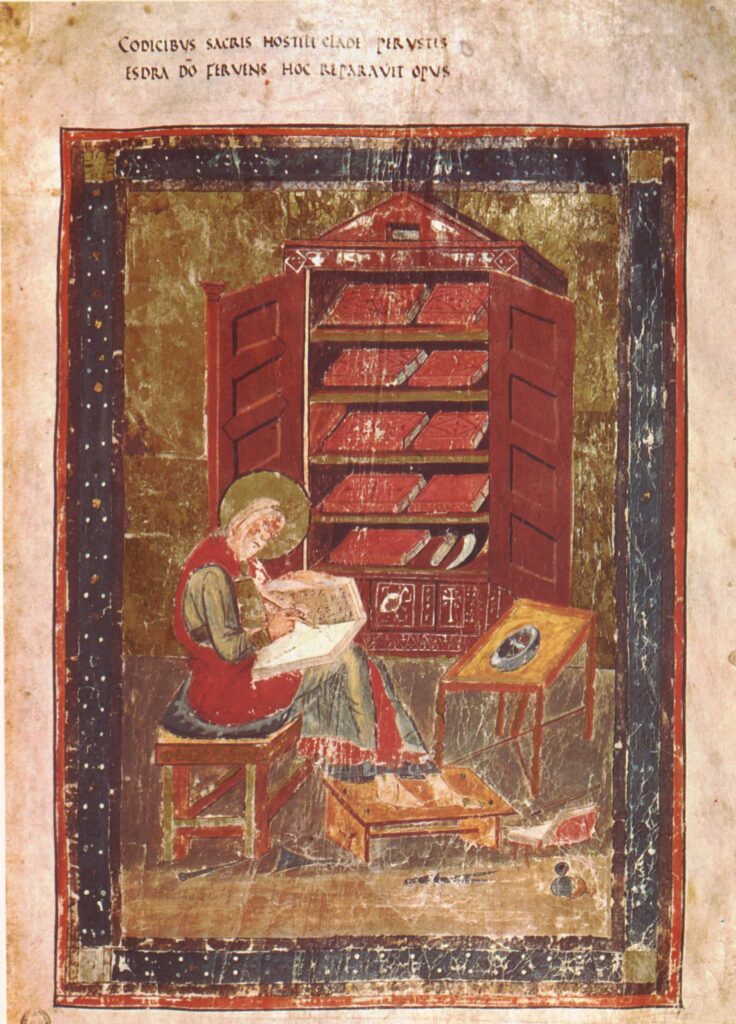
Folio 5r from the Codex Amiatinus (Florence, Biblioteca Medicea Laurenziana, MS Amiatinus 1), Ezra the scribe. “When the sacred books had been consumed in the fires of war, Ezra repaired the damage.”
The bookcase mirrors the famous “Ezra miniature” within the Codex, depicting the scribe Ezra restoring sacred texts in front of a specialized book cupboard (armarium).
By mirroring this ancient furniture, Thomas Hill signaled that the “Life of the Mind” at Soulton was an unbroken tradition reaching back to the foundations of English Christianity and the ministry of Erkenwald.
The Wren Influence and the Geometric Proof
The construction of the bookcase reflects the same rigorous proportions found in the Wren-steps and the Chess Court (1668). During this phase, likely with advice from Sir Christopher Wren, the material culture of Soulton became a “theatre of memory”:
-
The Thomas Hill Bookcase: A functional tool for the modern scholar and a bridge to the Northumbrian Renaissance.
-
The Dancing Pavement: As lost Tudor ceilings were being replaced, this pavement turned the floor into a geometric “proof,” ensuring that even when the “heavens” were lost, the intellectual map remained underfoot.
A Living Tradition Across the Centuries
| Era | Key Figure | Contribution to the Tradition |
| Tudor | Rowland Hill | The Founder. Established the site as a sanctuary for the ideas that produced the Geneva Bible. |
| Restoration | Thomas Hill | The Architect of Reason. Commissioned the bookcase and famously dismissed local witch trials using logic. |
| Hungry 40s | Hannah Deakin | The Preserver. Maintained the estate’s integrity during the economic hardships of the 1840s. |
Conclusion
The Thomas Hill Bookcase is more than a piece of furniture; it is a “proof” of resilience. Thanks to the scholarly insights of BYRGA GENIHT and the family’s preservation of their private study, we can now see that in the wake of the 17th century’s chaos, the Hill family chose to rebuild using the tools of the mind: geometry, history, and a deep reverence for the scholarly ministry of Erkenwald.
