


Challenging the Timeline: Unearthing Early Landscape Design in Tudor England
It’s a persistent misconception that the deliberate shaping of land for aesthetic pleasure – what we understand as landscape gardening – is a development that post-dates the Tudor era in England.
And it is wrong.
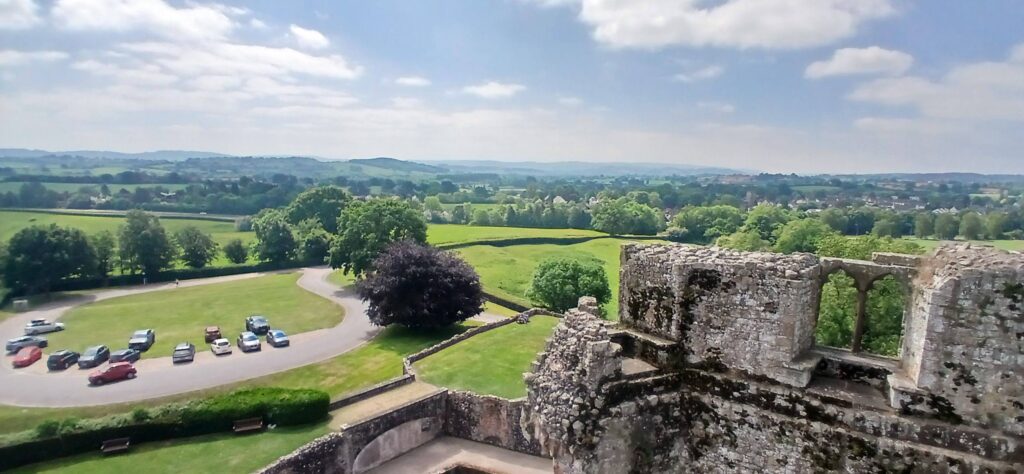
View from the Great Tower of Raglan Castle – the landscape we can see was a Tudor landscape garden
For instance, a visit (yesterday) to Raglan Castle in Wales (which we are delighted to have cause to be at today) quickly dispels this notion, revealing a sophisticated and ambitious approach to garden design that flourished in the mid-16th to early 17th centuries (from the 1550s, contemporary with Old Sir Rowland’s work at Soulton).
The tangible remains here matter of factly show that the often-held belief that grand landscape schemes only truly emerged later in British history is wrong.

Raglan Castle – it got a little bit Las Vagas in the later phases (!)
The extensive gardens at Raglan, meticulously crafted by the Earls of Worcester from the 1550s to the 1620s, underscores the early appreciation for manipulating the environment for visual impact and recreational purposes. The monumental earthworks involved in creating the tiered terraces, the engineered water features like the “great Poole” and the intricate water parterre (documented in detail as early as 1652), all speak to a profound understanding of spatial design and a commitment to shaping the land on a grand scale.

The Geneva Bible foregrounded as a critical Renaissance text in the Raglan displays – great to see!
These were not mere collections of plants; they were carefully conceived spaces intended to complement the castle’s architecture and express pollical and philosophical ideas, as a kind of teaching prop.

Raglan Castle – looking on the Pitched Stone Court from the Great Tower
Furthermore, the historical records and surviving features point to a level of detail and intentionality that belies the idea of landscape gardening being a later invention.

A pebbel mosaic pavement at Raglan — where might we have seen one of these before?
The documented summerhouse, the designed steps between terraces, the potential for balustrading, and even the layout of functional spaces like the hopyard and orchard within the broader garden scheme, all demonstrate an approach to land management that extended far beyond basic cultivation.

Raglan Castle’s Moat Walk – preserves the niches for the classical sculptures. A space for learning technology to be unlocked (like idea of a memory palace we might be familiar with now) before it was ruined.
The “Moat Walk” with its planned niches for statuary reveals a clear desire to integrate art and the designed environment.

Geometric designs in the window reveal of the old library – Raglan had a famous library, broken up in the Civil War: something like happened to Old Sir Rowland’s library
On a perhaps more relatable level we can see this Renaissance era interest in landscapes in high visual arts, for instance in Leonardo da Vinci’s Mona Lisa.

Mona Lisa, by Leonardo da Vinci, from C2RMF retouched – note the landscape
Therefore, to overlook the gardens at Raglan Castle, and others like it from the same period, is to miss a crucial chapter in the history of landscape design. These sites provide compelling evidence that the art of shaping the land for beauty and enjoyment was a significant undertaking well before the era typically associated with the emergence of landscape gardening as we often imagine it today. Raglan is a testament to the early ambition and sophistication of British landscape artistry, urging us to reconsider our timelines and appreciate the Tudor and early Stuart periods as a vital stage in this fascinating evolution.

Grotto Hill Hawkstone
Adding further weight to this understanding of early landscape appreciation in the 1500s is the integration of the Soulton landscape with what we now know as the Hawkstone Follies, which somewhat lazily gets associated with 18th Gothic Revival but is much older than that as a pleasure ground.
Soulton Hall is placed in the landscape where it is to give an ideal identity of Eleusis with the inland cliffs of Hawkstone beyond the bridge and London beyond mirroring the sacred way and Eleusis.

Fragments at Eleusis – conspicuously in mind in the landscape setting of Soulton Hall by Old Sir Rowland Hill
This ambitious project similarly demonstrates a sophisticated approach to land manipulation, utilizing existing features like the ruins of Red Castle, natural grotto caves, and deer parks to create a deliberately propositional and visually engaging landscape.
These endeavours, contemporary with the developments at Raglan, reinforce the idea that a keen eye for shaping and enhancing the natural environment for aesthetic and experiential purposes was already a significant aspect of British culture well before the later, more widely recognized phases of landscape gardening.

The Mansion at Attingham Park (another Hill dynasty house) – the landscape there was worked on by Repton, but landscape gardening pre-dates his period in England
