

‘Nay, You Must Call Me Rosalind’
Soulton Hall’s collection continually reveals compelling connections across history, art, and literature.
Our focus today turns to a striking 1937 print by Edward A. Wilson, an enchanting depiction of Shakespeare’s As You Like It.
Commissioned by John Morrell & Co., the print captures attention with its intricate tree trunk carvings – visible declarations of Orlando’s love for Rosalind in the Forest of Arden. This imagery powerfully evokes the youthful passion and pastoral romance central to As You Like It.
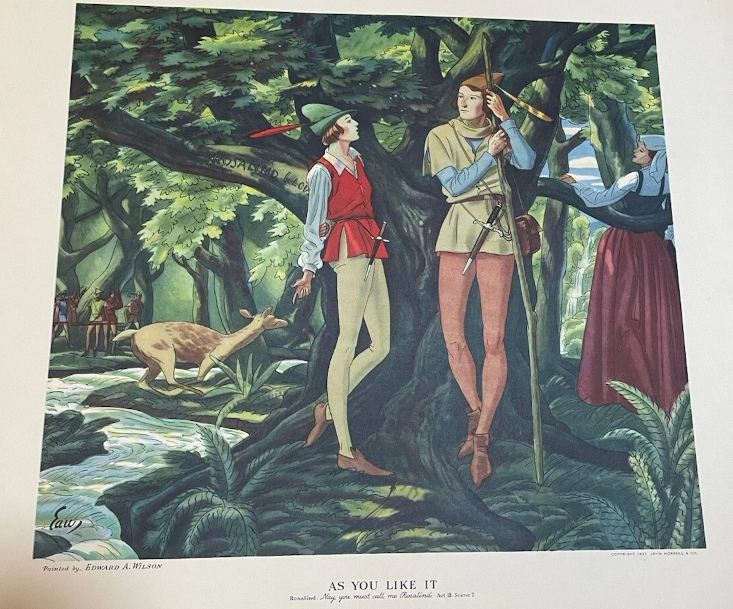
As You Like It Edward A Wilson Print 1937 John Morrell & Co
Closer inspection reveals further compelling details. Duke Senior and his loyal lords appear, embracing their rustic life in exile. By the brook, a deer stirs, its presence injecting a poignant note beyond the idyllic pastoral as this could be the hunt wich causes refelctions later from Jaquis on the killing of the natives of the forest by the temporary human occupants. This vulnerable creature subtly underscores themes of usurpation and humanity’s dominion over the natural world.
A little removed, Celia stands with a subtly awkward posture, suggesting her own internal reflections within the scene.
The print has a title which is a direct quotation from the play:
Nay, you must call me Rosalind.
Spoken by Rosalind while disguised as Ganymede, this line encapsulates the comedy’s playful wit and intricate themes of identity. It marks a moment of delightful dramatic irony as Rosalind teases Orlando, subtly revealing her true self while maintaining her disguise. This sympathetic exploration of gender identity and performance, evident in Rosalind’s extended role, has long captivated audiences and resonates deeply with the LGBTQ+ community, aligning with contemporary dialogues on self-discovery and authentic expression.
Edward A. Wilson’s artistic style perfectly complements As You Like It’s whimsical and romantic spirit.
Dated 1937, this print exemplifies a period when commercial art frequently turned to classical literature, presenting these timeless stories to a broader public in accessible, aesthetic forms.
Beyond this striking print, Soulton Hall holds a unique and profound claim: it is the birthplace of As You Like It. Our historic estate, with its ancient trees, woodland, and rural charm, doesn’t just mirror Shakespeare’s Forest of Arden; it was historically home to the family of Thomas Lodge, whose prose romance, Rosalynde, Euphues’ Golden Legacy, served as Shakespeare’s direct source text for the play.
Much like the play’s characters who discover refuge and transformation in nature, Soulton Hall provided a critical setting for retreat, inspiration, and discovery in a Tudor courtly emergency, and was the estate of Old Sir Rowland.
Even more profoundly, our own ‘dancing pavement’ beckons the revelry and movement of the play’s joyous conclusion.
This tangible historical thread deeply embeds Soulton Hall within the very genesis of As You Like It, making this print’s presence here exceptionally resonant.
We invite you to explore the Soulton Hall collection and uncover further artistic interpretations and hidden gems from classic literature!
