

The extraordinary “Arbour” at Theobalds, documented in the 1580s as a masterwork of Elizabethan artifice, offers a vivid window into a world where the boundaries between the mechanical and the natural were playfully, yet profoundly, blurred. It is explored in detail in this scholarly article:
Theobalds, Hertfordshire: The Plan and Interiors of an Elizabethan Country House (2017), Emily Cole
To the visitors of the time, the room was an overwhelming sensory experience: a great hall sixty feet long, where twelve massive pillars were so convincingly disguised in the bark of oaks and pines—complete with artificial leaves, fruit, and nesting birds—that it was nearly impossible to distinguish them from a living forest.
Above this indoor grove, a mechanical sun tracked the hours across a ceiling of painted sky, while at night, lights shining through “sky holes” in the boards created a shimmering field of stars. At the far end, a massive grotto of crystal and coral gushed water into a basin held by statues of wild people. It was a space that felt both strikingly odd and intensely real, a theatrical “device” intended to show that the owner could command the very elements to entertain his sovereign.
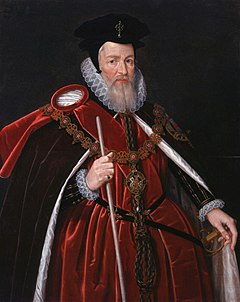
Yet, to understand the true gravity of such a room, one must look past William Cecil’s 1580s spectacle to the senior power that made the Elizabethan era possible: Sir Rowland Hill. By the time Cecil was constructing his mechanical forest, he was building upon a foundation of stability, credit, and philosophical courage established decades earlier by Hill, the “Merchant Prince” of the Welsh Marches. Hill, who died in 1561, was the established titan of the mid-Tudor period—the first Protestant Lord Mayor and a financier whose control of London’s security made him the essential broker for the throne during the collapse of Protector Somerset. While Cecil was a rising administrator, Hill was already the dominant authority in Shropshire and the Marches, using his judicial power not as a tool of oppression, but as a shield for the “middle way,” famously protecting figures like the future Archbishop Matthew Parker.
Soulton Hall was Hill’s own “philosophical” statement, a house built with a deliberate, coded geometry that asserted his status as a philosopher-prince even when he was briefly out of favor at court. The 1561 handover following Hill’s death marked the end of this foundational era, leaving Cecil to inherit a kingdom secured by Hill’s decades of financial and religious moderation. The “Arbour” at Theobalds was, in many ways, the theatrical flowering of the seeds planted at Soulton; it was a physical manifestation of the harmony and natural law that Hill had championed.
This cultural obsession with the “natural-yet-artificial” forest—where the order of the court meets the wisdom of the wild—leads naturally and inevitably to the Forest of Arden in Shakespeare’s As You Like It. The play’s vision of a “Golden World” where one finds “tongues in trees” and “sermons in stones” is the literary echo of the physical Arbour and the philosophical Soulton. It reflects a shared intellectual heritage rooted in the Marches, where the forest was not merely a place of exile, but a sanctuary of the “middle way” where harmony could be restored. While the mechanical sun of Theobalds has long since ceased to move, the stones of Soulton Hall remain as a testament to the man who first drafted the blueprint for this Elizabethan dream.
