

Today, April 29th, is International Dance Day!
It’s a day to revel in the universal language of movement, to appreciate the diverse forms of dance across cultures, and to recognize the profound impact dance has on our lives and the meaning it can carry.
We would like to use this opportunity to bring your attention is drawn to a truly special feature of Soulton Hall, our dancing pavement which a a tangible link to dance history .

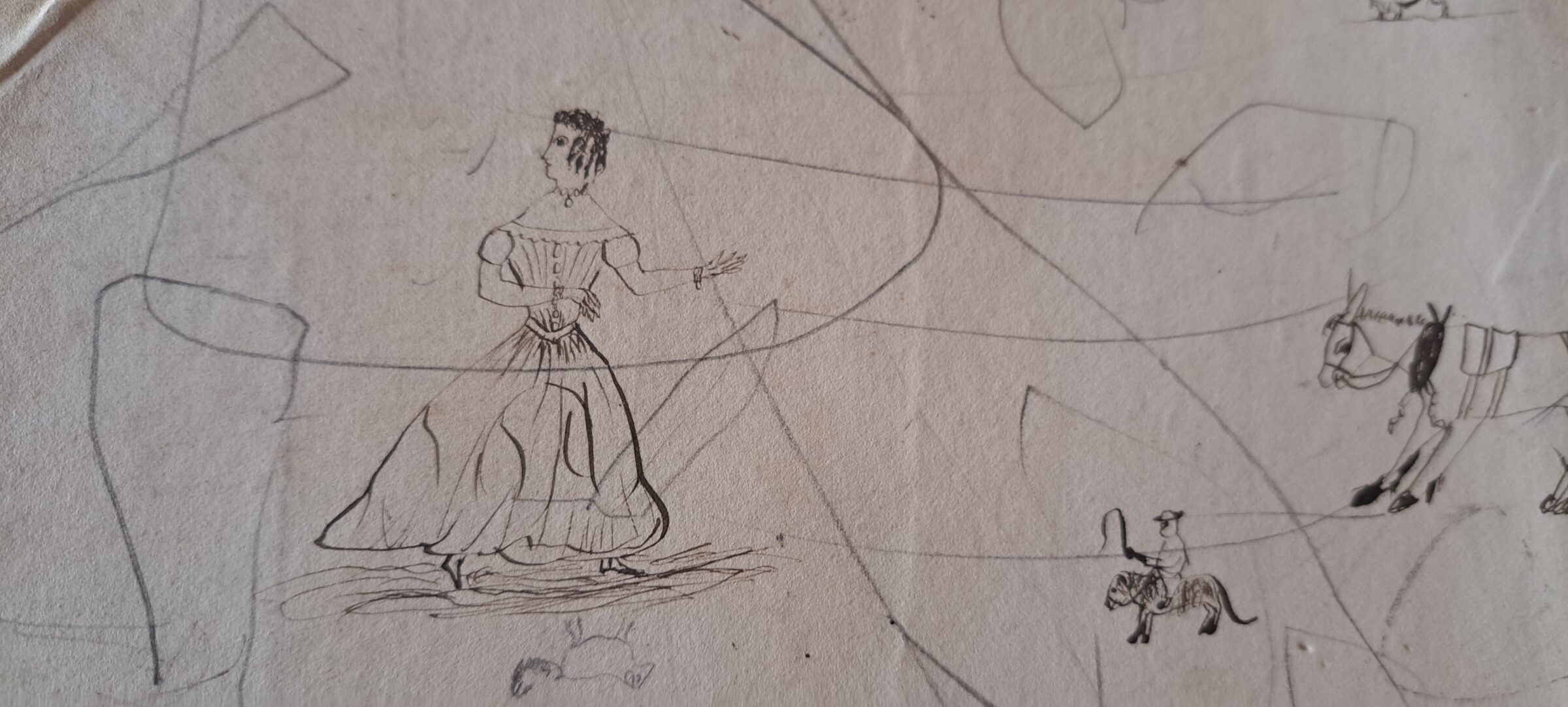
Marginalia in by Hannah Deakin in the 1830s Soulton Day Book; in the 1840s this was book used to design the Soulton Dancing Pavement.
Now, picture this – choreographic notation, not confined to paper, but etched directly into the pavement! And within the hall’s papers lies further documentation of this dance, a “dance of harmony” specifically linked to the god of marriage within Shakespeare’s “As You Like It.”
What makes this even more captivating is the understanding that this is not just any dance. It’s understood to have its roots in very ancient tradition, stretching back to classical antiquity. Shakespeare, a keen observer of courtly life, witnessed this tradition and incorporated it into a significant moment of denouement and renewal within his play.
This was not merely a fleeting moment of merriment on stage.

The Soulton Dancing Pavement, showing The Dance, which features in AS YOU LIKE IT
This dance is understood to be deeply intertwined with mathematics, using its principles to create a social allegory through its steps and formations. This resonates with ancient philosophies that saw mathematical harmony reflected in the order of the universe, suggesting that this dance was a way to embody and enact social cohesion and renewal through structured movement, as Plato put it:
The Dance, of all the arts, is the one that most influences the soul. Dancing is divine in its nature and is the gift of God.
The idea that Shakespeare, in a serious moment of resolution in “As You Like It,” consciously drew upon this ancient, mathematically encoded dance of harmony connected to marriage, elevates our understanding of the play and the depth of cultural traditions in his time. The pavement at Soulton Hall, therefore, isn’t just a surface; it’s a potential key to unlocking a lost dance tradition, a physical manifestation of a cultural practice observed by one of the greatest playwrights in history.
International Dance Day reminds us that dance exists in countless forms and often holds layers of meaning we may not immediately perceive. The story of the dance at Soulton Hall, with its ancient roots, mathematical underpinnings, and Shakespearean connection, serves as a powerful reminder of the rich history and potential for profound social commentary embedded within this art form. It encourages us to look beyond the surface and appreciate the deep cultural significance that dance can carry, sometimes literally etched in stone. Happy International Dance Day!
