

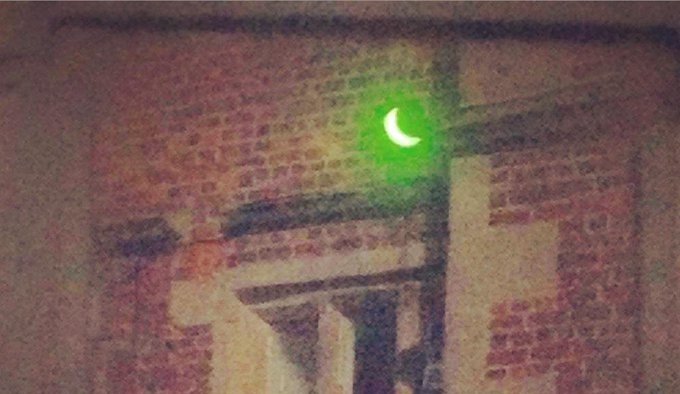
Window to the Soul: Representation of Plato’s Cave at Soulton?
The Great North American Eclipse of April that took place today was a breath-taking celestial event that captivated millions.
As the Moon’s shadow swept across the continent, casting darkness upon the land, sky-watchers marvelled at the Sun’s corona and solar prominences.
Many enthusiasts employed pinhole cameras to safely observe the eclipse. These simple devices, consisting of a small hole in a piece of cardboard or paper, project an inverted image of the Sun onto a surface. In essence, pinhole cameras are a rudimentary form of camera obscura, harnessing the same optical principles to capture and project light.
That being said, it is a useful day to invite readers to think a bit more deeply about the camera obscura, and then about how it was understood in the time of Old Sir Rowland Hill – which we will do in this blog….

A total solar eclipse is seen in Dallas, Texas on Monday, April 8, 2024
While the UK missed to see this, we will get to see a partial eclipse on the morning of 29 March, 2025

A.T. Sinclair – via http://eclipse.gsfc.nasa.gov/
The tweet below shows a 2015 eclipse seen at Soulton..
#solareclipse with @SoultonHall reflected; viewed in welding mask. pic.twitter.com/9SwnJXXWSl
— Soulton Hall (@SoultonHall) March 20, 2015
********
The camera obscura, a simple yet profound optical device, has captivated minds and shaped the course of human history. From its humble beginnings as a curiosity to its pivotal role in the development of photography, this dark chamber has been a source of wonder and innovation.
Early civilizations may have intuitively grasped the principles of the camera obscura, utilizing its effects in art and religious rituals. Ancient Greek philosophers like Aristotle and Euclid pondered the nature of light and vision, laying the groundwork for future exploration. Chinese and Middle Eastern scholars, such as Mozi, Ibn al-Haytham, and Shen Kuo, delved deeper into the phenomenon, making significant contributions to our understanding of optics.
The camera obscura’s ability to project inverted images of the outside world fascinated people and led to a diverse range of applications. From entertainment to scientific research, this versatile device was employed in various forms. Artists, scientists, and enthusiasts alike were drawn to its potential, recognizing its value as a tool for observation, study, and creation.
In the 13th century, scholars like Robert Grosseteste, Roger Bacon, and John Peckham explored the camera obscura’s properties and its potential applications. They delved into the nature of light, the formation of images, and the principles of perspective.
The 16th century marked a significant period of advancement for the camera obscura. Key figures such as Gemma Frisius, Gerolamo Cardano, Francesco Maurolico, Giambattista della Porta, and Daniele Barbaro made substantial contributions to its development. They introduced innovations like lenses, improved image quality, and popularized the device through their writings and teachings.
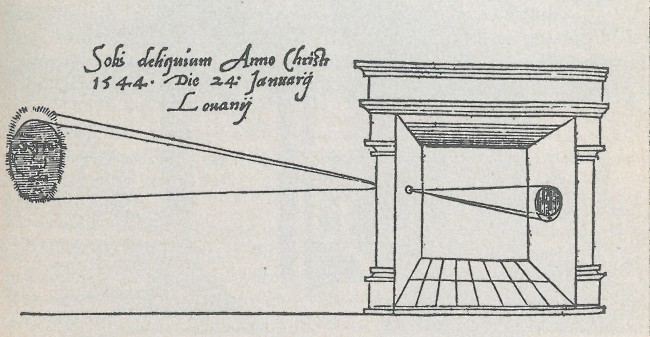
First published picture of camera obscura, in Gemma Frisius’ 1545 book De Radio Astronomica et Geometrica
The camera obscura’s impact on the development of photography is undeniable. By providing a way to capture and fix images on light-sensitive materials, it paved the way for the birth of modern photography.
********
The Aedicule Room, or Soulton Hall Chapel, presents intriguing evidence suggesting its use as a camera obscura. The presence of fittings for a shutter over the window, along with other architectural details, hints at its adaptation for projecting images onto the interior walls. This intriguing setup is believed to have been employed to create a tangible allegory of Plato’s Cave, a philosophical concept that explores the nature of reality and perception.

The chapel in Soulton Hall has an aligment to the dawn sun on Easter morning
Plato’s Cave is a metaphor for the human condition, where individuals are chained in a cave, only able to see shadows cast on the wall.
These shadows represent the limited, illusory world we perceive. A few prisoners are freed and ascend to the surface, experiencing the true world of light and reality. Upon returning to the cave, they struggle to convince the chained prisoners of the true reality, often met with disbelief and hostility.
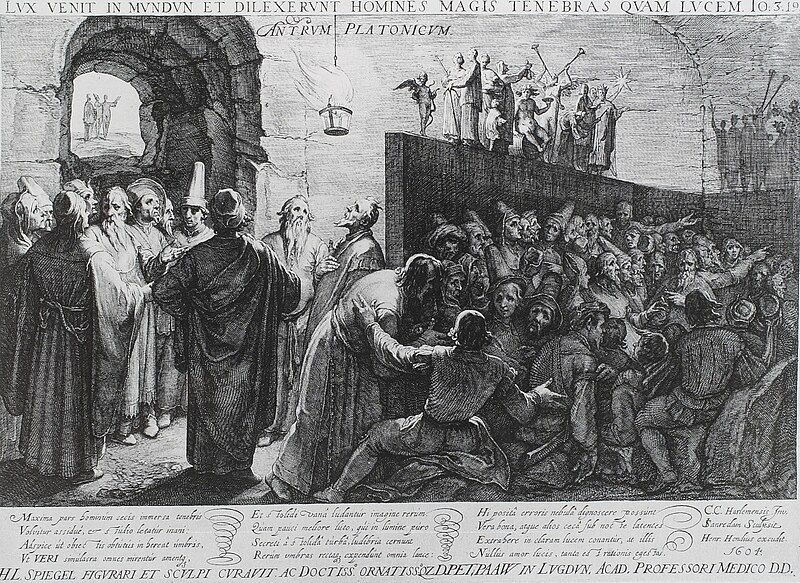
Plato’s allegory of the cave by Jan Saenredam, according to Cornelis van Haarlem, 1604, Albertina, Vienna
This allegory highlights the difficulty of enlightenment and the resistance to new ideas.
In the 16th century, a period marked by significant intellectual and societal shifts, Plato’s Cave held particular relevance. The invention of the printing press and the spread of literacy facilitated the dissemination of new ideas and challenged traditional beliefs.
Religious reforms and political upheavals further destabilized the established order, prompting individuals to question the nature of reality and their place in the world.

Plato
Sir Rowland Hill, a Neo-Platonist, would have been drawn to the philosophical depth and symbolic power of Plato’s Cave. By creating a physical manifestation of this allegory, he could have sought to explore the limitations of human perception, the pursuit of truth, and the challenges of enlightenment. The camera obscura, with its ability to project images and manipulate light, would have provided an ideal tool for this endeavor.
