

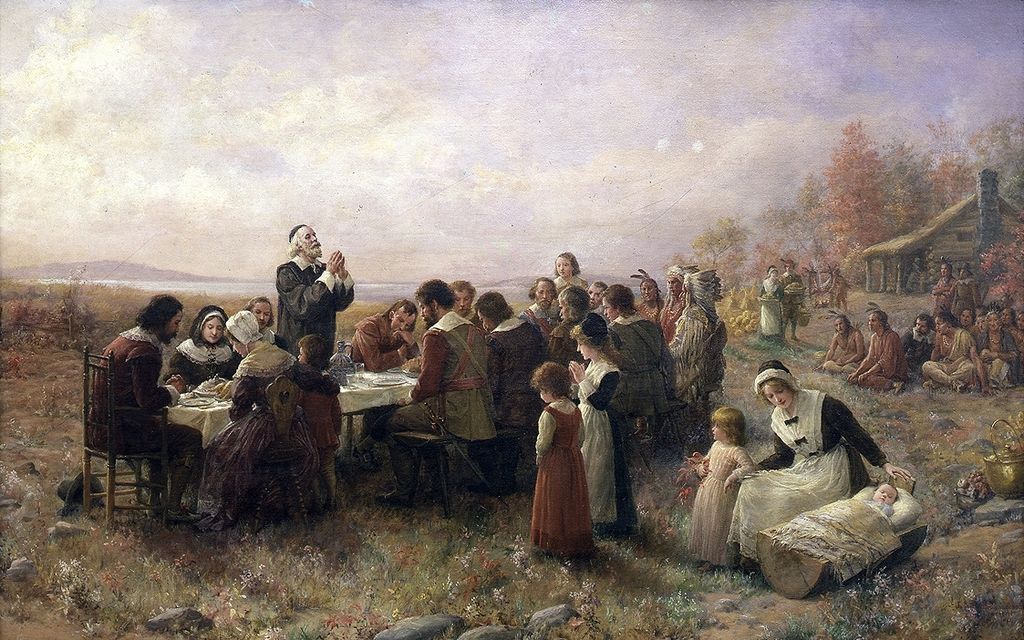
Today, the people of the United States are celebrating Thanksgiving, an annual tradition steeped in history and gratitude.
This cherished holiday traces its roots back to 1621, when the Pilgrims, who had arrived on the Mayflower a year earlier, gathered with the Wampanoag people to give thanks for their survival and the bountiful harvest. This historic feast, a testament to the resilience of the human spirit and the generosity of the land, has evolved into a beloved tradition celebrated by millions.
Among the precious belongings the Pilgrims brought with them on the Mayflower was a Geneva Bible.

The frontispiece of the 1560 Geneva Bible at Lambeth – showing Rouland Hall (Rowland Hill) as publisher. The Hall pun is considered a pun and a tripbute to the shared effort of the project
This particular Bible holds a special significance, as it was printed by Sir Rowland Hill, a patron of the arts and a prominent figure associated with Soulton Hall. The Geneva Bible, with its on individual interpretation, became a powerful tool in shaping the intellectual and spiritual landscape of early America. It provided a foundational link between the Pilgrims’ aspirations and the ideals that would later inspire the Founding Fathers.
This link to Soulton also finds expression in early colonial buildings which are similar in style to those at at Soulton, matters upon which the Ashton family have instructed the scholar James D. Wenn to set out and investigate for some years now, and which he first noticed in modern times. For instance, the Governor’s Palace at Williamsburg, an important statement of colonial ideas and architectural inclination.

Governor’s Palace at Colonial Williamsburg.
Its imposing red brick façade, topped by a distinctive pyramidal roof, is a striking sight, while the cupola, rising majestically above the central section, adds a touch of elegance and symmetry to the building’s silhouette.
This architectural masterpiece may remind you of somewhere…

Scholarly reconstruction of Soulton Hall in accession created by James D. Wenn and James R. Syrett of Byrga Geniht Ltd for Soulton Hall in 2024.
And you would not be alone in noticing this, and placing emphasis on the Geneva Bible in the founding of America, because we can see that Franklin did so in the Great Seal design.

Franklin’s design for the First Great Seal of America, inspired by the Geneva Bible
