

Chasing Shadows: In Search of Shakespeare’s Chairs

First Folio. of Mr. William Shakespeare
William Shakespeare, the celebrated English playwright and poet, continues to captivate the public imagination centuries after his death.
This enduring fascination has fuelled myths and legends surrounding the man himself. One prominent theme within these narratives revolves around the artefacts purportedly connected to Shakespeare – hair, chairs, even fragments of wood claimed to originate from his residence.
A particularly intriguing aspect of these legends lies in their focus on the physicality of Shakespeare, specifically, where he may have sat. These stories often centre on chairs and other furniture, as if understanding his physical presence somehow unlocks a deeper understanding of the man and his genius.
Let look at some captivating, albeit potentially slightly flexed, narratives.

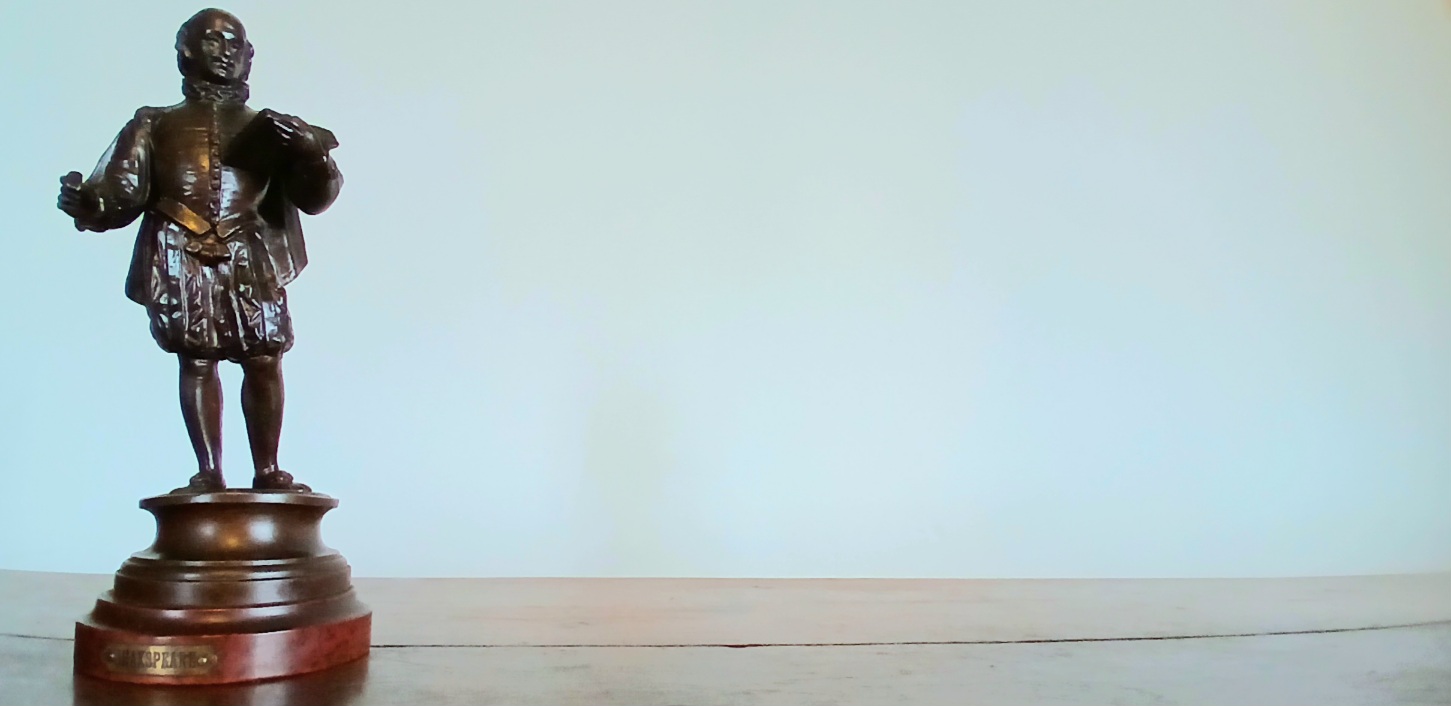
Statuette of William Shakespeare at Soulton Hall
Shakespeare’s Courting Chair: A Family Connection?
When Samuel Ireland toured Warwickshire researching material for his travel guide Picturesque Views on the Upper, or Warwickshire Avon (published in 1795), he met a descendant of Shakespeare’s sister Joan Hart in Stratford. This individual recounted a story about an armchair in the Hathaway family home in Shottery, claiming it had always been known “in his remembrance” as “Shakespeare’s courting chair.”
Moreover, the descendant asserted that the chair had been passed down from Shakespeare to his granddaughter, Lady Elizabeth Barnard, and subsequently to the Hathaway family. Driven by a desire to:
“obtain the smallest trifle appertaining to our Shakespeare”
Ireland purchased the armchair along with a purse adorned with bugle beads, purportedly gifted by Shakespeare to Anne Hathaway. He also expressed interest in acquiring an ancient bed from the cottage, maybe the tester bed traditionally known as the “Hathaway Bed,” but the elderly resident refused to sell it “at any price,” citing her own childhood association with the bed.
Upon its arrival in London, Ireland proudly displayed the armchair among his other curiosities within his study in Norfolk Street. However, this unwavering confidence in the chair’s authenticity was not shared by Ireland’s son. Young William Henry, who had accompanied his father on the Warwickshire journey, witnessed his father’s obsessive pursuit of Shakespearean relics and his willingness to readily accept any claim of authenticity. This first-hand observation, coupled with a desire to impress his father, later fuelled William Henry’s audacious Shakespeare forgeries.
It is possible that William Henry himself added the carved ‘WAS’ (for ‘William & Anne Shakespeare’) to the panel back of the chair, between the two earlier engravings of the Shakespeare shield with a spear and falcon, as visible in the photograph.
Thirteen years later, in his book Confessions, William Henry recounted his visit with his father to Shottery and the:
“old oak chair, wherein it was stated our bard was used to sit, during his courtship, with his Anne upon his knee.”
He also offered a cynical commentary, tinged with the skepticism of one who had successfully perpetrated his own notorious “Shakespeare manuscript” forgeries. He observed that the armchair in his father’s study was:
“perfectly well known to all the inspectors of the manuscripts; MANY of whom I have often seen seated therein to hear the perusal of the papers; and their settled physiognomies have frequently excited in me a desire for laughter which it has required every effort on my part to restrain.”
The Courting Settle: A Manufactured Memory?
The “Courting Settle” at Anne Hathaway’s Cottage is a high-backed bench steeped in romantic legend. Tradition holds that this was the very place where William Shakespeare and Anne Hathaway courted, whispering sweet nothings and gazing into each other’s eyes. This story was perpetuated by the last descendants of the Hathaway family, Mary Baker and her granddaughters, who likely embraced the narrative to enhance the allure of the cottage for visitors.
While a charming tale, historical evidence suggests the settle dates from the early 18th century, making it too recent to have been used by Shakespeare and Anne Hathaway. Despite its likely fabricated origin, the “Courting Settle” remains a captivating symbol of romantic love and a testament to the enduring power of the Shakespearean mythos. It serves as a reminder of the human desire to connect with the past, even if the stories themselves may not be entirely accurate.
The Falcon Inn Chair: A Tale of Toppers and Trees
This elegant armchair boasts an oak frame with intricate details. The scrolled cresting above a floral-carved panel rests within a beautifully carved frame. The scrolled arms, supported by baluster-turned legs, provide a sense of grandeur. The single-plank seat, supported by shaped and carved rails, rests on turned legs and plain stretchers.
An old label affixed to the back of the panel reads: “Chair from the Falcon Inn, Bidford where Shakespeare held his Club meetings.” While this romantic notion of Shakespeare frequenting this chair is captivating, the chair’s production date (circa 1630) makes this attribution unlikely.
The “English Disease” and the Shakespearean Chair
A telling anecdote involves Thomas Jefferson and John Adams, who visited Stratford-upon-Avon in 1786. While not particularly impressed by the modest scale of Shakespeare’s birthplace, they partook in a then-widespread practice: “tourist scavenging.”
In the 18th and 19th centuries, it was considered perfectly acceptable, even expected, for travelers to collect souvenirs from historical sites, often by removing fragments of the very artifacts they were there to see. This “English disease,” as it was aptly termed by the artist Benjamin Robert Haydon, saw visitors to Stonehenge, the Pyramids of Giza, and countless other sites chipping away at ancient monuments.
Shakespeare’s chair, likely a replica or simply a chair associated with his writing room, became a prime target for these souvenir hunters. Despite its dilapidated condition, visitors were eager to claim a piece of the Bard’s legacy, and the chair’s owner even capitalized on this by selling fragments to eager tourists.
Jefferson and Adams, despite their esteemed positions, were not immune to this cultural phenomenon. They each removed a sliver of wood from the chair, a seemingly innocuous act that exemplifies the widespread acceptance of this destructive practice.
While the overt destruction of historical sites has thankfully declined, the impulse to collect souvenirs remains strong in modern tourism. This manifests in various ways, from the over-commercialization of historical sites to the ethical concerns surrounding mass tourism.
A Cautionary Note Regarding Historical Artifacts
While these chairs carry a captivating Shakespearean legend, it’s important to note that other pieces of furniture, such as the Sir Rowland Hill furniture at Soulton Hall, boast more robust provenance.
Documents support their links to As You Like It through connections to the Lodge family and the familial relationships between Shakespeare’s mother and Old Sir Rowland, traced via the Corbets and the Ardens.

Old Sir Rowland Hill’s Chair of Estate.
This highlights the importance of rigorous historical inquiry when examining purportedly authentic artefacts.
The fervent desire to establish a tangible connection to celebrated historical figures can occasionally lead to embellishment and even the fabrication of historical narratives. By meticulously investigating the provenance and historical context of these artifacts, we can gain valuable insights into the evolving relationship between the public and Shakespeare, as well as the enduring power of the playwright to captivate the human imagination.
