


Ancient Oaks, Ancient Legends
Having recently returned from London’s Lord Mayor’s Show, and now immersed in the autumnal beauty of Soulton, it seems fitting to explore a local connection to the city: the curious naming of two ancient trees. For as long as anyone can remember, these trees have been linked to London through their unusual names.
They are close by the hall, and they are called Gog and Magog.

Gog and Magog: two ancient oaks at Soulton named after a city of London Legend
Where does this strange naming custom come from? London, and the old association of Soulton with being a kind of some-time emergency outpost of that city, in the time of Old Sir Rowland Hill.
Gog and Magog, or sometimes known as Gogmagog and Corineus, are legendary giants from medieval British folklore. Their story is intertwined with the early history of Britain, linked to the reign of mythical kings. For centuries, they have lead the procession are two imposing wicker giants: Gog and Magog. These legendary figures have served as the traditional guardians of the City of London since the reign of Henry V.

Gog and Magog, the traditional guardians of the City of London: they have been carried in the Lord Mayor’s Show since the reign of Henry V.
According to the legend, the Roman Emperor Diocletian had thirty-three wicked daughters.
To control them, he arranged marriages for them, but the daughters, led by their eldest sister Alba, plotted to kill their husbands. As punishment, they were cast adrift on a boat with limited supplies. After a perilous journey, they landed on a great island, which they named Albion. With the help of demonic forces, they populated the island with a race of giants.
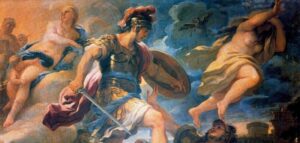
Aeneas
Later, Brutus, the great-grandson of Aeneas, arrived on the island after fleeing the fall of Troy.
He named the island Britain and brought with him a skilled warrior named Corineus.
Corineus challenged the leader of the giant race, Gogmagog, to single combat and defeated him by hurling him off a cliff, now known as “The Giant’s Leap.” As a reward, Corineus was given the western part of the island, which became Cornwall.

Brutus of Troy, the legendary founder and first king of Britain according to medieval myth, was a descendant of the Trojan hero Aeneas.
Brutus, meanwhile, founded the city of New Troy, which later became known as London.
This story is part of Geoffrey of Monmouth’s 12th-century Historia Regum Britanniae, a historical work that blends Celtic mythology, Greek legend, and biblical references. While the historical accuracy of the text is questionable, it was widely believed for centuries and played a significant role in shaping the identity of medieval Britain. Some of this will ring bells for people familiar with King Lear which Shakespeare sets in a primordial British Isles after these times.
It’s a common human tendency to mythologize the past, often portraying early inhabitants as giants (there is a tradition stonehenge was built this way for example).
These figures, often based on real people, are exaggerated in folklore to embody strength, power, and heroism.
********
Another version of the legend suggests that Gog and Magog were the last surviving sons of Diocletian’s wicked daughters. They were captured and chained to the gates of a palace on the site of the Guildhall to serve as guardians.
By the reign of Henry V, carved giants guarded the Guildhall gates.
These figures made their first recorded appearance in the Lord Mayor’s Show in 1554 – a couple of years after Sir Rowland Hill and Sir John Gresham had saved the Mid Summer watches, and in 1605, the Pageantmaster identified in text the giants in the procession as Corineus and Gogmagog.
********
London’s own pagan giants, while not literally huge or monstrous, represent the idealized memory of great men from a bygone era.
The practice of carrying effigies in festivals is deeply rooted in history. Over time, these effigies evolved to represent saints or other significant figures.
The giant figures in the Lord Mayor’s Show are a continuation of this tradition, connecting modern celebrations to ancient customs.

Sunset in fall time at Soulton
Over the centuries, various versions of Gog and Magog have been created and displayed. In the 17th century, wicker and pasteboard effigies were used, but these were short-lived. In the 18th century, wooden statues carved by Captain Richard Saunders were introduced, lasting for over two centuries until their destruction during the Blitz. The current statues, carved by David Evans in 1953, are a gift to the city and symbolize London’s enduring spirit and its commitment to defending its liberties…
…and quietly in Shropshire, for the longest time, a pair of ancient oaks near the house of a former Lord Mayor of London have quietly carried names that evoke these legendary figures and what they represent.
