

Stratford’s Bard (and others) on Resisting Evil
In the sixteenth century, where brute force often seemed to reign supreme and power was often abused by people unfit to wield it, Shakespeare, in As You Like It, offered a unique perspective on “beating the bad guys.” Shakespeare suggested that true victory lies not in brute strength or violent confrontation, but in cultivating inner strength, studying philosophy, being inspired by good examples, working hard, and embracing a more virtuous path.

Shakespeare Quote on a sign in the AS YOU LIKE IT wood at Soulton: And this our life exempt from public haunt
Finds tongues in trees, books in the running brooks,
Sermons in stones and good in every thing.
I would not change it.
This blog looks at the “bad guys” in As You Like It and Rosalynde, analysing their actions and the factors that ultimately led to their downfall in the Forest of Arden which starts around Stratford and Tiddigton, which, in retrospect, seem almost inevitable.

Stratford hinterland (Village of Tiddington): a frontier for the Forest of Arden – where the bad guys ultimately lose to virtue.
********
The world of early modern English theatre is a labyrinth of intriguing mysteries, and the lost play Torrismount offers a captivating glimpse into this enigmatic past.
Produced by the Children of the King’s Revels theatre company around 1607-1608, Torrismount has vanished (so far), leaving behind only a few tantalizing clues.
The Children of the King’s Revels may have produced a direct translation of Torquato Tasso’s 1587 tragedy, Il Re Torrismondo. While Tasso’s play features a character named Torrismondo, it’s not based on the historical Visigoth king. Instead, inspired by Sophocles’ Oedipus Rex, Tasso crafted a tragic tale of a Visigothic king who unknowingly enters a forbidden and ultimately devastating relationship, mirroring the tragic fate of Oedipus. Il Re Torrismondo is celebrated for its powerful language and exploration of profound moral themes.
This suggests that ‘Torrismount’ may have been a high-brow, intellectual work that engaged with classical themes and dramatic conventions, reflecting the sophisticated tastes of the Children of the King’s Revels and their elite audience.
Of interest to Soulton and As You Like It is how Torrismount shares the same name as the usurping Duke in Thomas Lodge’s Rosalynde, the pastoral romance that served as the primary source for Shakespeare’s beloved comedy As You Like It.

Published in 1590 Rosalynde is a pastoral romance writen by Thomas Lodge in 1590 – his family owned Soulton before Old Sir Rowland Hill
This striking similarity raises a series of intriguing questions:
Did the playwright of “Torrismount” draw inspiration from Rosalynde, perhaps borrowing the name and some plot elements from Lodge’s work?
Could both the playwright and Lodge have drawn inspiration from a common source, such as a historical figure or another literary work, leading to the shared name?
Or is the shared name merely a coincidence, a curious case of two authors independently choosing the same name for their villainous characters?
While we may never know the definitive answer, the shared name Torrismount adds a layer of intrigue to the already enigmatic Torrismount play.
It highlights the interconnectedness of literary works during the Elizabethan era, where ideas, characters, and even names could flow freely between authors. This intriguing connection serves as a reminder of the challenges scholars face in unravelling the intricate web of influences and inspirations that shaped the tapestry of early modern English drama. It also invites us to speculate on the possible connections between this lost play, Rosalynde, and perhaps even Shakespeare’s own masterpiece.
The possible connection to As You Like It deepens the intrigue for those who find Shakespeare as captivating as many do.

Opening of Shakeaspeare’s play AS YOU LIKE IT as seen in the First Folio
Duke Frederick, the tyrannical brother in Shakespeare’s play, mirrors Torismond in Rosalynde by usurping his brother’s rightful place. This shared villainous archetype, along with the shared name, suggests a potential link between Torrismount, Rosalynde, and As You Like It, hinting at a broader network of literary influences.
Duke Frederick himself embodies the corrupting influence of unchecked power and ambition. His actions are marked by a ruthless pursuit of self-interest, demonstrating a complete disregard for morality and the well-being of others. Frederick’s primary sin lies in his usurpation of his brother, Duke Senior, the rightful ruler. This act of betrayal not only strips his brother of his rightful inheritance but also casts a long shadow of fear and instability over the entire dukedom.
Furthermore, Frederick’s reign is characterized by a ruthless exercise of power as he:
- banishes his brother and his loyal followers to the Forest of Arden, effectively depriving them of their homes and livelihoods;
- considers eliminating Duke Senior entirely, demonstrating a chilling disregard for human life.
Frederick’s cruelty extends beyond his brother, as he:
- exploits his position to enrich himself, seizing lands and revenues that rightfully belong to others;
- manipulates those around him, urging Oliver to betray his brother and even resort to violence if necessary.
Perhaps most disturbingly, Frederick’s actions corrupt those around him. He poisons the atmosphere of his court, fostering an environment of fear and suspicion. He even attempts to manipulate his own daughter, Celia, into aligning with his ambitions, demonstrating a chilling disregard for familial bonds.
Duke Frederick’s character serves as a potent reminder of the dangers of unchecked ambition and the importance of compassion and justice.
His downfall, though ultimately brought about by his own hubris, serves as a powerful message about the consequences of pursuing power at any cost.
As You Like It itself offers a counterpoint to the tyranny of Duke Frederick. The play celebrates the restorative power of nature and the importance of study, virtue, friendship, and harmony.
By escaping the corrupting influences of the corrupted court and finding solace in the natural world, the characters in As You Like It ultimately triumph over adversity. They demonstrate that true happiness lies not in the pursuit of power and wealth for its own sake, but in cultivating virtuous relationships, embracing simplicity, and finding solace in the beauty of the natural world and seeing leadership as service.
The case of Torrismount reminds us that even seemingly minor details, such as a shared character name, can offer valuable clues about the creative processes of early modern playwrights and the interconnectedness of their works.

The Tiddington Obelisk
Shakespeare often drew inspiration from contemporary events for his characters.
Shakespeare, drawing on contemporary events, likely satirized Friedrich I, Duke of Württemberg, in the character of the “German Duke” in The Merry Wives of Windsor. Friedrich’s 1592 visit to England, with its pomp and circumstance, likely provided Shakespeare with fodder for the comedic portrayal of the boastful and arrogant German Duke, known for his extravagant lifestyle and court. This satirical portrayal, with its humorous depictions of the Duke’s antics, including the infamous horse-stealing incident, would have resonated with Elizabethan audiences who were likely aware of the German Duke’s visit and perhaps even some of the more outlandish stories circulating about him.
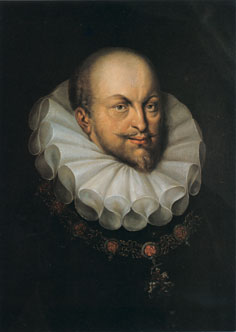
Friedrich I, Herzog von Württemberg (1557-1608)
Duke Frederick craved the prestigious honor of becoming a Knight of the Garter and persistently petitioned Queen Elizabeth for this distinction. After inheriting the dukedom and gaining greater influence, the Queen finally granted his request. However, in want many thinks was a deliberate snub, she failed to inform him in time for the spring 1597 investiture ceremony. This event served as the backdrop for Shakespeare’s The Merry Wives of Windsor, with the play subtly referencing his prior visit to England and his conspicuous absence from the Windsor ceremony.
Frederick I’s reign as Duke was between 1593 – 29 January 1608 amd was known for his autocratic rule and centralization of power, as he:
- suspended the existing constitution of the Duchy, effectively concentrating power in his own hands;
- abolished the councils established by his predecessor, Duke Louis, further weakening checks on his authority; and
- to consolidate his power, he appointed Matthäus Enzlin as his chancellor, granting him significant power and influence. Enzlin’s subsequent actions, including embezzlement and extortion, would later contribute to his downfall, highlighting the potential for abuse of power within even the most centralized regimes.

William Shakespeare’s First Folio
These allusions likely amused the play’s initial audience, as they were included in the First Folio edition, presumably based on an early private performance, but were omitted from the 1602 Quarto, which likely reflects a later, publicly staged version of the play.
Frederick I, would co autocratic rule and centralization of power. He suspended the existing constitution of the Duchy, effectively concentrating power in his own hands. He also abolished the councils established by his predecessor, Duke Louis, further weakening checks on his authority. To consolidate his power, he appointed Matthäus Enzlin as his chancellor, granting him significant power and influence. Enzlin’s subsequent actions, including embezzlement and extortion, would later contribute to his downfall, highlighting the potential for abuse of power within even the most centralized regimes.
Similarly, while a direct historical parallel may not be as easily identifiable for Duke Frederick in As You Like It, his character likely reflects Elizabethan anxieties about political instability and the abuse of power. The theme of usurpation, a recurring one in Elizabethan drama, reflects the contemporary concerns about political intrigue and the dangers of tyrannical rule that permeated the era.
Furthermore, considering that Sir Rowland Hill, of Soulton a prominent Tudor statesman and Shakespeare’s cousin, was active during in the territory of German, this connection invited the audience to consider the play within the broader context of Tudor England and the political and social currents of the time.
********
