


The United States and the United Kingdom share a deep-rooted intellectual and cultural heritage, bound by a common language and historical ties.
Today, as the United States engages in pivotal presidential and other elections, it offers a fascinating glimpse into the workings of a democratic system that has been influenced by centuries of shared history and political thought.
Two texts closely linked to Old Sir Rowland Hill and this house form part of the crucible of America’s founding: the Geneva Bible and The Laws of Geneva. It is a fitting day to reflect on their profound influence.
King James I was deeply troubled by the Geneva Bible. Its notes, with their republican leanings and opposition to absolute monarchy, clashed with his political views. Despite the 1611 publication of the King James Version, a translation he had commissioned, it struggled to compete with the Geneva Bible’s popularity. To bolster his sponsored translation, which often closely followed the Geneva Version, King James took drastic measures. In 1616, he banned the production of the Geneva Bible in England.
Undeterred, the Geneva Bible continued to be printed abroad and smuggled into England. Archbishop Laud later escalated the ban by forbidding the importation of these Bibles. However, the demand remained, prompting printers in Amsterdam to produce Geneva Bibles with deceptive title pages, falsely claiming they were printed in London by Christopher Barker in 1599. Careful bibliographic analysis has revealed that many of these Bibles were actually printed in the 1630s and 1640s.
The Geneva Bible was a significant influence on the Declaration of Independence and other founding documents of the United States.
Its emphasis on individual liberty and limitations on monarchical power provided a philosophical foundation for the American Revolution. The Geneva Bible was the preferred Bible of the early Pilgrim settlers of New England and was used in Jamestown.

The frontispiece of the 1560 Geneva Bible at Lambeth – showing Rouland Hall (Rowland Hill) as publisher. The Hall pun is considered a pun and a tripbute to the shared effort of the project
The Geneva Bible’s epistemological force in authorizing resistance to divine right stemmed from its interpretation of scripture, which challenged the absolute authority of monarchs. By emphasizing individual conscience and the limitations of monarchical power, it provided a theological framework for questioning and resisting tyrannical rule.
The Geneva Bible’s commentaries often highlighted instances of biblical figures who defied unjust authority, such as the prophets who challenged kings and the Israelites who rebelled against oppressive regimes. These biblical narratives legitimized resistance against unjust rulers, suggesting that divine authority could be exercised against those who abused their power.
Furthermore, the Geneva Bible’s emphasis on the supremacy of the divine over earthly rulers undermined the notion of the divine right of kings.
By asserting that true authority ultimately resides with the divine, the Bible implied that human rulers were accountable to a higher power and could be held responsible for their actions. This understanding empowered individuals to challenge unjust rulers and to seek alternative forms of governance.
The iconic title page of the Geneva Bible depicted a scene of divine intervention: the Israelites, led by Moses, stand poised to cross the Red Sea as Pharaoh’s pursuing army closes in. This powerful image, accompanied by verses from Psalms and Exodus, resonated deeply with the English exiles in Geneva, symbolizing their own aspirations for liberation from oppressive rule.

Franklin’s Design foteh Grea Seal of the Unites States
Two hundred 200 years later, as the United States emerged from British colonial rule, the founders drew inspiration from this biblical narrative.

Thomas Jefferson’s design description for the Great Seal. Courtesy Library of Congress.
Benjamin Franklin and Thomas Jefferson proposed a state seal design mirroring the Geneva Bible’s illustration, with the Israelites’ plight paralleling the American colonies’ struggle for independence. This connection highlighted the shared longing for freedom and the belief in divine providence inherent in these two examples being set on the table so explicitly.
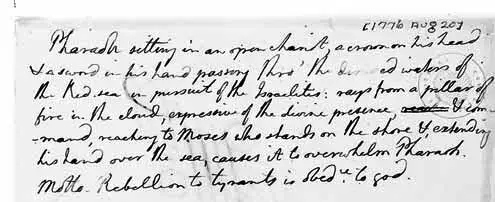
Benjamin Franklin setting out a proposed design for the Great Seal of the United States, August 1776. (Courtesy Library of Congress)
It’s widely believed that a Geneva Bible was among the precious few books carried aboard the Mayflower. This suggests its significance to the Pilgrim Fathers, during their perilous journey and subsequent settlement in the New World.
********
Sir Rowland Hill also published The Laws of Geneva, which provides a detailed account of the 16th-century Genevan government. This significant text delves into the city-state’s political and administrative structure, offering insights into various aspects of its governance, including church governance, civil government, legal procedures, proclamations, and financial matters. The book explores the roles of ministers, elders, deacons, and the practices of visiting the sick, as well as the functions of the Senate, Council, Treasurer, and Captain General.

Renaisance Geneva
It details legal processes, the responsibilities of judicial officials, and offers a glimpse into the specific laws and regulations enacted by the Genevan government. The text also discusses currency valuation, taxation, and financial management, including the duties of the Treasurer. The Laws of Geneva offers a comprehensive view of Geneva’s commitment to religious purity, good governance, and social justice. It is particularly intriguing that this detailed account of a city-state republic was presented to an English readership at the dawn of Elizabeth I’s reign.
The book’s enduring significance is evident in its 1642 reprint during the English Civil War, suggesting its relevance to contemporary political and social debates.
We know that copies of this text also made their way to America, further attesting to its influence on political thought.
********
These texts, of importance to the Founding Fathers, show an interest in leaders as guardians in the Platonic sense: an expectation that public office is held for the public good, and leadership is a service ultimately subject to higher ideas.
This perspective influenced how young America built its amazing civic buildings, a topic for another day…
