

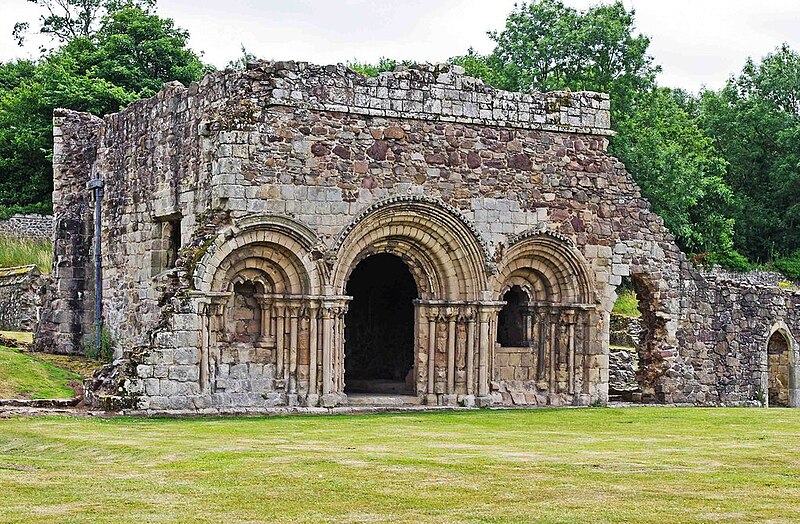
Some exciting reconstructions of Haughmond Abbey have just been shared.
Sir Rowland Hill aquired this Abbey at the dissolution. https://t.co/NLG1d30wSc
— Soulton Hall (@SoultonHall) November 25, 2023
Haughmond Abbey: A Beacon of Monastic Life
Nestled amidst the rolling Shropshire Hills lies Haughmond Abbey, a Cistercian monastery founded in the 12th century. Its impressive stonework and evocative ruins hint at a time of devotion, scholarship, and self-sufficiency. Visitors can explore the remnants of the church, chapter house, and cloisters, imagining the lives of the monks who once walked these very grounds.
A Shared Legacy: Sir Rowland Hill and the Dissolution of the Monasteries
But what connects Soulton Hall to this monastic marvel?
The answer lies (as it so often does) in Sir Rowland Hill (d. 1561), a pivotal figure in both Soulton’s and England’s history.
The Dissolution of the Monasteries saw the closure and dismantling of many religious institutions, including Haughmond Abbey.
Sir Rowland Hill stept in to take control of abbey at dissolution (as he did elswhere, including Shrewsbury Abbey).
Haughmond Abbey itself was converted into a residence and its lands were granted by Sir Rowland Hill, to his heirs through his sister, Elizabeth who had married into the Barker family of Wollerton.
Interestingly, another member of the Barker family married Sir Rowland Hill’s friend and mentee, Sir Thomas Leigh (c.1504-1571). This marital connection led to the founding of the Leigh dynasty at Stoneleigh Estate in Warwickshire, which includes Jane Austen(!)
