

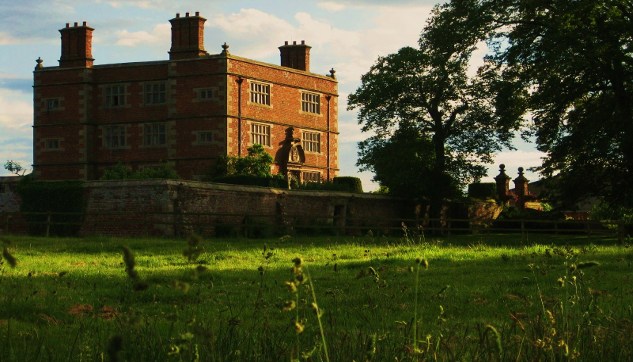
The art in the Deakin Room was recently refreshed to better tell Soulton’s story. Below is an explanation of why this specific artwork was chosen.
********
The first pictures to point out in this room are the two large engravings above the beds. These are architectural drawings by Ottavio Bertotti Scamozzi, from 1776, depicting the Teatro Olimpico in Vicenza, which Ottavio Bertotti Scamozzi directed, helping to found Italian Opera as we know it today. The building itself was completed by another Scamozzi, Vincenzo Scamozzi, in 1585, but is famous for having been the final work of Andrea Palladio, who started work on the theatre in 1580. As such, the Teatro Olimpico is hailed as the oldest opera house in the world. Soulton Hall has an important part to play in this story, because its eastern facade, along with the forecourt in front of it, together form an evocation of a classical theatre (specifically, the theatre at Epidaurus, where the arc of the seating extends beyond 180 degrees). This design, twenty years before the Teatro Olimpico, introduced classical ideas of theatre-production to the medieval pageantry over which Sir Rowland Hill presided as Lord Mayor of London, and ushered in the golden age associated with Christopher Marlowe, William Shakespeare and Ben Johnson.
The next engraving is a ticket to a 1775 Masquerade Ball in Soho! This was manufactured by the cosmopolitan artist Francesco Bartolozzi. Bartolozzi was born in Florence and died in Lisbon, but the bulk of his career was spent in London, where he was a fellow of the Royal Academy. Bartolozzi’s ticket represents the Italian culture of entertaining and classical fashion that became popular in England in the eighteenth-century, which built upon the earlier Renaissance activities of well-travelled scholarly gentlemen such as Sir Rowland Hill. The eighteenth-century was a golden age for the Grand Tour, where wealthy young Englishmen would visit Italy for education, life experience and inspiration; but in fact for the rest of Europe, England was the destination. The Agricultural and Industrial revolutions taking place in Shropshire, in particular, proved a big draw. On the cultural and religious side, too, grand tourists made pilgrimages to the sites of significance in the story of the Elizabethan Religious Settlement and the social model of Europe’s most successful Protestant country. This is why a giant pillar was erected at Hawkstone Cliffs to the memory of Sir Rowland Hill, who was the publisher of the first edition of the Geneva Bible as well as a leading force in the creation of civic institutions across the country.
The third item in this curated set of engravings is a 1724 work of one of England’s most celebrated artists, William Hogarth. Hogarth is renowned for is witty satire, and these two images are no exception.
The first lampoons the vices of the establishment, and each of the pillars of the social order are displayed with their many attendant vices: greed, hypocrisy, shallowness. The image is framed by the circle of a telescope, and by saying the elite are on the Moon, Hogarth protests inequality and lack of connection between the government and the governed. For this reason the artist is seen as a champion of the people, and a stabilising cultural force in the national psyche.
The second image is a lampoon of the world previous print, the Masquerade Ticket. Hogarth puts up a mirror to the artificiality of polite society in the eighteenth century, and exposes much silliness. The social comment within this is entirely in step with the Moon above. It warns against becoming beguiled by wealth and fashion and so forgetting the serious work of maintaining a just and fair society. Through the oratory window to the left of this picture, you can see Soulton Court, the eighteenth-century replacement of the old medieval and Tudor gatehouse and great hall range. The long room with the round windows was a manorial courtroom. The two round windows hark back to the Oxford Sessions House (where one round window stood above three arches, rather than two above six), as well as Hugh May’s chivalric building schemes at Windsor Castle (later re-built by Wyatville).
Soulton’s design influenced the Shire Hall in Stafford, and then the US Capitol in Washington DC, where one round window is the core motif of each wing flanking the famous rotunda. Do the events that took place in these buildings survive Hogarth’s penetrating criticism? In the case of Soulton Court, we hope so, and there is some reason for taking this view, as a witch trial brought to court here was thrown-out by the Justice of the Peace, marking the end of that dark chapter of English legal history.
What Hogarth also tells, us, however, is to never be complacent!
Above the oratory window you will find a contemporary work by emerging artist Sam Pooley-Stride, ‘Seas of the Moon’ (2021). This image was part of a 2022 exhibition at Soulton which was stated between the Long Barrow and the Moot Hall (the old courtroom within Soulton Court). The title references how people used to think that the Moon has oceans of water on it. The work is a meditation on the poetry as well as the science of astronomy, and our changing understanding of the world we inhabit.
The painting above the chimneypiece shows otters playing. It is piece by Eric Rowe of the late 20th century, Rowe was named BBC wildlife artist of the year. The dynamic between this work and the antique hand-carved statues beneath comments upon the role of sculpture and architecture in theatre. The fisherman looking up at the painting of the water and the otters animates both pieces with new meaning, and liveliness is breathed into a ‘still life’ arrangement of physical objects. The theatre is the same, where the potentialities of the building, especially a richly-ornamented building like the Teatro Olimpico depicted opposite, are only fully brought to life by the cultural interactions between characters and space. This meditation extends forth to the whole of life, as William Shakespeare noted in his play As You Like It, which is connected to Soulton Hall:
All the world’s a stage,
And all the men and women merely players;
They have their exits and their entrances;
And one man in his time plays many parts,
- Shakespeare, ‘As You Like It’
Act II, Scene VII. The Forest of Arden.
________________________________
The art in this room was curated by James D. Wenn of BYRGA GENIHT.
