


For those unfamiliar with Shropshire, here are a few helpful notes on Hodnet, highlighting some of its unique features and referencing less-accessible sources.
Sir Richard Vernon in Henrt IV Part 1
It is well-known that Elizabeth Vernon, wife of Henry Wriothesley, 3rd Earl of Southampton, provides a Hodnet-Vernon-Southampton connection to this region of North Shropshire, and this connection has inspired some scholars to link the area to Shakespeare’s Romeo and Juliet and Sonnets.[1]. And, while it goes without saying that the Romeo and Juliet story is older and derived from orther maerial, e.g. The Tragicall Historye of Romeus and Juliet is a narrative poem, first published in 1562 by Arthur Brooke, there is a firm tradition that the scandal of the Vernon-Wriothesley marriage was part of the creative mix.
********
However, there is, via Sir Richard Vernon, an unquestionable link between Hodnet and a character in another of Shakespeare’s plays: Henry IV, Part I (the closing action for which is at Shresbury).
Sir Richard Vernon is a cautious rebel, working with Hotspur in the the play:
EARL OF DOUGLAS
You do not counsel well:
You speak it out of fear and cold heart.VERNON
Do me no slander, Douglas: by my life,
And I dare well maintain it with my life,
If well-respected honour bid me on,
I hold as little counsel with weak fear
As you, my lord, or any Scot that this day lives:
Let it be seen to-morrow in the battle
Which of us fears.…
HOTSPUR
To-night, say I.VERNON
Come, come it nay not be. I wonder much,
Being men of such great leading as you are,
That you foresee not what impediments
Drag back our expedition: certain horse
Of my cousin Vernon’s are not yet come up:
Your uncle Worcester’s horse came but today;
And now their pride and mettle is asleep,
Their courage with hard labour tame and dull,
That not a horse is half the half of himself.– Act 3, scene 4. Henry IV, Part 1. Shakespeare
The link is that his son, Richard, married Benedicta de Ludlow, a daughter of the de Ludlow family; by that alliance the name ‘Vernon’ (of Haddon Hall, decended from the Lords of Vernon in Normandy) came to be carried by the Lords of Hodnet.
This is why the church in Hodnet is decorated with Vernon fret tiles, which happens in the later C16th in the time of Henry Vernon, who was the first of the Vernon family to own the advowson of Hodnet (which ‘Old’ Sir Rowland Hill had at the second Reformation, and passed it on via the Barkers and Lord Kilmorey).
Tong
Some generations on William Vernon, by marrying Benedicta Pembridge of Tong Castle, became not only Lord of Hodnet but also of Tong, in Shropshire, an church in which some scholars say there are epitaphs writen by Shakespeare.
The (contested) claim appears to have been first recorded by the eminent Antiquarian Sir William Dugdale.
The Hodnet Font
The font in Hodnet Church, by accounts, was origianally in Toung Church. It is very fine and very early.
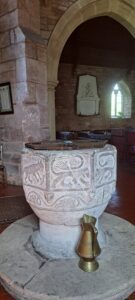
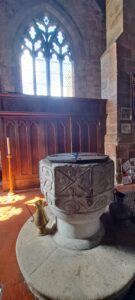
Romanesque font in Hodnet Church, said to be C17th
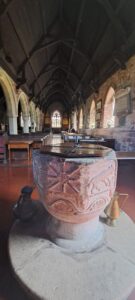
Romanesque font in Hodnet Church, said to be C17th
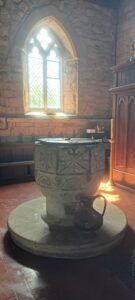
Romanesque font in Hodnet Church, said to be C17th
********
[1] See, for example, the work of Prof Hammerschmidt-HummelSources
These local sources were consulted for this note
- The Lords of Hodnet Manor, Mothershaw, G., 2003. Lion FPG, West Bromwich
- St. Luke’s Church, Hodnet, A brief History. Mothershaw, G. Undated. Hodnet Church
