


Decoding Deliberate Design Discrepancies
Quoins are those special blocks you see at building corners. They’re like bodyguards, strengthening corners and keeping them pretty! We are going to come back to that term, now we have defined it.
********
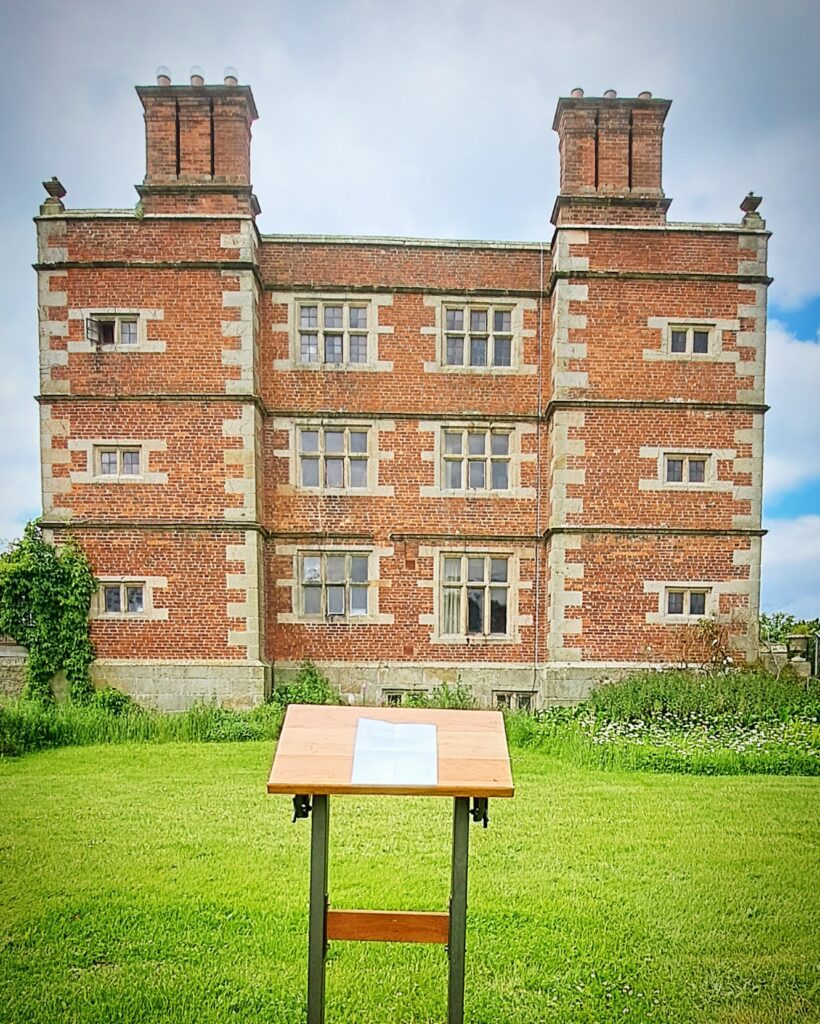
To understand Soulton Hall as a building with “sermons in stones” embedded within its design, we must recognize that only one side of the cube is truly “senior” – the east facade. This emphasis is evident in its symmetry (note that the the dropped window sill in the Blue Room is a 19th-century alteration).

The East front of Soulton Hall, the senior and only symetrical, face of the hall
Furthermore, to fully grasp Soulton Hall’s “sermons in stones,” we must consider Sir Rowland Hill’s known interest in mathematical codes and his fascination with the rhombic dodecahedron. This geometric form is particularly interesting because a cube divided into a 3×3 grid can be used to construct it. Soulton Hall itself might embody this concept: the three rows could be represented by the string courses (horizontal bands of bricks), and the three columns by the tower-like projections.
Now look again at this face of the house.
While Soulton Hall’s east facade appears meticulously symmetrical, closer inspection reveals a few deliberate “mistakes” that might hold symbolic meaning.
- Central Column Width: The central column is noticeably wider than the flanking tower-like projections (turrets).
- Quoin Misalignment: The quoins (cornerstones) on the left side of the right turret deviate from the pattern seen elsewhere. All other quoins begin with a thin stone on the bottom square and a thicker one on the top two, but this particular one is reversed.
Intentional Deviations?
Interestingly, the building’s internal layout might explain the wider central column. The misaligned quoins, however, seem to suggest an awareness of this deviation, perhaps even inviting the viewer to “correct” it mentally.
A lectern in the Epidaurus Court of Soulton Hall
While we are discussing Quoin stones: there are eight on the upper floors and 9 on the state rom floor, we have atheory about what that says, but it is for another day.
********
This post discusses interpretations of Soulton Hall’s design that have been the subject of ongoing consultation by BYRGA GENIHT Ltd.
